We may earn a commission if you buy through our links.
Quick picks
| Product | Key Specs |
|---|---|
| See price on Amazon |
|
| See price on Amazon |
|
| See price on Amazon |
|
| See price on Amazon |
|
Best Slow Feeder Bowls for Senior Dogs in 2026
For senior dogs who gulp food — and faster eating was associated with higher bloat risk in a large study of big-breed dogs (Glickman et al., 2000) — Outward Hound Fun Feeder Slo-Bowl (PSR 8.5/10) is our top pick, with BPA-free labeled plastic, a non-slip base, and dishwasher-safe cleanup. For owners prioritizing durability, the JASGOOD Stainless Steel Slow Feeder (PSR 8.2/10) offers a maze design in stainless steel.
TL;DR
- Top Pick: Outward Hound Fun Feeder — maze design, BPA-free labeled, dishwasher safe (PSR 8.5/10)
- Best Durable: JASGOOD Stainless Steel — stainless construction, silicone base, no plastic degradation concerns (PSR 8.2/10)
- Large Dog: Dogit Go Slow — 6-cup capacity for large-breed senior dogs (PSR 7.9/10)
- Mental Enrichment: Northmate Green — grass-blade design encourages foraging-style eating (PSR 7.6/10)
How We Researched This Article
This article follows PSR’s 5-step evidence-synthesis process. Safety review covered materials, stability and cleaning as described by manufacturers. Bloat risk evidence references Glickman LT et al., Non-dietary risk factors for gastric dilatation-volvulus in large and giant breed dogs, J Am Vet Med Assoc 2000 (PMID: 11128539).
What Matters in a Senior Dog Slow Feeder?
Material safety: Only purchase slow feeders explicitly labeled BPA-free and food-safe. Stainless steel avoids plastic-related concerns altogether, which is why the JASGOOD stainless feeder scores highest on Safety here.
Maze complexity and dental sensitivity: Senior dogs with dental disease or tooth extractions may struggle with deep, narrow maze channels. A moderate design (such as Outward Hound’s medium pattern) slows eating without requiring dogs to force their muzzle into tight spaces.
Non-slip base: Senior dogs with reduced coordination may push a lightweight bowl across the floor while eating. Non-slip bases (suction cups, silicone rings, or weighted bases) keep the bowl stationary during the eating process.
Capacity: Match bowl capacity to your dog’s meal size. A bowl that is too small requires refilling mid-meal, defeating the slowing purpose. Large-breed senior dogs eating 4–6 cups per meal need a large-capacity option like the Dogit.
Dishwasher compatibility: Senior dogs on wet food or fresh toppers require thoroughly cleaned slow feeders after every meal. Dishwasher compatibility (full dishwasher vs. top-rack only) affects daily maintenance.
PSR Composite Score Breakdown
| Criterion | Weight | Outward Hound | JASGOOD Stainless | Dogit Go Slow | Northmate Green |
|---|---|---|---|---|---|
| Safety & Ingredients | 25% | 8.5 | 9.0 | 8.5 | 8.0 |
| Durability & Build Quality | 20% | 8.0 | 9.0 | 8.0 | 7.5 |
| Pet Comfort & Acceptance | 20% | 9.0 | 8.5 | 8.0 | 8.0 |
| Value for Money | 20% | 9.0 | 8.0 | 8.5 | 7.5 |
| Ease of Use | 15% | 8.5 | 8.0 | 8.0 | 7.0 |
| PSR Composite | — | 8.5 | 8.2 | 7.9 | 7.6 |
Score notes: Outward Hound earns the highest Pet Comfort and Value for its range of maze levels and low cost. JASGOOD earns the highest Safety and Durability — stainless construction avoids plastic concerns and does not warp in the dishwasher. Northmate Green earns lower Ease of Use — grass-blade design traps wet food and is harder to clean than flat maze designs.
Outward Hound Fun Feeder Slo-Bowl: Best Overall
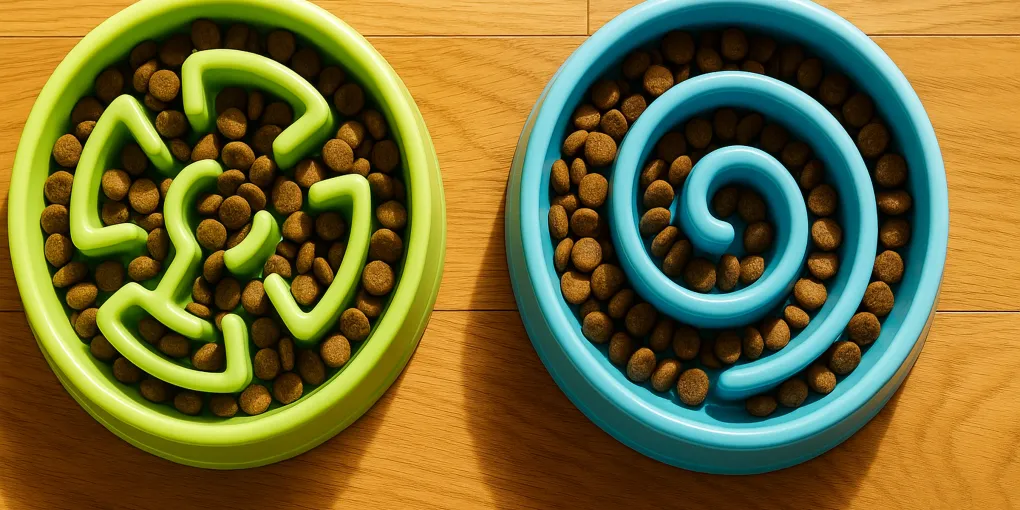
The Outward Hound Fun Feeder is a plastic maze bowl sold in several sizes and maze levels, which makes it easy to match to a senior dog’s muzzle and dental comfort.
Key features for senior dogs:
- Multiple maze complexity levels — choose the appropriate complexity for your dog’s dental health and frustration tolerance
- Non-slip base keeps the bowl stationary without suction cup wear
- Labeled BPA-free and food-safe by the manufacturer
- Fully dishwasher safe — accommodates wet food cleanup
Safety: One-piece construction with no detachable parts. Replace the bowl if it cracks or is chewed.
Best for: Senior dogs with moderate food-gulping behavior; all breed sizes (available in mini through extra-large); owners wanting an affordable first slow feeder.
We may earn a commission if you buy through our links.
JASGOOD Stainless Steel Slow Feeder: Best Durable Option
For owners concerned about plastic material safety or who need a slow feeder that will last years of dishwasher cleaning without degrading, the JASGOOD stainless feeder delivers the same maze-based speed reduction in 304 food-grade stainless steel with a silicone non-slip ring.
Why stainless matters for long-term use:
- 304 stainless steel avoids plastic-related concerns
- More resistant to scratching than plastic, and scratches can make plastic harder to clean
- Silicone ring base provides reliable non-slip performance without suction cup failure
Best for: Senior dogs on fresh or wet food diets; owners wanting a long-lasting slow feeder; dogs who have chewed or damaged plastic slow feeders.
We may earn a commission if you buy through our links.
Dogit Go Slow Anti-Gulping Bowl: Best for Large Dogs
The Dogit Go Slow offers a 6-cup capacity — the largest of the reviewed options — making it appropriate for large-breed senior dogs eating 3–6 cups of kibble per meal. Large and giant breed dogs are the dogs researchers have studied for GDV risk.
Large-breed GDV context: In a prospective cohort of 1,637 large and giant breed dogs, factors associated with higher GDV risk were increasing age, a first-degree relative with GDV, a faster speed of eating, and a raised feeding bowl (Glickman et al., 2000, J Am Vet Med Assoc; PMID: 11128539). Slow feeders were not tested, so a slow feeder is a sensible way to slow a fast eater rather than demonstrated bloat prevention. Feed from floor level unless your veterinarian advises otherwise, and treat unproductive retching, a swollen belly or restlessness after a meal as an emergency.
Bloat is an emergency. The American College of Veterinary Surgeons describes GDV as rapidly progressive and life-threatening. Signs include an anxious look or looking at the belly, standing and stretching, drooling, a swelling belly, and retching with nothing coming up; later signs include panting, weakness, and collapse (ACVS; Merck Veterinary Manual). If you see these signs, go to an emergency veterinarian immediately.
Best for: Large-breed senior dogs over 60 lbs eating large kibble portions; giant and deep-chested breeds such as those in the Glickman cohort (for example Great Danes, Weimaraners and Saint Bernards).
We may earn a commission if you buy through our links.
Northmate Green Interactive Slow Feeder: Best for Mental Enrichment
The Northmate Green’s grass-blade design mimics foraging behavior — dogs use their tongue and snout to extract food from between individual blades rather than navigating a maze. It suits owners who want mealtime to involve some searching.
Enrichment for senior dogs: Foraging-style feeding adds a scent-searching element to meals. If your dog shows signs of cognitive change, talk to your veterinarian; a feeder is enrichment, not treatment.
Limitation: The grass-blade design traps wet food and requires more thorough cleaning than flat maze bowls. Top-rack-only dishwasher compatibility limits cleaning convenience for wet-food users.
Best for: Senior dogs who enjoy foraging-style feeding; dry kibble users who want to extend foraging time; dogs who have mastered standard maze slow feeders.
We may earn a commission if you buy through our links.
Test the bowl with your dog’s food and muzzle
Before committing to a slow feeder, put the exact kibble or wet-food portion in the bowl and watch one calm meal. A senior dog should be able to reach the food without scraping its nose on a sharp ridge, lifting the bowl, or abandoning the meal. Measure the time to finish and inspect the remaining food in the maze; a longer meal is not a benefit if the dog cannot reach the last pieces. For wet food, check whether the channels can be opened and rinsed by hand. A shallow, dishwasher-safe design is often the more practical choice when arthritis, dental pain, or daily cleaning makes a deep maze frustrating.
Related Senior Dog Care Articles
- Best Senior Dog Food for Large Breeds
- Best Joint Supplements for Senior Dogs
- Best Orthopedic Dog Beds for Senior Dogs
- Best Dental Chews for Senior Dogs
- Best Automatic Pet Feeder
Frequently Asked Questions
Why do senior dogs need slow feeder bowls?
Not every senior dog needs one; they are for dogs that gulp. Faster eating was one of several factors linked to bloat (GDV) in a large study of big-breed dogs, but slow feeders themselves were not tested (see the large-breed section above). Feed from floor level unless your vet advises otherwise, and treat unproductive retching, a swollen belly, restlessness or drooling after a meal as an emergency.
Are slow feeders safe for dogs with dental disease?
Shallow maze patterns are generally safe for dogs with dental sensitivity — they require tongue and lips rather than teeth to extract food. Deep, narrow maze channels can cause frustration for senior dogs with dental pain. If your senior dog has diagnosed dental disease, choose a bowl with wider, shallower maze channels.
Should I use a slow feeder for a senior dog with a sensitive stomach?
Ask your veterinarian first. A slow feeder may help a dog that eats too fast, but regurgitation, vomiting or post-meal discomfort in a senior dog needs a veterinary exam, because these signs have many causes. Your vet may also suggest smaller, more frequent meals.
How much slower is a slow feeder compared to a regular bowl?
It depends on the maze design, the food and your dog. Time one meal in your regular bowl and one in the slow feeder with the same portion to see the difference for your dog.
Can I use a slow feeder for wet food?
Yes, but cleaning requirements change significantly. Wet food fills maze channels and is harder to remove than kibble. Dishwasher-safe bowls handle wet food better. Avoid slow feeders for wet food if the bowl is not dishwasher safe — incomplete cleaning promotes bacterial growth in maze crevices.