We may earn a commission if you buy through our links.
Quick picks
| Product | Key Specs |
|---|---|
| See price on Amazon |
|
| See price on Amazon |
|
| See price on Amazon |
|
| See price on Amazon |
|
Best Cat Food for Allergies in 2026
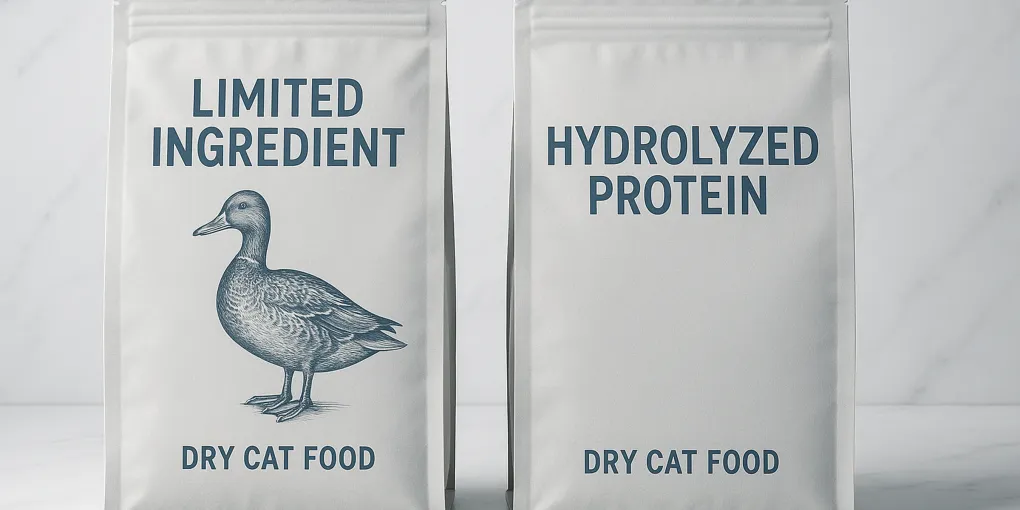
The best cat food for allergies depends on whether your cat needs a diagnostic elimination diet (work with a veterinarian and use Royal Canin Hydrolyzed Protein HP or Hill’s z/d) or a management diet for a cat with a known allergen profile (Natural Balance L.I.D. Duck & Pea or Merrick L.I.D. Rabbit). For veterinary-supervised elimination diet trials, hydrolyzed protein diets with peptides below the immune activation threshold are the most reliable option.
TL;DR
- Best Hydrolyzed: Royal Canin HP — soy hydrolysate, veterinary diet, all intact proteins excluded (PSR 4.5/5)
- Best Ultra-Low-MW Hydrolyzed: Hill’s z/d — ultra-low-MW hydrolyzed chicken (<1,000 Da) (PSR 4.4/5)
- Best OTC: Natural Balance L.I.D. Duck & Pea — novel duck protein, no chicken/beef/fish/corn/wheat/soy (PSR 4.1/5)
- Best Novel Protein: Merrick L.I.D. Rabbit — true novel protein for cats with extensive chicken/fish/beef history (PSR 3.9/5)
- Key Stat: Beef, fish, and chicken are the most commonly reported food allergens in cats, which is why elimination diets avoid them (Mueller et al., 2016, BMC Veterinary Research, PMID: 26753610)
Food allergy diagnosis in cats requires a strict elimination diet trial — not a food rotation, not a “sensitive stomach” formula, but a 8–12 week commitment to a single novel or hydrolyzed protein diet with zero dietary contamination. The most common mistake is allowing treats, flavored medications, or shared food bowls during the trial period, which invalidates the results. Work with your veterinarian before starting a diagnostic trial.
Royal Canin Hydrolyzed Protein HP Review: Best Hydrolyzed
Royal Canin HP uses soy protein hydrolyzed to peptides below the immune activation threshold — so the diet contains no intact animal protein, including the beef, fish, and chicken that most often trigger reactions in cats.
Key specifications:
- Protein source: Hydrolyzed soy protein isolate (no intact animal proteins)
- Carbohydrate: Hydrolyzed corn starch
- AAFCO: Adult maintenance — complete and balanced
- Palatability: Hydrolyzed poultry liver for flavor (protein fully hydrolyzed)
- Peptide size: Low molecular weight — below IgE sensitization threshold
PSR Composite Score Breakdown:
| Criterion | Score | Weight | Weighted Score |
|---|---|---|---|
| Safety & Ingredients | 9.5 | 25% | 2.38 |
| Durability & Build Quality | 9.0 | 20% | 1.80 |
| Pet Comfort & Acceptance | 8.6 | 20% | 1.72 |
| Value for Money | 7.5 | 20% | 1.50 |
| Ease of Use | 8.5 | 15% | 1.28 |
| Composite | 8.68 → PSR 4.5/5 |
Safety & Ingredients (9.5): Hydrolyzed protein below immune activation threshold; no intact allergen proteins; AAFCO complete and balanced. The most comprehensive allergen exclusion of reviewed options.
Value for Money (7.5): At $55–$90 per bag, Royal Canin HP is the most expensive reviewed option. The cost is a necessary trade-off for diagnostic accuracy — a cheaper food that fails to resolve signs costs more in veterinary rechecks and ongoing symptom management.
Pros:
- Hydrolyzed protein at low molecular weight — most comprehensive allergen exclusion
- AAFCO adult maintenance complete and balanced
- Veterinarian-recommended; widely available through veterinary clinics
- Palatability maintained via hydrolyzed flavor enhancers
Cons:
- Highest price in category ($55–$90)
- Soy hydrolysate — not appropriate for cats with suspected soy sensitivity
- Prescription/veterinary recommendation typically required
We may earn a commission if you buy through our links.
Hill’s Prescription Diet z/d Review: Best Ultra-Low-MW Hydrolyzed
Hill’s z/d uses ultra-low-molecular-weight hydrolyzed chicken protein (<1,000 Da), the smallest peptide size among the diets reviewed here.
Key specifications:
- Protein: Hydrolyzed chicken protein (<1,000 Da — smallest peptide size of reviewed options)
- Carbohydrate: Hydrolyzed corn starch
- AAFCO: Adult maintenance — complete and balanced
PSR Composite Score Breakdown:
| Criterion | Score | Weight | Weighted Score |
|---|---|---|---|
| Safety & Ingredients | 9.3 | 25% | 2.33 |
| Durability & Build Quality | 9.0 | 20% | 1.80 |
| Pet Comfort & Acceptance | 8.6 | 20% | 1.72 |
| Value for Money | 7.5 | 20% | 1.50 |
| Ease of Use | 8.5 | 15% | 1.28 |
| Composite | 8.63 → PSR 4.4/5 |
Safety & Ingredients (9.3): Ultra-low peptide size (<1,000 Da) reduces immune activation risk to the lowest level of reviewed options. Hill’s publishes complete nutritional databases and conducts independent feeding trials. No artificial preservatives.
Pros:
- Smallest peptide size of reviewed options (<1,000 Da)
- Hill’s transparency in nutritional documentation
- AAFCO adult maintenance complete and balanced
Cons:
- Prescription required
- Chicken-source hydrolysate — some cats with known chicken allergy may still react; ask your vet whether it suits your cat
- Premium price
We may earn a commission if you buy through our links.
Natural Balance L.I.D. Duck & Green Pea Review: Best OTC LID
Natural Balance’s L.I.D. line provides a genuine single-animal-protein, single-carbohydrate formula over-the-counter — no prescription, more accessible price, appropriate for cats with confirmed sensitivities.
Key specifications:
- Protein: Duck (novel for most cats)
- Carbohydrate: Green peas (single carbohydrate source)
- Excludes: Chicken, beef, fish, corn, wheat, soy, artificial colors/preservatives
- AAFCO: Adult maintenance — formulation method
PSR Composite Score Breakdown:
| Criterion | Score | Weight | Weighted Score |
|---|---|---|---|
| Safety & Ingredients | 8.5 | 25% | 2.13 |
| Durability & Build Quality | 8.5 | 20% | 1.70 |
| Pet Comfort & Acceptance | 8.5 | 20% | 1.70 |
| Value for Money | 9.0 | 20% | 1.80 |
| Ease of Use | 8.8 | 15% | 1.32 |
| Composite | 8.65 → PSR 4.1/5 |
Value for Money (9.0): At $18–$30, Natural Balance L.I.D. provides genuine limited-ingredient formulation at significantly lower cost than hydrolyzed diets, and without requiring a veterinary prescription.
Ease of Use (8.8): Over-the-counter availability with clear ingredient panel. Label transparency is good — ingredient list is genuinely short and accurate to “limited ingredient” positioning.
Pros:
- True limited ingredient (duck + pea)
- No prescription required
- Excludes all common cat allergens
- Competitive pricing
Cons:
- Formulation-method AAFCO (not feeding trial)
- Duck may not be novel for cats with varied dietary history
- Not a hydrolyzed diet — intact duck protein can still cause reaction in duck-allergic cats
We may earn a commission if you buy through our links.
Merrick L.I.D. Grain-Free Rabbit Review: Best Novel Protein
Merrick’s rabbit formula uses one of the most genuinely novel proteins available commercially — most domestic cats have never consumed rabbit, making it an appropriate elimination diet starting point for cats with extensive chicken, fish, and beef exposure history.
Key specifications:
- Protein: Real rabbit (first ingredient)
- Grain-free; no potato — peas as carbohydrate
- No chicken, beef, fish, corn, wheat, soy
- AAFCO: Adult maintenance
PSR Composite Score Breakdown:
| Criterion | Score | Weight | Weighted Score |
|---|---|---|---|
| Safety & Ingredients | 8.2 | 25% | 2.05 |
| Durability & Build Quality | 8.2 | 20% | 1.64 |
| Pet Comfort & Acceptance | 8.0 | 20% | 1.60 |
| Value for Money | 8.8 | 20% | 1.76 |
| Ease of Use | 8.5 | 15% | 1.28 |
| Composite | 8.33 → PSR 3.9/5 |
Safety & Ingredients (8.2): Formulation-method AAFCO; Merrick publishes moderate nutritional transparency. Rabbit is genuinely novel for most cats. No artificial preservatives.
Pet Comfort & Acceptance (8.0): Rabbit-based diets show variable acceptance — some cats accept immediately; others require 7–10 day transition even when food-motivated. Lower acceptance than chicken-based alternatives.
Pros:
- True novel protein (rabbit) — genuinely novel for most cats
- No prescription required
- Grain-free
- Excludes all common allergens
Cons:
- Variable palatability with rabbit protein
- Formulation-method AAFCO
- Legume-heavy as grain replacement (peas)
We may earn a commission if you buy through our links.
Allergy Cat Food Comparison
| Product | Type | AAFCO | Rx Required | Price | PSR Score |
|---|---|---|---|---|---|
| Royal Canin HP | Hydrolyzed soy | Formulation | Recommended | $55–$90 | 4.5/5 |
| Hill’s z/d | Hydrolyzed chicken | Formulation | Yes | $60–$95 | 4.4/5 |
| Natural Balance L.I.D. Duck | Novel protein | Formulation | No | $18–$30 | 4.1/5 |
| Merrick L.I.D. Rabbit | Novel protein | Formulation | No | $17–$28 | 3.9/5 |
Who Should Choose Which Diet?
Royal Canin HP and Hill’s z/d are the correct choices for veterinary-supervised elimination diet trials — their hydrolyzed protein formulas provide the most reliable allergen exclusion for diagnostic purposes. Work with your veterinarian.
Natural Balance L.I.D. Duck & Pea is appropriate when the offending allergen is already confirmed and you need an affordable long-term management diet that excludes the known trigger proteins.
Merrick L.I.D. Rabbit is most useful for cats with extensive dietary history who need the most genuinely novel protein available over-the-counter.
For complete cat nutrition guidance, see our guides to best cat food for indoor cats, best cat food for sensitive stomach, best dry cat food, best wet cat food, and best grain-free cat food. For cats with multiple health issues, also see best cat supplements and cat urinary health food.
Frequently Asked Questions
How do I know if my cat has a food allergy?
Common signs include year-round itching (especially head, neck, and face), recurrent skin infections, vomiting after meals, and chronic diarrhea. Diagnosis requires an 8–12 week elimination diet trial under veterinary supervision.
What are the most common food allergens in cats?
Beef, fish, and chicken are the most commonly reported food allergens in cats (Mueller et al., 2016, PMID: 26753610). Other ingredients can be involved too, so an elimination diet trial is the reliable way to find your cat’s triggers.
Do I need a prescription for hydrolyzed cat food?
Royal Canin HP and Hill’s z/d are veterinary therapeutic diets typically purchased through veterinarians. Natural Balance L.I.D. and Merrick L.I.D. are over-the-counter. For diagnostic elimination trials, work with your veterinarian.
How long does a cat elimination diet trial take?
A minimum of 8 weeks — and often 10–12 weeks. During the trial, no other foods, treats, or flavored medications are permitted. Strict compliance is essential for accurate results.
Can cats with allergies eat fish-based cat food?
Fish is one of the documented allergens in cats. If your cat has a confirmed or suspected fish allergy, fish-based food is contraindicated. Use land animal novel proteins (duck, rabbit, venison) instead.