We may earn a commission if you buy through our links.
Quick picks
| Product | Key Specs |
|---|---|
| See price on Amazon |
|
| See price on Amazon |
|
| See price on Amazon |
|
| See price on Amazon |
|
Best Dog First Aid Kits for Senior Dogs
For senior dog owners who want emergency preparedness for age-related health events, Adventure Medical Kits Workin’ Dog is our top pick — an organized, 45-item kit designed specifically for dogs with an illustrated first aid guide, comprehensive wound care supplies, and a durable carry bag. RC Pet Products First Aid Kit is the most complete option at 50 items with a laminated emergency reference card ideal for high-stress situations.
TL;DR
- Top Pick: Adventure Medical Kits Workin’ Dog — 45 items, illustrated guide, dog-specific design
- Most Complete: RC Pet Products — 50 items, laminated emergency card, comprehensive supplies
- Travel: Kurgo Dog First Aid Kit — attaches to pack/leash, waterproof guide, compact
- Budget: Rayco International — 30 essential items, accessible price
How We Researched This Article
We compared each kit’s listed contents, organization, and included instructions against owner first aid guidance from the American Red Cross and AVMA, plus the 2026 RECOVER First Aid Guidelines.
Why Senior Dog Owners Need a Dedicated First Aid Kit
Senior dogs face more emergency scenarios than younger dogs due to:
Reduced thermoregulation: Senior dogs cannot manage body temperature as efficiently. Heatstroke at lower ambient temperatures and hypothermia from shorter cold-weather exposure both become more likely.
Cardiovascular events: Dogs with known or undiagnosed heart disease may experience collapse, syncope, or respiratory distress. A first aid kit cannot treat these events — but having emergency veterinary contact information and knowing how to safely transport a collapsed dog makes critical seconds count.
CDS-related accidents: Senior dogs with cognitive dysfunction may misjudge distances, fall from furniture or stairs, or ingest inappropriate items. Wound care supplies and toxin emergency contacts are relevant.
Mobility-related injuries: Dogs with arthritis or rear weakness fall more frequently — especially on slippery surfaces. Wound care and temporary joint support materials matter.
Medication emergencies: Senior dogs on multiple medications risk accidental double-dosing, missed doses, or adverse reactions that require immediate veterinary guidance.
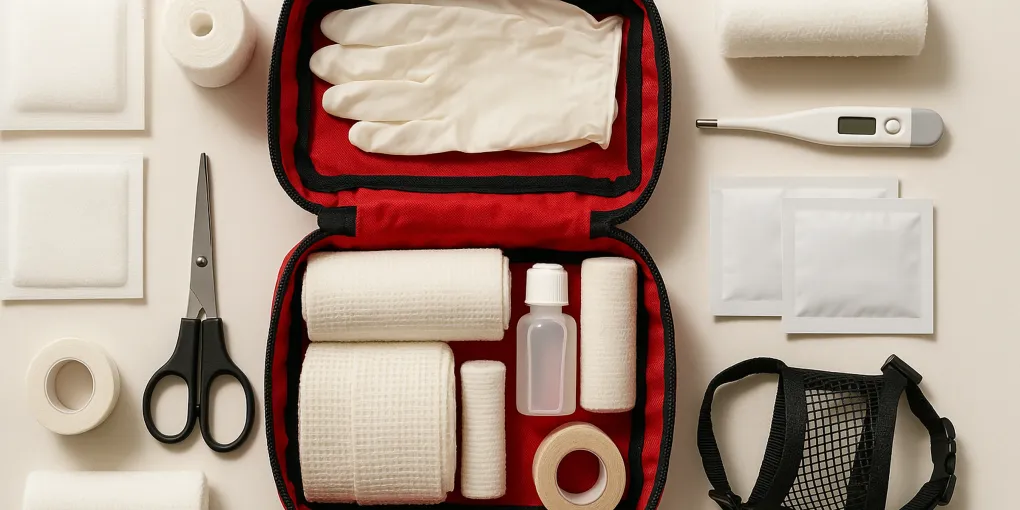
What a Senior Dog First Aid Kit Should Include
Beyond standard supplies, tailor a senior dog kit with:
Core wound care:
- Sterile gauze pads and rolled gauze
- Self-adhesive bandage wrap (VetWrap)
- Antiseptic wipes (chlorhexidine based)
- Saline wound flush
- Medical tape (non-adhesive to fur where possible)
Assessment tools:
- Digital rectal thermometer (normal range 101–102.5°F; seniors below 99°F or above 104°F warrant emergency veterinary care)
- Penlight for oral and wound examination
- Stethoscope (if owner is trained to use)
- Latex-free exam gloves
Transport and restraint:
- Soft fabric muzzle in the dog’s size
- Emergency blanket (mylar) for hypothermia prevention
- Dog-specific syringe for oral medication administration
Documentation (irreplaceable for senior dogs):
- Laminated card: current medication list, doses, prescribing veterinarian
- Laminated card: known health conditions, allergies, vaccine status
- Local emergency veterinary clinic address and phone
- ASPCA Animal Poison Control Center: (888) 426-4435
- Pet Poison Helpline: (855) 764-7661
Adventure Medical Kits Workin’ Dog: Best Overall
Adventure Medical Kits brings its outdoor emergency medicine expertise to dog first aid with the Workin’ Dog kit. The 45-item kit is organized into labeled compartments within a durable ripstop nylon bag, with a detailed illustrated first aid guide that covers wound treatment, bleeding control, hypothermia, heatstroke, and basic life support. Designed for outdoor and working dog contexts — comprehensive coverage for events far from veterinary care.
What makes it the top pick:
- Illustrated guide with step-by-step emergency instructions — critically important when owners are panicking and have no time to search for guidance
- Organized compartment system allows fast retrieval of specific items
- Dog-specific contents — sized and designed for canine patients, not adapted from human kits
- Durable ripstop nylon bag withstands outdoor and travel use
Safety: All included medical supplies meet standard quality requirements. Expiration-sensitive items (tape, dressings) clearly labeled.
Best for: Senior dog owners who want a comprehensive, well-organized kit for both home emergency preparedness and outdoor activities; owners of senior dogs with known cardiac or mobility conditions where emergency preparedness is especially important.
We may earn a commission if you buy through our links.
RC Pet Products First Aid Kit: Most Complete
RC Pet Products’ kit includes 50 items with a laminated emergency reference card — a particularly important feature for senior dog owners who need fast information access in a stressful moment. The laminated card is more durable and usable under field conditions than a paper guide, and the 50-item count provides a buffer for emergencies requiring multiple supply types.
Why laminated reference matters:
- In an emergency, owners are under stress and cannot retain detailed instructions from memory
- A laminated card is readable with blood or water on it — paper guides deteriorate rapidly
- 50 items allows multiple wound care episodes without restocking
Best for: Owners who prioritize reference material quality and maximum supply count; owners of senior dogs with multiple health conditions who may face complex emergency scenarios.
We may earn a commission if you buy through our links.
Kurgo Dog First Aid Kit: Best for Travel
Kurgo’s kit attaches to a backpack, leash, or harness via integrated clip system — keeping first aid supplies accessible during hiking, travel, or dog park visits. The 35-item kit uses a waterproof guide booklet, appropriate for outdoor conditions. Durable construction handles repeated outdoor use cycles.
Why attachment matters for active senior dogs:
- Senior dogs who still hike or travel need accessible emergency supplies — supplies in a car or at home are useless on a trail
- The waterproof guide is readable in rain — a significant advantage over paper guides in outdoor contexts
- Clip system allows attachment to owner gear without adding a separate bag
Best for: Active senior dog owners who take their dogs hiking, camping, or traveling regularly; owners who want first aid access during outdoor excursions.
We may earn a commission if you buy through our links.
Rayco International Pet First Aid Kit: Best Budget
Rayco International provides 30 essential first aid items in a compact zippered pouch at an entry-level price. Covers the core wound care and assessment functions without the advanced organizational systems or comprehensive guides of the premium kits.
Where it delivers:
- Essential wound care supplies at an accessible price
- Compact and lightweight — easy to include in car, travel bag, or home medical station
- Basic guide provides foundational instructions for common first aid scenarios
Limitations:
- 30 items — may require supplementation for households with multiple dogs or where prolonged first aid may be needed
- Less durable pouch construction than Kurgo or Adventure Medical
- Basic (non-laminated, non-illustrated) guide
Best for: Budget-constrained owners wanting essential first aid coverage; owners supplementing an existing human first aid kit with dog-specific supplies.
We may earn a commission if you buy through our links.
Essential Contacts for Senior Dog Emergencies
Regardless of which kit you choose, save these contacts in your phone and include them in your kit:
- ASPCA Animal Poison Control Center: (888) 426-4435 (24/7, consultation fee applies)
- Pet Poison Helpline: (855) 764-7661 (24/7)
- Your primary veterinarian: Keep their after-hours number
- Nearest 24-hour emergency veterinary clinic: Find and save before you need it
Related Senior Dog Care Articles
- Best Dog Mobility Harness for Senior Dogs
- Best Non-Slip Mats for Senior Dogs
- Best Dog Ramps and Stairs for Senior Dogs
- Best Orthopedic Dog Beds for Senior Dogs
- Best Cognitive Supplements for Senior Dogs
Frequently Asked Questions
What should a first aid kit for senior dogs include beyond standard kits?
Senior dogs need additional emergency items: a copy of their current medication list, their veterinarian’s emergency contact, a lightweight muzzle, a list of known health conditions for emergency responders, and blankets for hypothermia prevention. Senior dogs lose body heat rapidly and take multiple medications that emergency veterinarians need to know about.
What are the most common emergencies in senior dogs that require first aid?
Common senior dog emergencies include: lacerations from falls, heatstroke (reduced thermoregulation), hypothermia, seizures, suspected toxin ingestion (CDS reduces appetite discrimination), acute pain crises, and collapse from cardiac disease. For most suspected emergencies, stabilize and transport to a veterinarian immediately. Heatstroke is the exception. If you suspect heatstroke, move the dog somewhere cooler and, if it is safe for you, start active cooling on the spot before you leave. RECOVER’s 2026 first-aid guidelines suggest running cool water over the body behind the neck, focusing on the thinly haired belly and soaking to the skin, with water kept away from the face. Partly submerging the body or using ice water from a cooler are acceptable alternatives; wetting only the paws is not enough. The guidelines advise stopping at a rectal temperature of about 103.5–104°F (39.7–40°C), even if the dog is still panting, or after about 15 minutes if you cannot measure it. For any dog with noisy breathing (snoring or high-pitched sounds, common in flat-faced breeds), keep cooling until panting clearly improves or the temperature reaches 101.5°F (38.6°C), whichever comes first. Then pat the dog dry and go straight to a veterinarian, calling ahead; skip on-scene cooling if handling the dog would put you at risk.
Can I give my senior dog any human pain medication in an emergency?
No — virtually all common human pain medications are dangerous for dogs. Ibuprofen and naproxen cause GI hemorrhage and acute kidney failure; acetaminophen causes liver failure. The only acceptable first aid action for pain is to keep the dog calm and transport to a veterinarian immediately.
Should I include my senior dog’s regular medications in their first aid kit?
Keep a laminated current medication list in the kit rather than the actual medications. If your senior dog has a prescribed emergency medication (diazepam for seizures, emergency cardiac medications), store those in a designated accessible location and include them in any evacuation kit.
How do I perform basic first aid on a senior dog who may bite from pain?
Approach calmly, avoid direct eye contact, speak softly. Apply a soft muzzle before handling if the dog is in significant pain — even gentle dogs bite reflexively when acutely painful. Support the body when moving — never lift by limbs. For suspected spinal injuries, keep the dog still on a flat surface and transport on a rigid board if available.
Sources
- RECOVER Guidelines: First Aid for Dogs and Cats. Clinical Guidelines (Mandell et al., 2026), J Vet Emerg Crit Care: https://pubmed.ncbi.nlm.nih.gov/42640813/