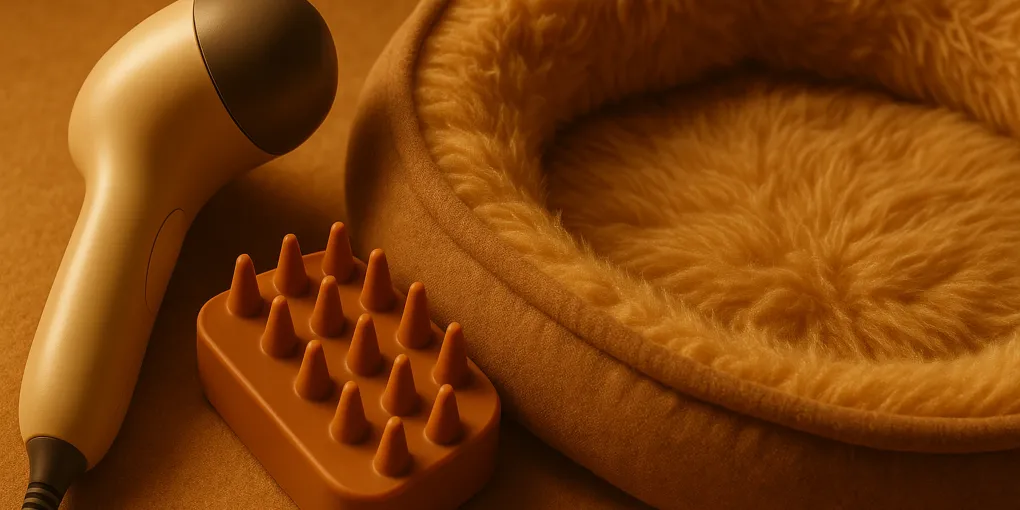
Wahl Pet Pro Massager
Best dog-specific powered optionType: Dog-specific vibration massager
$18-$35
Quick picks
| Product | Key Specs |
|---|---|
| See price on Amazon |
|
| See price on Amazon |
|
| See price on Amazon |
|
| See price on Amazon |
|
Product availability, certifications, and retailer details can change; check the current Amazon page before buying.
Best massage tools for senior dogs: quick answer
The best massage tool for most senior dogs is not a high-powered massage gun. It is a quiet, low-force tool that lets you control pressure and stop quickly when your dog says no.
Our top dog-specific powered pick is the Search Amazon for Wahl dog massagers because it is built for pet handling, is light enough to move slowly around a dog’s body, and does not require the owner to adapt an aggressive human percussion device. For a safer first step, the Search Amazon for Mighty Paw silicone grooming brushes keeps the force under your hand and works well for dogs who already enjoy grooming.
Massage can be useful comfort care for some older dogs, but it is not a treatment for arthritis, neurologic disease, intervertebral disc disease, or post-surgical pain by itself. Veterinary arthritis guidance from VCA Hospitals and the Merck Veterinary Manual emphasizes diagnosis, weight control, medication when needed, and activity planning for chronic joint pain. A canine rehabilitation review on PubMed (PMID: 27895275) frames modalities such as massage and therapeutic exercise as clinician-guided tools rather than one-size-fits-all home treatment. Use massage as a calm handling routine unless your veterinarian gives a more specific plan.
Quick picks by dog and owner situation
- Best dog-specific powered option: Search Amazon for Wahl dog massagers. Choose this if your dog already accepts brushing and you want gentle vibration without buying an athlete-style percussion gun.
- Best manual starter: Search Amazon for Mighty Paw silicone grooming brushes. Start here for thin-coated seniors, anxious dogs, and dogs with uncertain pain tolerance.
- Best adjustable fallback: Search Amazon for quiet low-intensity vibration massagers. Use only the lowest setting and avoid thumping percussion heads.
- Best low-risk touch tool: Search Amazon for soft rubber dog grooming mitts. Good for dogs who relax when being petted but move away from devices.
What matters in a senior-dog massage tool
Low force matters more than motor size. Many popular massage guns are designed for adult human athletes with large muscle groups. Senior dogs may have thin skin, muscle loss, bony hips, painful joints, and lower tolerance for vibration. A tool that feels mild on your palm can still feel sharp on a small dog or on the rear legs of a dog with hip arthritis.
Noise matters too. A device that makes a dog tense, pant, hide, or brace is working against the goal. If your dog relaxes under a silicone brush but stiffens when a motor turns on, the manual tool is the better choice.
No heat is the safer default. Heat can be appropriate in some rehabilitation plans, but it should not be built into an unsupervised home massage routine for a senior dog with unknown circulation, skin sensitivity, swelling, or neurologic status. All picks here either avoid heat or should be used with heat turned off.
Handler feedback matters. Your hand should always be close enough to feel the dog’s muscles, skin temperature, flinching, and tension. Long sessions with a tool held in one place are a common mistake. Keep the tool moving slowly and lightly, and stop before your dog becomes restless.
Wahl Pet Pro Massager: best dog-specific powered option
The Wahl Pet Pro Massager is the cleanest powered starting point because it is marketed for dogs rather than deep human muscle work. It is small, easy to hold, and better suited to slow movement over shoulder, back, and hip muscles than large percussion guns.
Use it only after a manual warm-up. Spend one or two minutes with your hand or a soft brush first. Then turn the tool on away from the dog, let the dog sniff or ignore it, and touch the tool to a large muscle group for a few seconds. Good signs include soft eyes, loose posture, leaning in, or staying relaxed. Stop if the dog turns away, pins the ears, freezes, pants suddenly, licks lips repeatedly, or looks back at the area.
Best fit: medium and large senior dogs that already tolerate grooming, dogs with mild muscle tightness after walks, and owners who want a repeatable low-vibration routine.
Skip it for: dogs with acute lameness, severe touch sensitivity, recent surgery, suspected spinal pain, open wounds, or any dog whose veterinarian has restricted massage.
Mighty Paw silicone grooming massage brush: best manual starter
A silicone grooming brush is the safest first purchase for most senior households. It does not surprise the dog with motor noise, it cannot jump to a high setting, and pressure stays directly under your hand. It also doubles as a grooming tool, so it is easier to build a routine around something the dog already understands.
Use short strokes with the coat over the shoulders, along the large back muscles beside the spine, and over the thigh muscles. Do not grind over elbows, hips, knees, the spine, or bony points. For thin-coated dogs, use lighter pressure than you think you need.
Best fit: small seniors, anxious dogs, dogs new to massage, dogs with reduced muscle mass, and owners who want a low-cost way to test whether touch-based relaxation helps.
Quiet low-intensity vibration massager: best fallback if you avoid percussion
Some owners already own a handheld vibration massager or want a more widely available device. The safe version is quiet, low-amplitude, adjustable, and used only on its lowest useful setting. The unsafe version is a hard-thumping massage gun promoted for deep-tissue human recovery.
Before using any human device, test it on the thin skin of your own forearm for 30 seconds. If it feels sharp, pounding, hot, or numbing, it is not appropriate for a senior dog. Keep it away from the spine, joints, ribs, abdomen, and head. Limit the first session to one large muscle group and reassess your dog the next day for extra stiffness or soreness.
Best fit: large dogs with good touch tolerance and owners who can follow strict low-setting rules.
Soft rubber grooming mitt: best for anxious dogs
A grooming mitt is less targeted than a powered tool, but it often wins with nervous seniors because it feels like normal petting. Look for H&H Pets-style Grooming Gloves or HandsOn-style Pet Grooming Gloves with soft rubber or silicone nubs rather than stiff rake teeth, a flexible wrist opening that will not scrape a thin-coated dog, and a surface you can rinse clean after use. At roughly $8-$16, a mitt also lets you keep one hand on the dog and one hand free for treats, balance support, or stopping the session.
Use a mitt when the main goal is relaxation, bonding, and gentle skin stimulation rather than deeper muscle work. Short-coated seniors often need only feather-light strokes over the shoulder and thigh muscles; long-coated dogs may need slower passes so the nubs do not tug. For dogs with cognitive decline, a predictable evening mitt routine can be easier to accept than a new device. It is also the easiest tool to use around bony hips and shoulders because you can instantly lighten pressure when you feel the dog tense.
Simple senior-dog massage routine
- Pick a non-slip surface, such as a rug or yoga mat, so your dog does not brace on slick flooring.
- Start with your hands for 60-90 seconds. If the dog cannot relax under your hand, do not add a tool.
- Work on one area only: shoulders, back muscles beside the spine, or thigh muscles.
- Use light pressure and slow movement. Never pin the dog in place.
- Stop after 2-3 minutes for the first session.
- Check the next day. If your dog seems stiffer, sore, avoidant, or less willing to be touched, reduce pressure or stop and ask your veterinarian.
Pair massage with other senior-dog comfort basics: a supportive orthopedic dog bed, traction from non-slip mats, safe access with dog ramps and stairs, and veterinarian-directed mobility support such as a senior dog mobility harness.
When to ask your veterinarian first
Ask before using massage tools if your dog has new limping, sudden reluctance to rise, a painful back, known disc disease, cancer, a hot or swollen joint, recent surgery, an open wound, unexplained weight loss, fever, or pain that is getting worse. Also ask if your dog takes pain medication but still seems uncomfortable. Massage should not delay diagnosis or medication adjustment.
For arthritis, the safer language is comfort support. Massage may help some dogs relax and may reduce muscle guarding around overworked areas, but it does not reverse arthritis or replace weight management, medication, controlled exercise, and veterinary rehabilitation when those are needed.
Evidence and source notes
Veterinary pain and rehabilitation sources consistently frame massage as one part of a broader plan, not a stand-alone cure. Useful owner-level boundaries include VCA’s arthritis overview, the Merck Veterinary Manual arthritis guide, and canine rehabilitation literature indexed at PubMed PMID 27895275. For this buyer guide, those sources translate into extra weight for low force, owner control, and dog acceptance rather than aggressive power.
Senior dog massage FAQ
Are massage tools safe for senior dogs with arthritis?
They can be safe when the pressure is light, the dog accepts touch, and arthritis care is already being guided by a veterinarian. Do not press directly on painful joints, swollen areas, or the spine. If the dog has severe pain, recent surgery, neurologic signs, or unexplained lameness, ask your veterinarian before using any powered tool.
Can I use a human massage gun on my dog?
Avoid high-force percussion massage guns for most senior dogs. If you use a human device at all, choose quiet low-intensity vibration, test it on yourself first, keep it on large muscles only, and stop immediately if the dog flinches, braces, pants, or moves away.
How often should I massage a senior dog?
Start with two or three very short sessions per week. If your dog stays relaxed and shows no next-day soreness, you can build a brief daily routine. Dogs with diagnosed orthopedic or neurologic disease should follow the schedule from their veterinarian or rehabilitation therapist.
What is the safest first massage tool for an old dog?
A silicone grooming brush or soft rubber grooming mitt is the safest first step because pressure stays under your hand and there is no motor noise. Add a powered dog-specific massager only if the dog clearly enjoys manual massage.
Frequently Asked Questions
- Gentle touch and light massage may help some senior dogs relax, but arthritis pain needs veterinary diagnosis and a broader care plan. Avoid direct pressure over painful joints, hot swollen areas, wounds, lumps, or the spine. Ask your veterinarian or a canine rehabilitation professional before using powered vibration on a dog with significant pain, neurologic disease, recent surgery, cancer, or unexplained lameness.
- High-force percussion massage guns are usually a poor fit for senior dogs. If you use any human device, choose a quiet low-intensity vibration mode, test it on your own forearm first, use it only over large muscles, and stop at the first sign of flinching, avoidance, panting, lip licking, or vocalizing. Dog-specific or manual tools are safer starting points.
- Start with 2-3 minutes of light stroking or a manual brush session. If your dog remains loose and engaged, build toward 5-10 minutes. Short sessions are better than one long session, especially for dogs with arthritis or muscle loss.
- Do not massage directly over the spine, bony points, swollen joints, wounds, lumps, the abdomen, the throat, or any painful area your veterinarian has not evaluated. Work beside large muscle groups with light pressure instead.