We may earn a commission if you buy through our links.
Quick picks
| Product | Key Specs |
|---|---|
| See price on Amazon |
|
| See price on Amazon |
|
| See price on Amazon |
|
| See price on Amazon |
|
Best Cat Litter Mats
The best cat litter mat is the Gorilla Grip Original Litter Mat, which combines a tortoise-shell textured TPR surface that captures litter effectively from cat paws, a large maximum size option (47 × 35 inches), and easy maintenance via hose-off or shake-clean in seconds. For cats with sensitive paws or those that hesitate on firm-textured surfaces, the PetFusion Paws Mat uses a softer BPA/PVC-free EVA foam that maintains high comfort acceptance.
Litter tracking is the most universally cited cat care nuisance — loose litter granules spread through rooms, embed in carpets, and require frequent floor cleaning. A well-placed, correctly sized litter mat addresses the root mechanical cause: litter carried between a cat’s paw pads and toe fur as they exit the box.
What to Look For
For durability, check whether the mat remains flat over time (curled edges cause tripping and litter bypass), whether the surface texture maintains effectiveness after repeated washing, and whether the material resists cat claw puncture that creates fraying. Also watch whether your cat walks across the mat rather than around or over it.
Top Picks
1. Gorilla Grip Original Tortoise Shell Litter Mat (Best Overall)
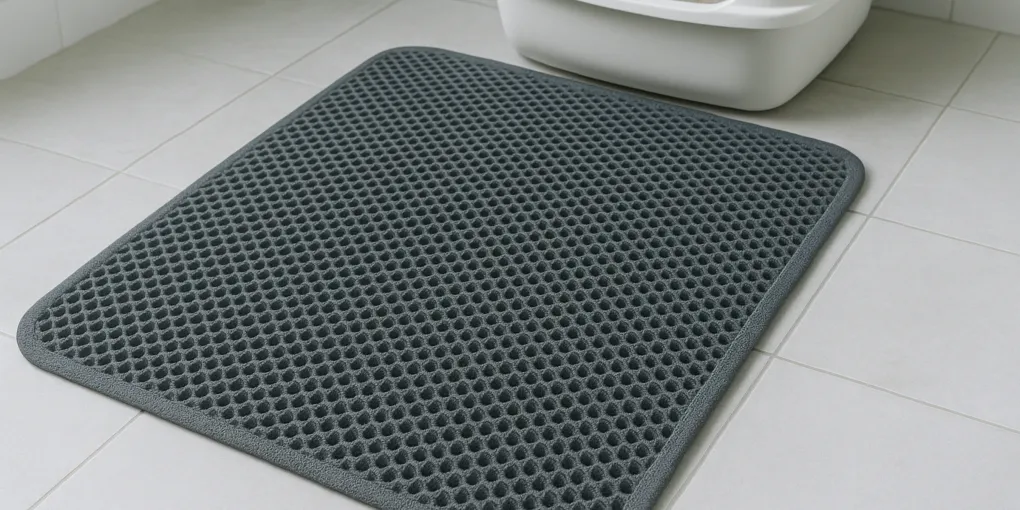
The Gorilla Grip’s hexagonal “tortoise shell” pattern creates hundreds of recesses that litter granules fall into as the cat walks across the surface, preventing them from being tracked further. The TPR rubber is thick (approximately 3mm) and resists curling at edges — a durability failure common in budget mats that allows granules to slide under the mat and accumulate on the floor beneath.
Available in sizes up to 47 × 35 inches, making it one of the largest readily available cat litter mats for multi-cat households or owners with covered boxes with extended entries.
2. PetFusion Paws Cat Litter Mat (Best for Soft Paws)
PetFusion uses an EVA foam construction that is explicitly BPA-free and PVC-free with a Certificate of Conformity available. The slightly softer surface texture is more comfortable for cats with sensitive paw pads (declawed cats, cats with paw dermatitis, or cats that routinely avoid firm-surface mats). The softer texture also makes it machine washable — a genuine maintenance advantage over rubber mats.
3. iPrimio Blackhole Litter Mat (Best Two-Layer Trapping)
The iPrimio Blackhole uses a two-layer design: an upper honeycombed layer that catches litter, and a lower collection tray where litter falls through for easy disposal. The top layer can be lifted and the bottom tray emptied directly into the trash without any shaking or outdoor cleaning. This design is particularly convenient in apartments or homes where shaking a mat outdoors isn’t practical.
4. Smiling Paws Premium Litter Mat (Best Value)
Smiling Paws provides a competent single-layer rubber litter mat at the lowest price point reviewed. The textured surface catches litter adequately for single-cat households with moderate tracking.
Placement and Sizing Strategy
A litter mat placed directly at the box exit intercepts the most litter because the cat’s first steps after exiting carry the highest litter load. For covered boxes with swinging doors, the mat should start at the door opening and extend outward — not set back away from the entrance.
Multi-cat households: Consider placing a mat on all accessible sides of the box if cats enter and exit from multiple angles. Two smaller mats placed in an L-shape configuration can cover more exit paths than a single large mat directly in front.
Carpet households: Place a waterproof mat under the litter box itself in addition to a tracking mat in front — litter that reaches the box exterior settles into carpet and is difficult to vacuum. The waterproof box underlay catches any moisture from box overflow or litter splash.
Related PSR Guides
- Best Cat Litter Box — full box comparison including top-entry options for scatter reduction
- Best Cat Litter — litter granule size affects tracking behavior
- Best Self-Cleaning Litter Box — automated boxes with enclosed designs reduce tracking
- Best Cat Litter Odor Control — box hygiene products that pair with mat maintenance
- Best Cat Bed — household comfort essentials
- Best Cat Water Fountain — keeping the box area clean pairs with hydration management
- Best Cat Supplements — digestive health options relevant to box output
- Best Cat Treats — positive reinforcement for mat introduction
Frequently Asked Questions
What is the best material for a cat litter mat?
TPR (thermoplastic rubber) and EVA foam are the best materials currently available for litter mats. TPR offers better durability and edge-curl resistance; EVA foam offers better washability and is softer underfoot. For households with cats that hesitate on firm surfaces, EVA foam (PetFusion Paws) is the better choice. For households prioritizing long-term durability and minimal maintenance, TPR (Gorilla Grip) is the better choice.
How often should I replace a cat litter mat?
Rubber litter mats should be replaced every 12–18 months as the surface texture degrades and becomes less effective at trapping litter. EVA foam mats compress and lose their texture faster — 8–12 months is a practical lifespan. Signs it’s time to replace: the mat no longer lies flat, the texture has become smooth, the material has absorbed odors that don’t wash out, or small pieces are breaking off that could be ingested by the cat.
Does the color of a litter mat matter?
Color does not affect function. Darker mats better conceal litter visually between cleaning sessions; lighter mats make it easier to see when the mat needs shaking or cleaning. Gray and charcoal are popular practical choices that show minimal litter accumulation while being easy to clean. Avoid bright colors that may fade quickly with repeated washing or UV exposure if the mat is near a window.
Can I use a regular doormat as a cat litter mat?
A flat-pile doormat can serve as a litter mat substitute if it has some texture. However, most standard doormats are not waterproof and will absorb cat urine if overshoot occurs, creating persistent odor. Dedicated litter mats are designed with waterproof backing to contain any moisture. If using a doormat, ensure the pile is short and the material is easy to wash. Shag or deep-pile doormats are not suitable — they embed litter granules too deeply for easy cleaning.
Why does litter still get tracked despite using a mat?
Very fine litter particles (under 1mm) pass through most mat textures and continue to be tracked. If tracking remains excessive despite a quality mat, consider switching to a heavier, coarser granule litter that catches better on mat surfaces. Long-haired cats carry more litter between toe fur than short-haired cats — regular paw grooming or trimming fur between the toes can reduce the amount of litter carried onto the mat and beyond.