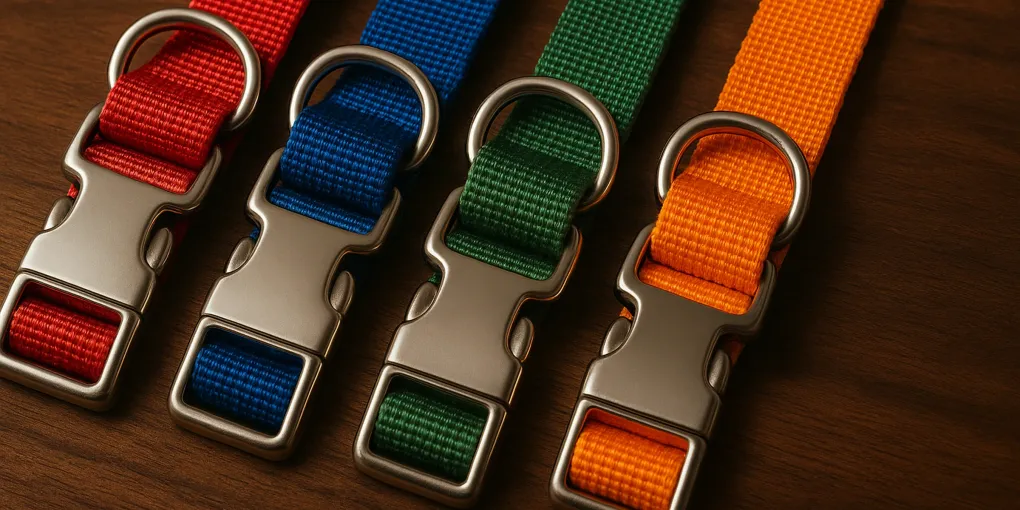
Best Dog Collar: Top Picks for Safety, Comfort, and Durability
We may earn a commission if you buy through our links.
Quick picks
| Product | Key Specs |
|---|---|
| See price on Amazon |
|
| See price on Amazon |
|
| See price on Amazon |
|
| See price on Amazon |
|
Best Dog Collar: Top Picks for Safety, Comfort, and Durability
The best dog collar for most dogs is the Ruffwear Front Range Dog Collar — it combines bomber-grade nylon webbing, an aluminum V-ring that won’t corrode, a quick-release aluminum buckle, and an ID tag slot that keeps your contact information accessible without tag jingle. For owners who want embedded contact information without a separate tag, the Orvis Personalized Dog Collar stitches your dog’s name and phone number directly into the webbing — eliminating the risk of a tag falling off in an emergency.
TL;DR
- Top Pick: Ruffwear Front Range — best for most dogs, rugged hardware, machine washable
- Runner-Up: Orvis Personalized — best for dogs who lose tags, direct-embroidered ID
- Budget: Blueberry Pet Classic — solid everyday collar at the lowest cost here, huge color selection
- Training: PetSafe Martingale — limited-slip design prevents collar escape for sighthounds and escape artists
How to Judge Dog Collars
A dog collar is one of the few pet products that stays on your dog nearly every hour of every day. The stakes for getting it right — in terms of both safety and comfort — are higher than most owners realize.
Safety matters most because collar failures have direct injury consequences. Look at hardware toxicity (lead-free buckles, nickel-safe alloys), construction failure points, breakaway mechanisms, and whether the collar design prevents accidental strangulation.
Build quality: Check how long the collar holds up under daily wear, water exposure, and the mechanical stress of leash attachment. Look at stitching density, webbing material grade, buckle material (aluminum vs. plastic vs. steel), and D-ring gauge.
Comfort and acceptance: Check collar width relative to dog size, presence of padding or lining, edge finishing to prevent fraying that causes skin irritation, and documented reports of dogs tolerating the collar without scratching or rubbing.
Value compares the price against material quality and expected lifespan — a collar that lasts five years is a better value than a cheaper one replaced annually.
Ease of use: Check how quickly the collar can be put on and removed, clarity of size adjustment, ease of cleaning, and whether ID tags can be attached securely.
1. Ruffwear Front Range Dog Collar — Best Overall
We may earn a commission if you buy through our links.
Overview
Ruffwear has built a reputation in the outdoor/adventure dog gear space, and the Front Range collar is their everyday-carry model — designed for dogs that actually do things. The webbing is the same material grade used in their harnesses and packs: a tightly woven nylon that resists fraying at cut edges and maintains its shape after hundreds of wash cycles.
The collar’s standout feature is its dual-ring hardware configuration. The aluminum V-ring is positioned centrally on the collar’s underside and is sized for ID tags — it holds them flat against the neck, reducing the clanking that drives both dogs and owners crazy. The leash attaches to a separate D-ring at the back of the collar, meaning the mechanical load of a pulling dog is absorbed by the D-ring rather than the tag attachment point, extending hardware life.
The aluminum buckle uses a side-release design that requires simultaneous compression of both buttons to open — a feature that makes accidental release near impossible while keeping deliberate release fast and one-handed. The buckle is constructed from cast aluminum, not the injection-molded plastic used in budget collars, and will not crack in cold weather or UV-degrade over time.
Safety Assessment
No recall history for the Ruffwear Front Range collar as of April 2026. Ruffwear hardware has been independently tested and confirmed free of lead and cadmium. The aluminum V-ring and D-ring meet ASTM F963 standards for metal toy safety (the applicable reference standard for pet product hardware). The nylon webbing does not contain plasticizers or chlorinated compounds.
Who It’s For
The Ruffwear Front Range is the right choice for active dogs, dogs whose owners prioritize hardware longevity over price, and households with a dog that swims, hikes, or otherwise subjects gear to real stress. It’s available in nine colorways and six sizes, covering necks from 8 to 33 inches — one of the widest ranges of any single collar model. If you have one dog and want to buy one collar and not think about it again for five years, this is the pick.
2. Orvis Personalized Dog Collar — Best Personalized/ID
We may earn a commission if you buy through our links.
Overview
The defining feature of the Orvis Personalized Collar is its embroidered identification system. Your dog’s name and one phone number are stitched directly into the nylon webbing using high-durability polyester thread in a contrasting color. Unlike engraved metal tags — which can lose legibility after years of scratching against pavement and other tags — the embroidered text retains full readability as long as the collar itself is intact.
This matters in a specific and serious scenario: dogs that escape their yard or get lost in unfamiliar environments. Metal ID tags are frequently lost or become unreadable. An embedded, permanent identification that anyone can read just by looking at the collar is a meaningful safety upgrade for dogs with a history of wandering or escape.
The collar uses heavyweight nylon webbing (noticeably thicker than standard pet store nylon) with a solid brass D-ring and center ring for leash and ID tag attachment respectively. Brass is inherently corrosion-resistant without plating — a distinction from the nickel-plated zinc alloy hardware used in many budget collars, which can develop a powdery corrosion layer over time.
Safety Assessment
No recall history. Orvis uses solid brass hardware throughout, tested to be free of lead and cadmium. The heavyweight nylon webbing is finished at cut edges to prevent fraying that could cause skin abrasion.
Who It’s For
The Orvis Personalized Collar is the right choice for dogs that regularly lose tags, households that want the cleanest possible ID solution without a separate engraved tag, and owners who want brass hardware and a premium-feeling collar. It’s particularly well suited for dogs in the medium-to-large range (25–80 lbs) where the collar weight is appropriate.
3. Blueberry Pet Classic Dog Collar — Best Everyday Value
We may earn a commission if you buy through our links.
Overview
The Blueberry Pet Classic is the benchmark everyday collar for cost-conscious owners who still want a properly constructed product. Available at a low cost in most sizes and in over 50 colorways and patterns, it occupies the sweet spot between dollar-store quality and premium gear pricing.
The collar uses standard-grade nylon webbing with bar-tack stitching at the D-ring attachment point — the stress concentration point that determines whether a collar fails during a sudden load. The plastic side-release buckle and slide adjuster are consistent with industry-standard hardware for this price category. The D-ring is nickel-plated steel on larger sizes, which provides adequate strength for dogs up to approximately 80 lbs.
Blueberry Pet offers the collar in a wide range of patterns beyond solid colors — seasonal prints, floral designs, and plaid options are available — which makes it popular as a secondary collar for casual wear or for matching with harnesses and leashes in the same collection.
Safety Assessment
No recall history for Blueberry Pet Classic collars. The nylon webbing is tested and confirmed free of lead and heavy metals per the brand’s published documentation. The plastic buckles comply with CPSC requirements. The primary safety limitation is the plastic D-ring on XS and S sizes — sufficient for small dogs (under 25 lbs) but not recommended for medium or large dogs that pull hard on leash.
Who It’s For
The Blueberry Pet Classic is the right choice for small-to-medium dogs, puppies in rapid growth stages who will outgrow collars before hardware degrades, households that like color variety or pattern options, and owners who want a serviceable everyday collar without premium pricing. For large dogs over 50 lbs that pull, upgrade to a collar with metal hardware throughout.
4. PetSafe Martingale Collar — Best Training/No-Slip
We may earn a commission if you buy through our links.
Overview
A martingale collar (also called a limited-slip collar or greyhound collar) operates on a dual-loop principle: the main loop fits loosely around the dog’s neck, and a smaller control loop connects to the leash. When the dog pulls back or attempts to slip backward out of the collar, the control loop tightens the main loop — but only to a preset maximum diameter, preventing the choking that makes traditional slip collars dangerous.
The PetSafe Martingale is the category-standard product for this collar type, widely recommended by professional trainers and shelter staff. The collar is particularly valuable for sighthounds (Greyhounds, Whippets, Italian Greyhounds) whose neck circumference is larger than their head — a geometry that allows conventional flat collars to slip over the head with backward pressure. It’s also used in training contexts for any dog that has learned to back out of their collar when startled.
PetSafe’s version uses polyester webbing (slightly less UV-resistant than nylon but softer and more comfortable against sensitive skin) with a metal D-ring and metal slide stops on the control loop. The metal components are zinc alloy with nickel plating — adequate for most climates but reviewed less favorably in salt air or very humid environments where corrosion accelerates.
Safety Assessment
No recall history for PetSafe Martingale collars. The limited-slip mechanism has an inherent safety advantage over traditional choke chains: the collar cannot fully close beyond a preset diameter, preventing tracheal compression at the level caused by slip leads or choke chains. The primary safety caveat is the requirement for supervised use only — the loose fit that makes the collar effective during walks creates a snagging risk when unsupervised. PetSafe’s polyester webbing is non-toxic and free of heavy metals per company documentation.
Who It’s For
The PetSafe Martingale is the right choice for sighthound breeds, dogs with a history of escaping flat collars, and dogs in active leash training programs where a clear correction signal is desired. It is not appropriate as an all-day wear collar. For households with sighthound breeds, this is essentially a required piece of equipment for safe outdoor walks.
Comparison Summary
| Collar | Best For |
|---|---|
| Ruffwear Front Range | Most dogs, active use, hardware longevity |
| Orvis Personalized | Dogs that lose tags, permanent embedded ID |
| Blueberry Pet Classic | Budget, puppies, color variety, small dogs |
| PetSafe Martingale | Sighthounds, escape artists, training |
Buying Guide: What to Look for in a Dog Collar
Material Matters More Than It Looks
Nylon collars are the dominant category because nylon webbing is strong, lightweight, resistant to moisture, and can be machine washed. The quality difference between budget and premium nylon collars shows primarily in the weave density (threads per inch) and the finishing at cut edges. Premium collars heat-seal or stitch-finish cut edges to prevent fraying; budget collars often leave raw edges that begin to fray within months and can cause skin irritation from the rough texture.
Leather collars offer natural breathability and a premium feel, but require conditioning every few months and are not machine washable. Leather is not recommended for dogs that swim regularly — repeated wet/dry cycles cause cracking and accelerate hardware corrosion.
Biothane (a waterproof polymer-coated webbing) is increasingly available as a third option — it offers leather-like appearance and feel with the waterproofing of plastic. It’s a strong choice for water dogs but tends to be stiffer and less comfortable for sensitive-skinned dogs than nylon.
Hardware: Plastic vs. Metal
The buckle and D-ring are the structural load-bearing components of any collar. Plastic buckles are adequate for dogs under approximately 40 lbs that don’t pull aggressively. For larger dogs or strong pullers, metal hardware (aluminum, stainless steel, or brass) provides substantially better load tolerance and eliminates the UV-degradation brittleness that causes plastic buckles to fail in cold weather.
D-ring gauge — the diameter of the wire forming the ring — correlates directly with the load it can sustain before deforming. A thin wire D-ring on a budget collar can bend open under sustained pressure from a large dog. This is the most common hardware failure mode in low-cost collars.
Sizing and Fit
Measure your dog’s neck circumference with a soft tape measure at the widest point, then add 2 inches for working space. Most collars list their adjustment range — confirm the collar can be adjusted to fit your measurement with room for the two-finger test. For puppies, choose a collar at the upper end of its adjustment range so it lasts longer, and recheck fit weekly.
Width matters for comfort relative to dog size. A 1-inch-wide collar is appropriate for dogs 30 lbs and up; dogs under 20 lbs are typically more comfortable in ¾-inch or narrower collars. The Blueberry Pet Classic and PetSafe Martingale offer width options calibrated to dog size.
Frequently Asked Questions
What type of dog collar is safest for everyday wear?
A flat buckle collar made of nylon or neoprene-lined nylon with a quick-release plastic or metal buckle is the safest option for everyday wear. It should fit two fingers snugly between the collar and your dog’s neck. Avoid choke chains, prong collars, or slip leads as everyday collars — these can cause tracheal injury if a dog lunges or gets snagged. The Ruffwear Front Range and Blueberry Pet Classic both use quick-release buckles designed to open under emergency pressure.
How tight should a dog collar be?
The standard guideline is the two-finger rule: you should be able to slide two fingers (held flat) between the collar and your dog’s neck, but no more. Too loose risks the collar slipping over the head; too tight can restrict breathing, cause skin chafing, or compress the trachea during pulling. Recheck fit every 2–4 weeks for puppies and growing dogs, as neck size can change rapidly between 8 weeks and 12 months.
Are martingale collars safe for daily wear?
Martingale collars are safe for supervised walks and training but are not recommended as an all-day, unsupervised collar. The limited-slip design tightens when a dog pulls back, which is beneficial during leash walks but creates a strangulation risk if the collar catches on furniture, fencing, or crate wire when no one is present. For daily wear at home, switch to a flat quick-release collar and use the martingale only during walks.
What collar is best for a puppy?
Puppies do best with a lightweight flat nylon collar with a plastic quick-release buckle in the smallest available size. The Blueberry Pet Classic starts at 8 inches, making it appropriate for most puppies from 8 weeks onward. Replace the collar every 4–6 weeks as a puppy grows — a properly fitting puppy collar should be checked weekly. Avoid heavy materials (leather, thick neoprene) until the puppy’s neck is fully developed at around 12 months.
Should I use a collar or harness for my dog?
Collars are suitable for calm dogs who do not pull and are used primarily for ID tag attachment. Harnesses are strongly recommended for dogs that pull, brachycephalic breeds (Bulldog, Pug, French Bulldog), and dogs with tracheal or cervical spine conditions. Many owners use both: a flat collar for ID tags and a harness for actual leash attachment during walks. The Ruffwear Front Range collar includes an aluminum V-ring specifically designed for ID tag attachment alongside a separate leash ring.