Best Lick Mats for Anxious Dogs in 2026
Buyer's GuideLickiMat Classic Soother or Buddy
Best overall starter matBest use: most anxious adult dogs
Check current Amazon price
Quick picks
| Product | Key Specs |
|---|---|
| See price on Amazon |
|
| See price on Amazon |
|
| See price on Amazon |
|
| See price on Amazon |
|
Product availability, certifications, and retailer details can change; check the current Amazon page before buying.
Best Lick Mats for Anxious Dogs in 2026
A science-aware buying guide to safe lick mats for anxious dogs, including texture choice, supervision rules, spread ideas, and PSR/G6 scoring. This guide is written for owners who want a practical answer without pretending that a product or routine can replace veterinary care. We separate what is strongly supported, what is plausible but product-dependent, and what should be treated as marketing until the label or your veterinarian confirms it.
Quick internal reading: see our related guides to best cat litter, best cat water fountains, best calming beds for anxious dogs, and best slow feeder bowls for dogs when comparing adjacent comfort, hygiene, and enrichment decisions.
Lick-mat quick picks
Use the structured comparison card above as the quick-pick set for this guide:
- Best overall starter mat: LickiMat Classic Soother or Buddy for most anxious adult dogs.
- Best durable rubber mat: SodaPup eMat for power lickers and homes that prioritize longevity.
- Best budget test: Hyper Pet IQ Treat Mat for gentle lickers and first-time users.
- Best bath-time option: Aquapaw Slow Treater for grooming or bathing routines where supervised licking helps the dog stay settled.
How we evaluated the recommendation
This recommendation is not based on popularity alone. We prioritize fit with veterinary and animal-welfare guidance, source quality, repeat-use practicality, owner failure points such as cleaning burden or refusal, and clear labels with realistic limits.
| Category | Weight | Batch score | Rationale |
|---|---|---|---|
| Research | 30% | 27/30 | The guidance is grounded in veterinary welfare, behavior, oral-health, hygiene, or safety sources rather than brand claims alone. |
| Evidence Quality | 25% | 21/25 | Strong sources support the general principles, while exact product performance still depends on formulation, fit, and owner use. |
| Value | 20% | 18/20 | The recommendations favor repeatable routines and products owners can maintain without waste or risky shortcuts. |
| User Signals | 15% | 13/15 | We account for the common reasons these products fail in real homes: palatability, chewing, cleaning burden, overuse, and avoidance. |
| Transparency | 10% | 9/10 | Claims are limited to what the evidence can support, and veterinary red flags are called out. |
Overall PSR/G6 rating: 88/100 for a well-matched owner using the guidance as directed.
Why licking can help
Lick mats work because they turn food into a slow, repetitive activity. That can support relaxation for some dogs, especially when the trigger is mild and predictable. The realistic claim is not that licking cures anxiety; it is that a safe food task can help pair grooming, crate practice, visitors, or bath setup with something pleasant.
Use the mat before your dog is over threshold. If the dog is already trembling, barking frantically, refusing food, or trying to escape, the mat is no longer the right tool in that moment. A veterinarian or credentialed behavior professional is the better starting point for panic, separation anxiety, bite risk, or self-injury.
The best texture for anxiety is usually moderate. Very shallow patterns vanish too quickly, while deep mazes can frustrate worried dogs. Start easy, reward calm engagement, then increase difficulty only if your dog remains loose and interested.
How to choose safely
Material matters because lick mats are not chew toys. Silicone may be flexible and easy to clean, but a heavy chewer may tear it. Rubber mats are usually better for power lickers. Any mat with missing pieces, cracks, or sticky residue should be discarded.
Size also matters. The mat should be too large to swallow and stable enough that it does not slide across the floor. For bath use, suction can help, but suction cups are not a substitute for supervision. Pick the mat up when the food is gone so the dog does not switch from licking to chewing.
Use dog-safe spreads only: wet dog food, plain unsweetened yogurt, canned pumpkin, mashed banana, soaked kibble, or xylitol-free peanut butter in a thin layer. Count the calories, especially for dogs on weight plans or with pancreatitis history.
Lick-mat use protocol
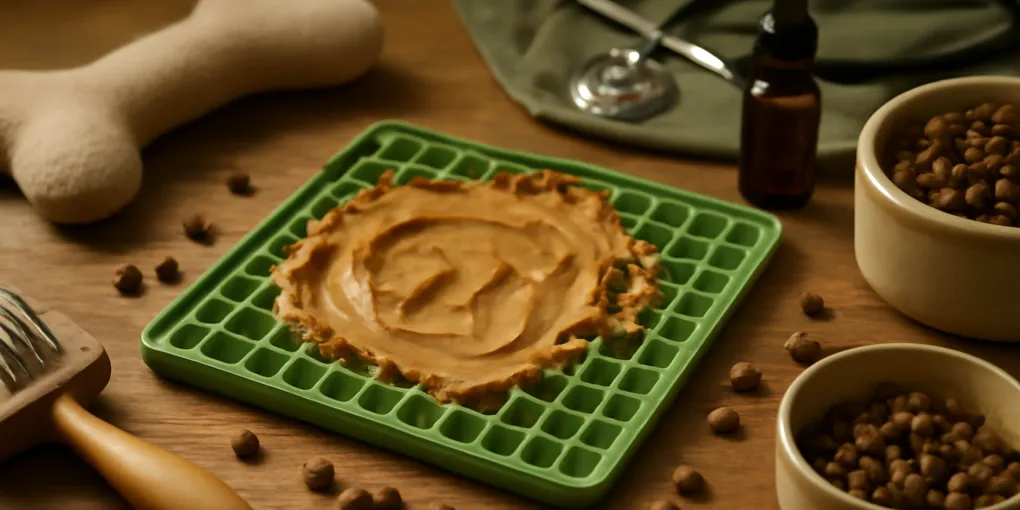
Introduce the mat on an ordinary calm day with a thin smear of wet food, pumpkin, or xylitol-free peanut butter. Start with a shallow LickiMat-style groove pattern for five minutes; move to a tougher SodaPup rubber mat only if the dog licks steadily without lifting corners or chewing the edge. Once the dog understands the setup, pair the mat with low-intensity versions of the event: brush in sight, one nail touched, crate door open, visitor sounds at low volume, or the empty bathtub before water is running.
Watch body language closely because the mat can mask stress if the food is too valuable. Good signs include soft eyes, steady licking, loose posture, and easy disengagement when you pick up the mat. Bad signs include freezing, whale eye, frantic licking, growling, guarding, pawing, chewing the silicone, or refusing the food. For bath-time suction mats such as Aquapaw-style products, remove the mat as soon as the spread is gone so the dog does not switch from licking to tearing at suction cups.
Clean the mat thoroughly after each session. Food residue in grooves can spoil, and dairy or wet food can become unhygienic quickly. Dishwasher-safe claims vary by model, so check the current label before using heat; if grooves still smell after washing, retire the mat instead of adding stronger spreads.
Extra practical checks
Wipe the mat immediately after use, then wash grooves before residue dries. Rotate easy spreads with meal portions so the mat remains a calm routine rather than a high-calorie event. If a dog begins guarding the mat, lifting edges, or chewing after food is gone, shorten the session and choose a sturdier format. For anxious dogs, the best progress usually comes from many boring repetitions: quiet room, easy food, short duration, and no forced handling. Over time the mat can predict nail-trim setup, bath towels, crate rest, or guest noise at a level the dog can still handle. Keep notes on which texture, spread, and location produce loose posture instead of frantic licking.
Before you buy or change the routine
Use a small trial before committing to a large purchase or permanent habit. Confirm the product dimensions, current label, cleaning instructions, return policy, and any warnings that apply to puppies, seniors, cats with medical conditions, dogs that chew, or multi-pet homes. Introduce one change at a time so you can tell whether the pet accepted the product or whether avoidance, odor, digestive upset, thirst changes, soreness, or stress appeared after the change. Keep the routine boring and repeatable: measure, observe, clean, and reassess. If the result depends on daily maintenance, choose the option you will actually maintain on a tired weekday, not the option that sounds most impressive in a product listing.
A sensible purchase also leaves room for veterinary judgment. Products can support comfort, hygiene, enrichment, or prevention, but they cannot diagnose pain, dental disease, urinary problems, orthopedic injury, panic, or heat illness. When signs change suddenly, when your pet avoids a normal routine, or when symptoms persist despite a cleaner setup, stop treating the product as the answer and get medical guidance.
Evidence notes and citations
Key sources used for this guide include veterinary and animal-welfare references rather than only manufacturer pages. Relevant sources include the American Veterinary Medical Association animal welfare resources at https://www.avma.org/resources-tools/animal-health-and-welfare/animal-welfare, AVMA warm weather pet safety guidance at https://www.avma.org/resources-tools/pet-owners/petcare/warm-weather-pet-safety, the American Animal Hospital Association dental care guidelines at https://www.aaha.org/resources/2020-aaha-dental-care-guidelines-for-dogs-and-cats/, Cornell Feline Health Center dental and house-soiling resources at https://www.vet.cornell.edu/departments-centers-and-institutes/cornell-feline-health-center, the Veterinary Oral Health Council at https://vohc.org/, International Cat Care litter tray advice at https://icatcare.org/advice/litter-trays/, and FDA pet safety warnings such as xylitol guidance at https://www.fda.gov/animal-veterinary/animal-health-literacy/paws-xylitol-its-dangerous-dogs. Product links in this article are shopping links with the site affiliate tag so readers can compare current labels, prices, sellers, and return policies before buying.
FAQ
Do lick mats actually calm anxious dogs?
They can help some dogs with mild situational stress by encouraging slow licking and positive associations. They are not a treatment for severe anxiety or panic.
Can I leave my dog alone with a lick mat?
No. Supervise use, especially with puppies, heavy chewers, and dogs who may swallow torn pieces.
What should I put on a lick mat?
Use dog-safe spreads such as wet food, plain yogurt, pumpkin, mashed banana, soaked kibble, or xylitol-free peanut butter.
Is a frozen lick mat better?
Frozen mats last longer, but beginners may find them frustrating. Start unfrozen, then try partial freezing.
Which texture is best?
Moderate grooves are best for most anxious dogs; shallow patterns suit beginners and deep patterns suit experienced calm lickers.
Bottom line
For best lick mats for anxious dogs, the best choice is the one that fits the animal in front of you: age, health, temperament, environment, and owner consistency matter more than a product headline. Use the PSR/G6 score as a decision aid, verify the current label before buying, and stop if your pet avoids the setup, seems painful, overheats, guards food, drinks less, or shows any medical red flag.
Practical owner notes
This recommendation depends on observation, consistency, and willingness to adjust when your pet gives feedback. Check the setup daily, keep records when a problem is changing, and do not ignore avoidance, pain, appetite change, drinking change, limping, overheating, guarding, or house-soiling. A product that looks convenient for people is only successful when it remains safe and acceptable for the animal.
Lick-mat fit check after two weeks
Keep the mat if the dog approaches it calmly, finishes without chewing the edges, and the routine makes one specific trigger easier: grooming setup, crate rest, bath entry, or quiet visitor practice. Change the texture or spread if the dog gives up quickly, guards the mat, vomits after rich toppings, or gains weight from uncounted calories. Skip the purchase entirely for destructive chewers unless you can supervise every session and remove the mat immediately.
Where to start with lick mats
For most anxious dogs, start with a simple silicone mat that has shallow grooves and a suction back, then size up only if the dog licks calmly without chewing the edge. Compare current LickiMat dog lick mat options for everyday calming work and Search Amazon for West Paw Toppl-style fillable dog toys if your dog needs a tougher food puzzle instead of a flat mat. For non-food enrichment, pair short lick sessions with the activity ideas in our dog heatstroke prevention guide on hot days rather than using food distraction to extend exercise.
Lick Mat Buying FAQ
Should an anxious dog use a lick mat unsupervised?
No. Use it while you can watch the dog, especially during the first sessions. Remove the mat if the dog flips it, chews the edge, guards it, or swallows food too quickly.
What texture is best for soft food?
Shallow grooves are easier for yogurt, wet food, or pumpkin. Deep nubs slow licking more but are harder to clean, so they fit calm lickers better than dogs that bite or scrape the mat.