Best Interactive Dog Toys for Mental Stimulation
We may earn a commission if you buy through our links.
Quick picks
| Product | Key Specs |
|---|---|
| See price on Amazon |
|
| See price on Amazon |
|
| See price on Amazon |
|
| See price on Amazon |
|
Best Interactive Dog Toys
Stuffed with food and frozen, it can keep many dogs busy far longer than a bowl meal. For dogs whose primary need is physical exercise rather than cognitive challenge, the Chuckit! Ultra Ball Launcher delivers superior exercise value at a similar price point.
TL;DR
- Best Mental Enrichment: KONG Classic — stuffable, freezable, power-chewer rated, universal breed appeal
- Best Exercise Toy: Chuckit! Ultra Ball Launcher — 140-ft throwing range, high-bounce natural rubber ball
- Best Advanced Puzzle: Nina Ottosson Dog Tornado Level 3 — rotating compartments, sustained problem-solving challenge
- Best Instinct Toy: Outward Hound Hide-A-Squirrel — hide-and-seek squeaker plush satisfies prey drive
- Key point: Dogs lose interest in the same toy with repeated play; switching toys can restore interest (Pullen et al., 2012, Anim Cogn, PMID: 22825035)
Mental stimulation matters for dogs — particularly for working, herding, and sporting breeds. Boredom can contribute to destructive chewing and excessive barking, and the right enrichment tool gives a dog something appropriate to do.
Why Interactive Toys Matter for Dog Behavior
Dogs are cognitive animals whose working and behavioral capacities were shaped by thousands of years of purposeful tasks — herding, retrieving, tracking, hunting. Many modern companion dogs have far fewer such tasks. Environmental enrichment, giving a dog appropriate ways to sniff, chew, forage, and solve problems, is a common part of veterinary behavior advice, and problem behaviors such as destructive chewing can have boredom as one contributor among many.
Interactive toys are one of the most accessible enrichment tools. Puzzle toys specifically engage problem-solving behavior; stuffable enrichment toys slow eating and extend feeding engagement; instinct toys (squeaker plush, hide-and-seek formats) tap into predatory behavioral sequences. A well-chosen toy gives your dog an appropriate outlet for these behaviors.
KONG Classic — Best Mental Enrichment
Best for: Daily mealtime enrichment, dogs with destructive boredom behaviors, households that want to replace bowl feeding with engaging alternatives
The KONG Classic is a long-standing, widely used enrichment toy. Its hollow rubber body can be stuffed with any combination of kibble, wet food, peanut butter (xylitol-free), canned pumpkin, or commercial KONG recipe pastes. Frozen overnight, a stuffed KONG takes much longer to empty than a bowl, turning a quick meal into a longer task.
The natural rubber compound comes in different strengths (red Classic, black Extreme for power chewers); pick the size and strength the maker lists for your dog and replace it when worn. The toy’s erratic bounce when tossed adds a physical play element that sustains interest beyond just the stuffed treat reward.
Limitation: The KONG requires preparation (stuffing, ideally freezing) that not all owners do consistently. Without stuffing it’s a basic chew toy — the enrichment value comes from the stuffed format. Power chewers who rapidly destroy standard red KONG should use KONG Extreme (black rubber, harder compound).
Chuckit! Ultra Ball Launcher — Best Exercise Toy
Best for: High-energy breeds, fetch-motivated dogs, owners with limited throwing endurance or shoulder concerns
The Chuckit! Ultra Ball Launcher addresses the primary limitation of manual fetch: throwing arm fatigue and limited throwing range. The launcher extends maximum throwing distance to approximately 140 feet, allowing sustained fetch sessions without repetitive strain on the owner’s shoulder. The included Ultra Ball uses natural rubber with a high-visibility orange coating that dogs and owners can track across grass and low-light conditions.
The Ultra Ball is made for fetch, not as a dedicated chew toy, and should be removed when not in active play. Replacement Ultra Balls are widely available and interchangeable with the Chuckit! launcher system.
Ball-driven breeds (Labrador Retrievers, Golden Retrievers, Australian Shepherds, Border Collies) get longer runs per throw, which suits dogs that need a lot of exercise. Build up session length gradually, and avoid long sessions in heat or for dogs with joint problems.
Limitation: The Chuckit! launcher requires outdoor space for maximum effectiveness. For indoor or small-space play, the throwing range is excessive. This toy meets physical exercise needs but provides minimal cognitive enrichment — pair with a puzzle toy for full daily enrichment coverage.
Nina Ottosson Dog Tornado Level 3 — Best Advanced Puzzle
Best for: Cognitively advanced dogs, working breeds, dogs that solve Level 1–2 puzzles in under 5 minutes
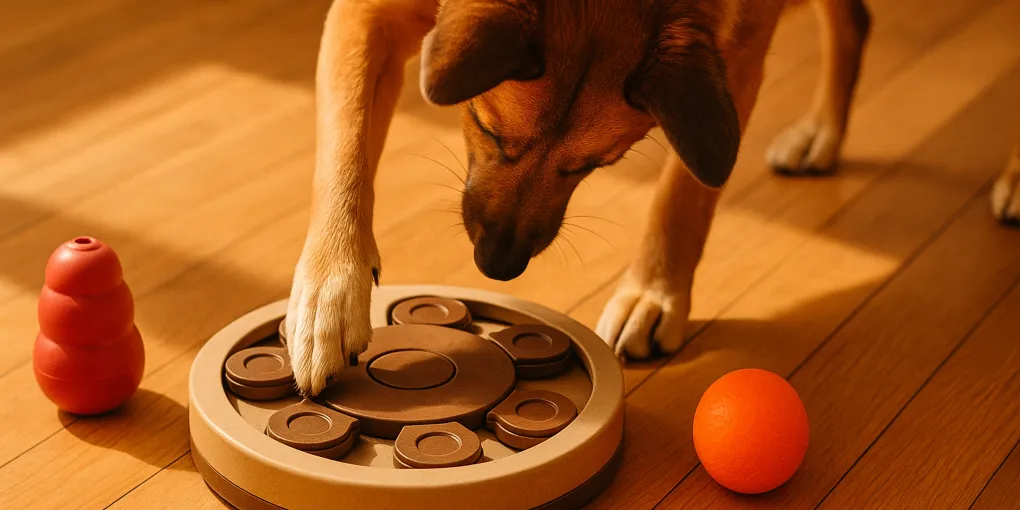
The Nina Ottosson Dog Tornado is a rotating compartment puzzle toy with three stacked discs that rotate independently. Treats are hidden in compartments across all three levels; the dog must learn to rotate each disc to expose the treat compartments, then nose or paw the treat out. The Level 3 rating reflects a complexity that many dogs require multiple sessions to solve — genuinely sustainable challenge.
The toy is made of hard plastic. It is not a chew toy — dogs that chew puzzle toys rather than problem-solve them will damage the plastic, so supervise and remove broken pieces. The Nina Ottosson line is a Swedish brand sold via Outward Hound in North America.
Limitation: The complexity that makes this toy valuable for advanced dogs makes it frustrating and discouraging for beginners. Dogs new to puzzle toys should start with Level 1 (Nina Ottosson Dog Brick) and progress. The Tornado should not be introduced until the dog has demonstrated confident engagement with simpler puzzles. Additionally, some dogs learn to flip or knock the entire toy rather than solve it — this behavior can be managed by placing the toy on a nonslip mat.
Outward Hound Hide-A-Squirrel — Best Instinct Toy
Best for: Scent-driven dogs, breeds with strong prey drive (Beagles, Dachshunds, Terriers), supervised play sessions
The Hide-A-Squirrel is a plush enrichment toy that taps into dogs’ natural hide-and-seek and prey-drive behaviors. The large plush log holds 3–6 plush squeaker squirrels (depending on size variant); the dog removes and interacts with the squirrels to complete the predatory sequence. Unlike puzzle toys, there’s no specific mechanical solution — the engagement is instinctual rather than cognitive.
Dogs with strong prey drive often take to it quickly. Novelty matters, so rotating the squirrels back in after play sessions extends the enrichment value.
Critical safety note: This is a supervised-use toy only. The plush and squeaker components are not designed for sustained unsupervised chewing. Ingestion of batting or squeaker parts is an aspiration and GI obstruction risk. The toy should be stored when unsupervised.
How to Build a Dog Enrichment Rotation
No single toy sustains engagement indefinitely. Dogs habituate to stimuli — for example, a toy that holds a dog’s interest for a long session when new may get only a brief look after a week of daily use (an illustration, not a study result). Pullen, Merrill and Bradshaw (2012, Anim Cogn, PMID: 22825035) repeatedly offered 16 kennel-housed Labradors the same toy in 30-second periods until they stopped playing with it; a different toy then renewed play, which they attributed to habituation to the toy as a whole.
A practical enrichment rotation for most dogs:
- Daily: One KONG stuffed and frozen as mealtime replacement — this never gets boring because the treats change
- Every other day: Puzzle toy session (Nina Ottosson or equivalent) — 10–15 minutes
- As needed: Physical toy (Chuckit! ball launcher, rope toys) — as exercise motivation dictates
- Weekly rotation: Plush/instinct toys (Hide-A-Squirrel) — reintroduce after 7–10 days for renewed engagement
Introducing novelty (new toys on rotation, new treat combinations in KONG, different puzzle difficulties as the dog advances) maintains the enrichment value of the same toy library over months.
Frequently Asked Questions
How much mental stimulation do dogs need per day?
There is no fixed daily requirement. As general guidance, many owners plan a short enrichment session each day, such as a stuffed food toy or a 10–15 minute puzzle session, alongside physical exercise. Needs vary by dog — energetic working and herding breeds often need more. Boredom can contribute to problem behaviors like destructive chewing, but these behaviors have many causes, so ask your veterinarian or a qualified behaviorist if they persist.
What is the difference between a puzzle toy and an enrichment toy?
Puzzle toys require dogs to solve a specific mechanical problem to access a reward (move a slider, rotate a compartment, lift a flap). Enrichment toys engage the dog’s natural behavioral drives — sniffing, chewing, chasing — without a specific problem to solve. Puzzle toys build sustained cognitive engagement; enrichment toys satisfy instinctual needs. Many owners use both. KONG stuffed and frozen toys are enrichment toys; Nina Ottosson toys are puzzle toys.
Are rubber or plastic dog toys safer?
Natural rubber toys (KONG, West Paw) and hard ABS plastic (Nina Ottosson puzzle toys) are both considered safe materials for most dogs when used as directed. The key safety variable is chew strength: rubber toys rated for power chewers (KONG Extreme black rubber) are appropriate for aggressive chewers; standard rubber and ABS plastic can fracture under high-force chewing. Plush toys should be supervised to prevent ingestion of batting and squeaker components.
What interactive dog toy is best for a high-energy breed?
The Chuckit! Ultra Ball Launcher is the best interactive toy for high-energy breeds requiring significant physical exercise (Labrador Retriever, Border Collie, Australian Shepherd, Vizsla). For indoor mental engagement, the Nina Ottosson Dog Tornado Level 3 challenges high-drive dogs with a complex puzzle that most dogs don’t solve immediately. Rotating between physical and cognitive toys across the week adds variety.
How do I introduce a puzzle toy to a dog that ignores it?
Start with the easiest difficulty level available and prime the toy with high-value treats your dog already loves (small pieces of freeze-dried meat, not just kibble). Hold the toy in your hand and let the dog watch you place the treats inside — this builds association between the toy and reward. Dogs that ignore a puzzle toy often need more motivating rewards or an easier difficulty level to start.
Bottom Line
The KONG Classic remains the best interactive dog toy for most dogs — it combines a durable design, food-stuffing versatility, and broad appeal across breeds and ages. The Chuckit! Ultra Ball Launcher is the appropriate top pick for dogs whose primary enrichment need is physical exercise through sustained fetch.
For households with cognitively advanced dogs seeking dedicated puzzle challenge, the Nina Ottosson Dog Tornado Level 3 delivers genuine mental work. And the Outward Hound Hide-A-Squirrel provides supervised prey-drive engagement that cognitive and physical toys don’t replace.
A well-built enrichment rotation using 2–3 toy types, rotated by day and week, keeps interactive play fresh over the long term. Always consult your veterinarian about your specific dog’s enrichment needs, especially for dogs with anxiety, aggression, or mobility limitations.