Quick picks
| Product | Key Specs |
|---|---|
| See price on Amazon |
|
| See price on Amazon |
|
| See price on Amazon |
|
Product availability, certifications, and retailer details can change; check the current Amazon page before buying.
Quick verdict
A cat fountain is only a hydration aid if it stays clean enough that the cat keeps using it. The weekly routine below focuses on the parts that usually fail first: slimy pump housings, mineral scale around the spout, forgotten pre-filters, and bowls that look clean from above while residue collects underneath. If a fountain cannot be fully disassembled, scrubbed, rinsed, and dried by an ordinary caregiver, it should not be treated as a low-maintenance health product.
This protocol is for routine home hygiene, not for diagnosing thirst, urinary disease, kidney disease, diabetes, vomiting, or sudden appetite changes. If a cat drinks dramatically more or less than usual, strains in the litter box, urinates outside the box, hides, loses weight, or seems painful, call a veterinarian before shopping for a different fountain.
How we evaluated the options
| Factor | Weight | Protocol standard | Practical pass/fail |
|---|---|---|---|
| Research | 30% | Supports normal drinking access without replacing veterinary care | Keep multiple water stations and track behavior changes. |
| Evidence Quality | 25% | Separates hygiene principles from product marketing | Biofilm and debris risk are plausible; hydration cures are not proven. |
| Value | 20% | Uses simple tools and realistic replacement intervals | If filters or brushes are hard to buy, long-term value drops. |
| User Signals | 15% | Accounts for common owner failure points | Pump noise, slime, and fussy reassembly are the recurring complaints. |
| Transparency | 10% | Requires visible materials, parts, and cleaning instructions | Hidden seams and vague filter claims score poorly. |
Supplies to keep next to the fountain
Keep a small caddy so cleaning does not depend on motivation. Useful supplies include an unscented dish soap, a bottle brush, a narrow straw brush for spouts, a soft toothbrush for corners, spare filters, a clean towel, and a notebook or phone reminder for filter dates. Avoid strong fragrance, abrasive pads that scratch plastic, and disinfectants unless the manufacturer and veterinarian both support the exact product and rinse process.
Stainless steel and ceramic bowls are often easier to inspect for residue than dark plastic, but material alone is not a guarantee. A stainless bowl with a complicated pump channel can be harder to maintain than a simple plastic bowl that fully opens. The maintenance question is not what looks premium in a product photo; it is whether every wet surface can be reached.
Daily two-minute check
Each day, look before refilling. Confirm the water is clear, the surface is free of hair and food crumbs, the pump sound is normal, and the flow pattern has not weakened. Top off with fresh water, but do not treat topping off as cleaning. Topping off dilutes debris; it does not remove slime from the pump cavity or bowl edges.
Watch the cat as well as the fountain. A cat that suddenly avoids the device, paws at it, drinks only from sinks, or hovers without drinking may be telling you that noise, location, smell, or whisker contact has changed. Put a plain water bowl beside the fountain during any troubleshooting so the cat never has to choose between stress and thirst.
Weekly deep-clean sequence
Unplug the fountain first. Empty the reservoir, remove the bowl, lift out the pump, and remove every filter or foam insert. Photograph the order of parts the first time if the manual is confusing. Many owners under-clean fountains because reassembly is annoying; a thirty-second reference photo prevents that failure point.
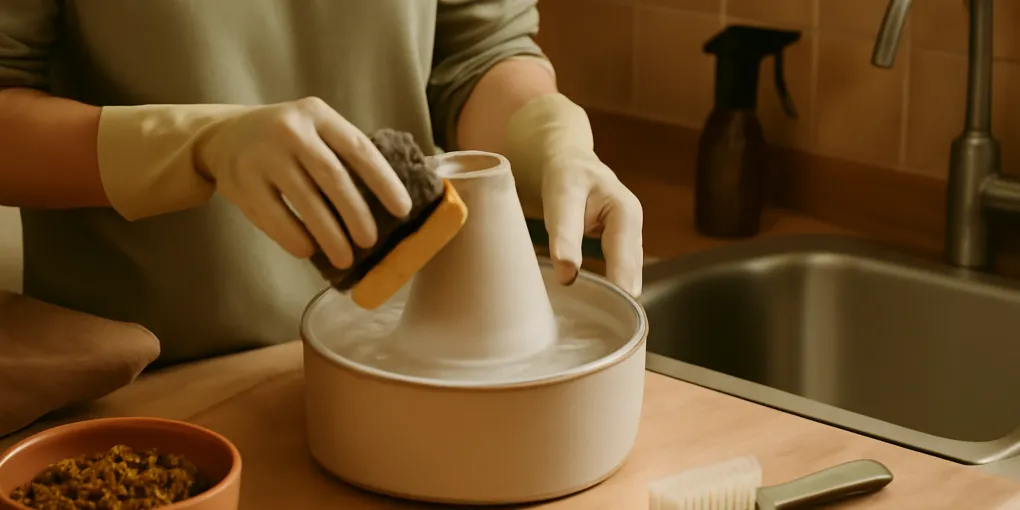
Wash the bowl and reservoir with warm water and mild soap. Scrub the waterline, spout, underside of the lid, and any molded corners. Open the pump cover and impeller chamber if the manual allows it. This is where hair, slime, and mineral grit often collect even when the bowl looks fine. Rinse until there is no soap smell, then dry exposed parts with a clean towel before refilling.
Inspect filters rather than blindly trusting the calendar. A carbon filter that is slimy, discolored, clogged with hair, or slowing flow should be replaced. A foam pre-filter that traps food particles needs rinsing or replacement according to the manual. Filters are not a substitute for washing hard surfaces; they are consumable parts in a cleaning system.
Monthly audit
Once a month, do a slower inspection. Check the cord for chewing, the pump for heat or rattling, the bowl for scratches, the gasket for trapped residue, and the base for moisture underneath. Look at the area around the fountain too. Damp mats, spilled kibble, and dusty corners can make a clean fountain less appealing.
Use this audit to decide whether the device still fits the household. If the fountain requires twenty minutes of fiddly work every week and the caregiver keeps postponing it, the safer choice may be a simpler bowl plus more frequent water changes. Consistency beats a feature list that collapses in real life.
Location and acceptance rules
Cats often prefer water away from food and away from noisy appliances. Put the fountain where the cat can approach without being cornered by dogs, children, or other cats. In multi-cat homes, one fountain rarely solves resource competition; multiple water stations reduce conflict and make it easier to notice which cat changed behavior.
Introduce a cleaned fountain gradually after any big change in pump, filter, or location. Keep the old bowl available. If the cat avoids the fountain for more than a short adjustment period, do not remove the backup bowl to force use. Forced scarcity can reduce drinking and increase stress.
Product notes and buying links
| Check price | Product type | Best fit | Hygiene warning |
|---|---|---|---|
| Search Amazon | Stainless open-basin fountain | Caregivers who want visible residue and dishwasher-safe parts | Pump still needs hand cleaning |
| Search Amazon | Ceramic fountain | Cats sensitive to plastic odors or scratches | Heavy parts can chip; inspect glaze |
| Search Amazon | Simple pump fountain with pre-filter | Homes with hair or dust near the bowl | Pre-filter clogs quietly and reduces flow |
| Search Amazon | Plain wide water bowl backup | Every household using a fountain | Must still be washed daily |
Compare current sizing, materials, seller details, and return policies before buying.
Common mistakes
The first mistake is cleaning only the bowl. Pumps and spouts are wet, warm, and narrow, which makes them ideal places for residue to hide. The second mistake is replacing filters but not scrubbing surfaces. A filter may improve taste or catch debris, but it cannot sanitize scratched plastic or a dirty pump chamber. The third mistake is moving the fountain to a convenient human location that the cat dislikes.
Do not use a fountain to explain away medical signs. More drinking can be normal in hot weather or after diet changes, but a major change in thirst or urination deserves veterinary attention. Less drinking after a fountain change may mean the product is less acceptable, not that the cat needs less water.
Bottom line
A cat water fountain is a maintenance commitment. Choose a model that opens fully, uses obtainable filters, has reachable wet surfaces, and can be cleaned on a schedule your household will actually follow. Keep a backup bowl, watch the cat’s behavior, and treat any sudden drinking or litter-box change as a health signal rather than a product problem.
Troubleshooting weak flow
Weak flow usually has a simple cause: low water, a clogged pre-filter, hair around the impeller, mineral scale in the spout, or a pump that was not seated correctly after washing. Work through those possibilities before assuming the fountain has failed. Unplug it, disassemble it, rinse the filter if the manual allows, and clean the impeller chamber with a small brush.
If flow improves for only a day or two after cleaning, the local water supply may be leaving mineral buildup quickly, the filter may be saturated, or the pump may be wearing out. In hard-water homes, owners often need a shorter cleaning interval than the marketing copy suggests. The cat’s behavior is the final judge: a quiet, full fountain is not succeeding if the cat avoids it.
Multi-cat and senior-cat adjustments
Multi-cat homes need redundancy. One fountain in a contested hallway can create subtle blocking even when nobody fights. Place water in more than one social zone, including at least one plain bowl. Watch whether a timid cat drinks only when another cat is asleep; that pattern means the resource layout needs improvement.
Senior cats may prefer low bowls, quiet pumps, and stable footing. Arthritis can make a tall basin or slippery mat less acceptable. If a senior cat changes drinking, litter-box use, appetite, or grooming, treat that as health information and schedule veterinary care rather than assuming the fountain is the cause.
Related Pet Science Review guides
For a broader water-product overview, see how to clean a pet water fountain. For cats using automated feeding equipment, see how to introduce a cat to an automatic feeder.
FAQ
What cleaning cadence keeps cat-fountain biofilm down?
Use a daily visual check and a weekly deep clean as the default. Clean sooner if you see slime, hair, food crumbs, odor, weak flow, or pump noise.
Are filters enough to keep the fountain clean?
No. Filters can catch debris or improve taste, but they do not scrub biofilm from the bowl, pump, spout, or seams.
Should I remove the old water bowl?
Not during transition. Keep a familiar plain bowl available so the cat always has low-stress water access.
What would make us replace a fountain
Replace a fountain when scratches, cracks, pump heat, persistent odor, unavailable filters, or impossible-to-clean seams make routine hygiene unreliable. A product does not have to fail electrically to be finished. If you dread cleaning it, the cat is depending on a system that will eventually be skipped.
Review cadence
Recheck the setup after the novelty period ends. Many pet products look successful on day one because the animal is curious and the caregiver is attentive. The more useful test is week three, when the product has been washed several times and the routine has become ordinary. If cleaning is slipping, replacement parts are annoying, or the animal uses the item less than expected, simplify the setup before small problems become normal.
Keep notes short: date, cleaning done, animal response, damage, and any health signs. Those notes help separate product problems from medical or behavior changes that need professional support.
Sources
- American Veterinary Medical Association. Pet care and preventive care resources. https://www.avma.org/resources-tools/pet-owners
- AAHA. Nutrition, pain, senior care, and preventive health guidance. https://www.aaha.org/resources/
- WSAVA Global Nutrition Committee. Nutrition toolkit. https://wsava.org/global-guidelines/global-nutrition-guidelines/
- Cornell Feline Health Center. Cat health and behavior resources. https://www.vet.cornell.edu/departments-centers-and-institutes/cornell-feline-health-center
- AAFP/ISFM. Environmental needs guidelines for cats. https://journals.sagepub.com/doi/10.1177/1098612X13477537
- Merck Veterinary Manual. Rabbit and small mammal care references. https://www.merckvetmanual.com/
- House Rabbit Society. Hay, housing, and health education. https://rabbit.org/