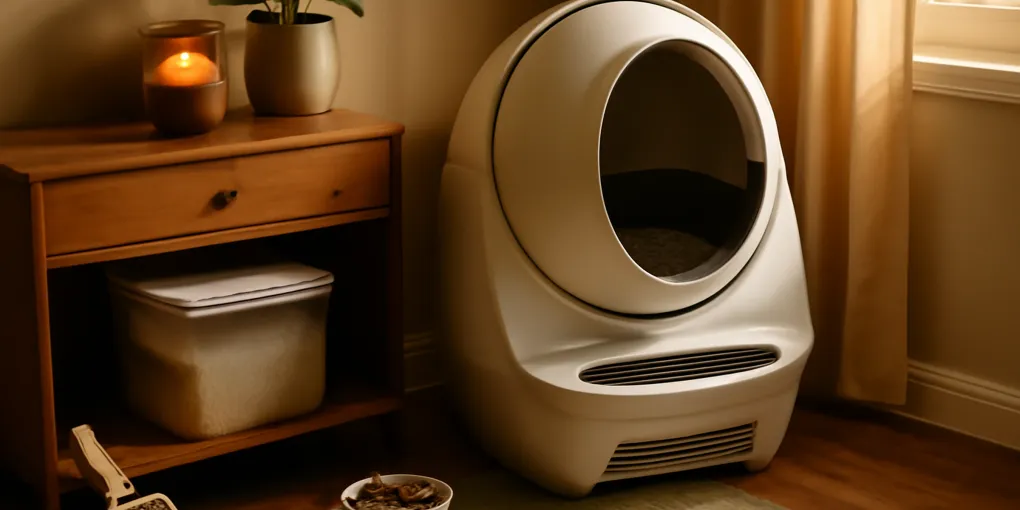
Do Automatic Litter Boxes Reduce Odor? Evidence, Trade-Offs, and Safety Checks
Evidence ExplainerQuick picks
| Product | Key Specs |
|---|---|
| See price on Amazon |
|
| See price on Amazon |
|
| See price on Amazon |
|
Product availability, certifications, and retailer details can change; check the current Amazon page before buying.
Quick answer
Automatic litter boxes can reduce one specific kind of odor: waste that sits uncovered because nobody scooped promptly. They do not remove the need for appropriate litter depth, enough boxes, ventilation, waste-bin emptying, sensor checks, or cat acceptance. In some homes they make odor better; in others they simply move the smell into a sealed drawer that becomes unpleasant when opened.
The best evidence-informed position is cautious. A self-cleaning box is a convenience tool, not a medical or behavior solution. If a cat avoids the box, urinates outside it, strains, cries, produces blood, hides, or changes elimination frequency, the next step is veterinary care and litter-box troubleshooting, not a more expensive robot.
How we evaluated the options
| Factor | Weight | What matters for odor claims | Practical takeaway |
|---|---|---|---|
| Research | 30% | Matches feline environmental-needs guidance | Cats need acceptable, accessible boxes more than automation. |
| Evidence Quality | 25% | Separates owner convenience from measured odor control | Marketing claims are weaker than observed cleaning and ventilation. |
| Value | 20% | Includes bags, liners, litter compatibility, and repair risk | High upfront cost only pays off if the cat uses it daily. |
| User Signals | 15% | Tracks repeated complaints: noise, drawer smell, sensor faults | Owner reviews are useful for failure patterns, not clinical proof. |
| Transparency | 10% | Clear safety limits, dimensions, weight ranges, and parts | Vague safety language or hidden consumable costs lower confidence. |
Where odor actually comes from
Litter odor is not one problem. Fresh feces smell different from ammonia-like urine odor, and both are affected by litter type, box size, airflow, humidity, diet, health, and cleaning frequency. Automation mainly shortens the time between deposit and removal. That can help with fecal odor and with urine clumps that would otherwise sit in the open.
However, odor can also come from dirty rake tracks, a waste drawer that is not emptied, a carbon filter that is saturated, urine that misses the clump area, or litter dust collecting inside the mechanism. A robot can hide those sources until the weekly clean, which is why some owners report that the room smells better while the drawer smells worse.
Cat acceptance decides whether odor improves
A perfectly engineered box is useless if the cat avoids it. Cats may dislike a small entry, tall step, moving rake, delayed cycling noise, tight interior, unstable ramp, covered-box feel, or a location that traps them. Older cats, kittens, large cats, anxious cats, and cats with arthritis may need easier access than the product photo suggests.
Introduce the automatic box as an additional box, not a replacement. Keep the familiar box in place until the cat uses the new one reliably. If the cat stops using any box normally, go back to basics: clean large boxes, quiet locations, appropriate litter, and veterinary evaluation for urinary or gastrointestinal signs.
Safety checks before buying
Confirm the manufacturer’s minimum weight, age, and size limits. Check whether the cycle can be delayed long enough for cautious cats and whether sensors stop movement reliably. Read the manual before purchase if available. Look for instructions on unplugging, deep cleaning, stuck waste, sensor errors, and what happens after a power outage.
Avoid products with unclear pinch-point protection, vague sensor descriptions, or no accessible cleaning path. A self-cleaning mechanism lives around urine, litter dust, and feces; if the design cannot be cleaned, odor control will degrade.
Maintenance reality
Most automatic boxes still need daily visual checks. You should confirm that the cat used the box, that waste moved correctly, that the drawer is not full, and that no clumps are stuck to the rake, globe, or track. Waste drawers often need emptying before the app or indicator says so, especially in multi-cat homes.
Weekly work usually includes wiping sensors, removing residue, checking mats and ramps, and cleaning the drawer area. Monthly work may include deeper disassembly. If the household will not do that, a large manual box scooped twice daily may smell better and be safer.
Product categories and buying links
| Check price | Category | Best fit | Odor limitation |
|---|---|---|---|
| Search Amazon | Rotating globe boxes | Owners willing to pay for automation and app monitoring | Drawer odor and large footprint remain |
| Search Amazon | Rake-style boxes | Cats comfortable with open trays and gradual movement | Rake tracks can collect residue |
| Search Amazon | Disposable-tray systems | Homes prioritizing low scrubbing | Consumables can be costly and wasteful |
| Search Amazon | Large manual box plus metal scoop | Cats who dislike machines or need easy access | Requires consistent scooping |
Compare current sizing, materials, seller details, and return policies before buying.
When automation is worth considering
Automation is most defensible when the cat already uses boxes reliably, the household struggles with prompt scooping, the chosen model fits the cat’s body, and the caregiver is willing to monitor the machine. It can also help owners notice changes if the app records visits accurately, though app data should never replace clinical judgment.
It is less defensible when the cat has active litter-box avoidance, the home lacks space for a large accessible unit, the budget cannot absorb repairs and consumables, or the owner expects the machine to eliminate all smell. In those cases, the money may be better spent on more boxes, better placement, veterinary care, or improved ventilation.
Bottom line
Automatic litter boxes can reduce odor from delayed scooping, but they are not odor-proof and not cat-proof. The evidence-informed purchase question is: will this specific cat use this specific box, and will this household clean the machine before hidden residue becomes the new odor source? If the answer is uncertain, keep a manual box available and treat automation as a trial, not a cure.
The odor test to run before upgrading
Before spending hundreds of dollars, run a seven-day manual-box test. Scoop at least twice daily, wash the box if residue remains, add a second box if the household has one box for multiple cats, and improve airflow without placing the box in a frightening location. If odor improves substantially, the main problem was likely cleaning interval, box count, or ventilation. Automation may help maintain that routine, but it is not the only solution.
If odor persists despite prompt scooping, look for other causes: old plastic holding smell, urine outside the box, litter that does not clump well for that cat’s output, a covered box trapping humidity, or medical issues changing urine or stool odor. A machine that cycles waste into a drawer will not fix those root causes.
App data and health monitoring
Some automatic boxes record visit frequency or weight. That can be useful as an early warning, but the data can be noisy. Multi-cat homes may confuse identities, cats may enter without eliminating, and a sensor error may look like a behavior change. Use app trends as a prompt to observe and call the veterinarian, not as a diagnosis.
Owners should still look at waste. Color, stool consistency, clump size, blood, diarrhea, and constipation clues can be missed when waste disappears quickly into a drawer. Convenience should not remove the caregiver from daily health monitoring.
Related Pet Science Review guides
For product-specific context, see our Litter-Robot 4 review for multi-cat homes and Litter Genie Easy Roll review. For box setup basics, see how to set up a rabbit litter box as a reminder that species-appropriate placement and cleaning come before gadgets.
FAQ
Do automatic litter boxes eliminate odor?
No. They can reduce odor from waste sitting in the open, but drawer maintenance, litter choice, ventilation, and cat health still matter.
Are self-cleaning boxes safe for kittens?
Follow the manufacturer’s age and weight limits. Many units are not appropriate for very small kittens, and any moving mechanism requires caution.
Should I replace every manual box?
No. Keep at least one acceptable manual option during transition, and keep backups if the cat is cautious, senior, ill, or living with other cats.
Apartment and small-space considerations
In a small apartment, odor control depends heavily on placement. A self-cleaning box in a closet may hide the unit but trap humidity and drawer smell. A box near the kitchen may be convenient to empty but unacceptable for hygiene and comfort. Choose a location with airflow, privacy, and enough room for the cat to enter and exit without feeling ambushed.
Noise matters more in small spaces too. A cycle that sounds mild during the day can startle a cat at night. If the unit allows cycle delays, use them during introduction. If the cat runs away every time the rake or globe moves, pause automation and rebuild confidence slowly.
What would make us skip a model
We would skip models with unclear sensor behavior, no manual available before purchase, cramped interior dimensions, hard-to-clean waste paths, or proprietary consumables that make the real cost unpredictable. We would also be cautious with units that require a specific litter if the cat already has a strong litter preference.
The strongest product pages show dimensions, cat size limits, cleaning videos, replacement part prices, and safety instructions plainly. If those details are hidden until after checkout, transparency is weak. Odor control is not just about the first week; it is about whether the machine can be maintained for years.
Final pre-purchase checklist
Before buying, write down the animal’s current routine, the problem you are trying to solve, and the maintenance you are willing to do every week. Confirm dimensions, materials, cleaning instructions, return terms, and replacement-part availability from the seller page or manufacturer. Save the manual, inspect the product on arrival, and introduce it while the household is calm.
After seven days, keep the product only if the animal uses it comfortably and the caregiver can maintain it without skipped steps. If the product creates avoidance, chewing, guarding, difficult cleaning, or reduced access to food, water, litter, or hay, the better decision is to return it and use a simpler setup.
Review cadence
Recheck the setup after the novelty period ends. Many pet products look successful on day one because the animal is curious and the caregiver is attentive. The more useful test is week three, when the product has been washed several times and the routine has become ordinary. If cleaning is slipping, replacement parts are annoying, or the animal uses the item less than expected, simplify the setup before small problems become normal.
Keep notes short: date, cleaning done, animal response, damage, and any health signs. Those notes help separate product problems from medical or behavior changes that need professional support.
Sources
- American Veterinary Medical Association. Pet care and preventive care resources. https://www.avma.org/resources-tools/pet-owners
- AAHA. Nutrition, pain, senior care, and preventive health guidance. https://www.aaha.org/resources/
- WSAVA Global Nutrition Committee. Nutrition toolkit. https://wsava.org/global-guidelines/global-nutrition-guidelines/
- Cornell Feline Health Center. Cat health and behavior resources. https://www.vet.cornell.edu/departments-centers-and-institutes/cornell-feline-health-center
- AAFP/ISFM. Environmental needs guidelines for cats. https://journals.sagepub.com/doi/10.1177/1098612X13477537
- Merck Veterinary Manual. Rabbit and small mammal care references. https://www.merckvetmanual.com/
- House Rabbit Society. Hay, housing, and health education. https://rabbit.org/