Do Puzzle Feeders Help Indoor Cats? Evidence, Setup, and Best First Picks
Evidence ExplainerQuick picks
| Product | Key Specs |
|---|---|
| See price on Amazon |
|
| See price on Amazon |
|
Product availability, certifications, and retailer details can change; check the current Amazon page before buying.
Do Puzzle Feeders Help Indoor Cats? Evidence, Setup, and Best First Picks
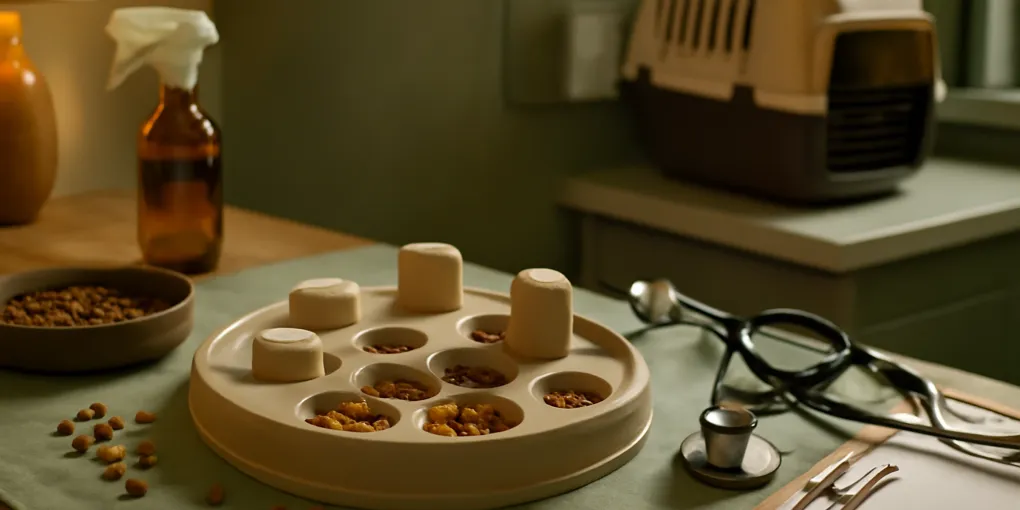
Puzzle feeders can help indoor cats when they are introduced gradually and matched to the cat’s confidence level. The best-supported benefit is not instant weight loss; it is environmental enrichment. Food puzzles make a cat work, search, paw, lick, or manipulate objects for part of the daily ration, which can reduce boredom and slow rapid eating for some cats.
The mistake is buying the hardest puzzle first. A frustrated cat does not become enriched; it walks away hungry or begs harder. Start with a visible, easy puzzle such as a food tree or shallow slow feeder, then increase difficulty only when the cat is succeeding. For a complete enrichment layout, pair feeders with vertical space, hiding places, and play routines from our indoor cat puzzle feeder plan.
Best first options
- Search Amazon for Catit Senses 2.0 Food Tree if your cat will paw at visible kibble and you want an easy-to-understand starter puzzle.
- Search Amazon for Doc and Phoebe Indoor Hunting Cat Feeder if your cat already explores and you want multiple small hunting-style feeders.
- Search Amazon for cat slow feeder wet food mat for cats who eat wet food and need a licking or shallow maze format instead of dry-kibble toys.
What the evidence actually supports
Peer-reviewed veterinary behavior literature and feline welfare guidance support food puzzles as a practical enrichment tool. The strongest argument is behavioral: domestic cats are built to perform repeated short hunting sequences, but indoor feeding often delivers calories in one motion from a bowl. A puzzle feeder restores part of the seeking and manipulation phase without requiring live prey or unsafe outdoor access.
Clinical reports describe food puzzles as useful in cases involving obesity management, anxiety-related behavior, destructive attention-seeking, and rapid eating. That does not mean the feeder itself treats disease. It means the feeder can be one part of an environmental plan when the owner also controls calories, protects rest areas, and provides predictable play.
Puzzle feeders are most defensible when the cat can succeed quickly. Early success matters because cats are less tolerant of failed tasks than many dogs. A transparent feeder with visible food usually works better for beginners than a closed puzzle that hides the reward completely. Senior cats and cats with arthritis may need lower feeders, wider openings, and fewer rolling toys.
PSR G6 Composite Score for cat puzzle feeders
| Factor | Weight | Score | Weighted contribution |
|---|---|---|---|
| Research fit | 30% | 4.3 | 1.29 |
| Evidence quality | 25% | 4.1 | 1.03 |
| Value | 20% | 4.2 | 0.84 |
| User signals | 15% | 4.0 | 0.60 |
| Transparency | 10% | 4.4 | 0.44 |
| Composite | 100% | 4.2/5 |
The score is not a medical claim. It reflects how well the product category or protocol maps to veterinary guidance, owner execution, replacement costs, and avoidable risk. A high score means the purchase or routine has a clear job and a low chance of causing new problems when used as directed. It does not mean every pet should use it or that it replaces veterinary care.
Choosing the right puzzle style
Visible vertical puzzles such as food trees let the cat see kibble and paw it down through levels. They are good for curious cats, kittens, and owners who want easy cleaning. The downside is noise and spill. Put the feeder on a washable mat and start with large enough pieces that do not wedge in corners.
Hunting-style mice or pods divide the ration into several objects placed around the home. They better imitate searching, but they require training. Start with the pod open near the usual feeding station, then gradually hide it in easy locations. Do not scatter pods where another pet can steal them or where the cat may be ambushed.
Wet-food lick mats and shallow mazes are better for cats who eat canned diets. They slow licking and add texture without forcing dry kibble. Choose silicone that is food-grade, dishwasher-safe, and not deeply grooved enough to trap residue. Replace mats that become chewed or rough.
Rolling balls are best for confident, active cats in homes with hard floors. They can be frustrating on thick carpet and may roll under furniture. Avoid tiny openings that make the reward too rare. The cat should get a few wins within the first minute.
A seven-day introduction plan
Day 1: place the new puzzle beside the normal bowl with a few favorite treats visible. Let the cat investigate without hunger pressure.
Day 2: put ten percent of the meal in the puzzle and the rest in the bowl. Help once if needed by moving one piece of food.
Day 3: increase to twenty-five percent if the cat succeeded. If not, make the puzzle easier by removing a lid or using shallower openings.
Days 4 and 5: use the puzzle for one small meal or snack. Keep sessions short. Pick the feeder up after twenty minutes so stale food does not become normal.
Day 6: move the puzzle one or two feet from the usual feeding location. This begins the search component without making the task hard.
Day 7: decide whether to advance. If the cat approaches eagerly and solves it, add a second location or a slightly harder setting. If the cat hesitates, stay at the current level for another week.
Weight management: useful, but not enough alone
Puzzle feeders can slow eating and make a measured ration last longer, but they do not create a calorie deficit by themselves. Owners sometimes pour extra kibble into a puzzle because the cat seems more active. That defeats the point. Measure the day’s food first, then allocate part of it to the puzzle.
For overweight cats, ask your veterinarian for a target weight, calorie plan, and safe rate of loss. Rapid weight loss is dangerous for cats. The feeder can support the plan by reducing begging and adding activity, but the ration still controls weight. If the cat is on a prescription diet or has diabetes, kidney disease, dental pain, or nausea, get veterinary guidance before changing feeding patterns.
Cleaning and safety checks
Food puzzles are food-contact surfaces. Wash them as often as you wash bowls, and more often if wet food is used. Inspect for cracks, chewed plastic, and loose pieces. If a toy has removable parts small enough to swallow, supervise or choose a simpler design. Multi-cat homes need special attention because one confident cat can monopolize all puzzles. Use separated rooms or multiple stations so timid cats still eat.
Avoid puzzles that require the cat to insert its head into a narrow container, force whiskers against tight sides, or fish food from a sharp edge. Also avoid heavy ceramic puzzles that can trap paws. A good puzzle should make eating slower and more interesting, not physically awkward.
Matching the feeder to the cat’s personality
A bold, food-motivated cat can start with a visible tower or rolling dispenser because the reward appears quickly and the movement is interesting. A cautious cat should start with a shallow tray or lick mat where the food is obvious. The shy cat’s first lesson should be, “this new object pays,” not “my dinner disappeared into a machine.”
A cat that wakes the household at dawn may benefit from a small hunting-style feeder placed the night before, but only after the cat has learned the device during supervised daytime sessions. A cat that raids another pet’s food needs separated feeding first; a puzzle feeder will not fix resource access if the wrong animal can eat the ration.
Senior cats need low-effort success. Choose wide openings, stable bases, and locations near preferred resting spots. If the cat has dental pain, arthritis, kidney disease, or nausea, refusal of a puzzle may be a health signal rather than stubbornness. The feeder should adapt to the cat, not the other way around.
How to judge success after two weeks
Success is not measured by how clever the puzzle looks. It is measured by the cat’s behavior. A useful feeder produces calm approach, repeated attempts, normal food intake, and less frantic begging or boredom around the old feeding time. It should not produce guarding, skipped meals, vomiting from stress, or obsession with knocking furniture around.
Keep a simple two-week note: feeder used, amount offered, amount eaten, and any behavior change. If the cat is on a weight plan, weigh food rather than guessing. If the cat eats less because the puzzle is too hard, that is not a safe dieting strategy. If the cat eats the same ration more slowly and spends more time exploring, the feeder is doing its job.
Rotate difficulty rather than constantly buying harder puzzles. Cats benefit from predictable wins. Two easy feeders used in different locations can be more valuable than one advanced puzzle that the owner admires and the cat avoids.
Red flags that the puzzle is not helping
Stop or simplify the puzzle if the cat starts skipping meals, guarding the feeder, swatting other pets, or vocalizing in frustration. Also watch for new vomiting, because some cats gulp the first pieces that finally fall out. Food puzzles are supposed to make meals more natural, not more stressful. A feeder that works for one cat in the home may be wrong for another cat in the same room.
The clearest red flag is weight loss that was not planned with a veterinarian. Owners sometimes celebrate that a cat is eating less from a puzzle, but unplanned reduced intake can be dangerous. Cats that go too long without adequate calories are at risk for serious liver complications. If the feeder changes intake, measure food and adjust the setup rather than guessing.
Evidence take for indoor-cat feeders
Puzzle feeders are best viewed as low-risk environmental enrichment with practical upside when introduced kindly. They are not a stand-alone obesity treatment, a cure for behavior problems, or proof that a cat needs harder meals. The right feeder gives the cat easy wins first, then adds variety after confidence is established.
FAQ
Are puzzle feeders good for cats that vomit after eating?
They may help if vomiting is related to eating too quickly, but vomiting has many medical causes. If vomiting is recurrent, increasing, or paired with weight loss, see a veterinarian before assuming a slow feeder is enough.
Should every meal come from a puzzle feeder?
No. Many cats do best with a mix of predictable bowl meals and puzzle snacks. Use puzzles for enrichment, not as a way to make every calorie difficult.
What if my cat ignores the puzzle?
Make it easier. Use higher-value food, leave rewards visible, and place it beside the normal feeding area. If the cat still avoids it, try a different style rather than forcing hunger.
Sources and veterinary references
- Dantas LM et al. Food puzzles for cats: feeding for physical and emotional wellbeing, Journal of Feline Medicine and Surgery, https://pubmed.ncbi.nlm.nih.gov/27102691/
- AAFP/ISFM Feline Environmental Needs Guidelines, https://pubmed.ncbi.nlm.nih.gov/23422366/
- Ohio State University Indoor Pet Initiative: environmental enrichment resources and references, https://indoorpet.osu.edu/veterinarians/environmental-enrichment-resources-and-references