Embark Breed + Health DNA Test Kit Review: A Screening Report, Not a Diagnosis
We may earn a commission if you buy through our links.
Quick picks
Embark Breed + Health Dog DNA Test Kit
Breed ancestry plus health screening- Breed results: 400+ breeds, types, and varieties, per the company
- Health panel: Screening for 270+ conditions, 55 traits, and 4 allergy risk scores, per the company
- Sample: At-home cheek swab, activated online before mailing
- Turnaround: Typically 2-4 weeks after the lab receives the sample, per the company
- Health reports are formatted for veterinarians, with variant details and plain-language explanations
- Non-invasive swab collection, and samples stay stable for at least six months
- Published methodology and a visible research program with Cornell collaborators
- A risk flag is not a diagnosis, and a clear report does not rule disease out
- Panel coverage is limited to known variants; some results come from linkage tests the company calls slightly less predictive
Bottom line
Embark’s Breed + Health kit is a screening service, not a diagnostic one. One cheek swab returns a breed-ancestry estimate plus carrier or at-risk flags for genetic variants linked to 270+ conditions, according to the company — and the sentence on Embark’s own site that matters most is that results are not diagnostic. What you are buying is a head start on veterinary conversations, not a verdict on your dog’s health.
We may earn a commission if you buy through our links.
For the adopter of a mixed-breed dog, a breeder weighing matings, or an owner of a breed with known hereditary risks, that head start can be worth having: the company reports that 1 in 3 dog parents say they changed their dog’s care after receiving results. If your dog is already showing symptoms, this is the wrong tool — veterinary diagnostics come first. And every accuracy figure below is Embark’s own, drawn from its published methodology and validation pages, so read the limits with the numbers.
What actually lands in the report
Breed first. Embark states ancestry against 400+ breeds, types, and varieties, including dingoes, coyotes, wolves, and village dogs, and the company claims 99% breed ancestry accuracy. Two disclosures in the company’s own explainer are worth knowing before you open the report. A slice of ancestry that cannot be pinned to specific breeds is reported as “Supermutt,” the company’s label for ancestry from multiple breeds whose DNA segments are so small they cannot be confidently assigned to any one breed. And a 100%-one-breed result — “single breed” in Embark’s language — is a statement about DNA, not paperwork: “purebred” refers to registration status, and the company notes a dog raised as a mixed-breed can turn out single breed.
The health side screens for variants associated with more than 270 genetic health conditions and reports 55 traits that shape daily life such as coat color, shedding, appetite, and size, per the company. Four Allergy Risk Scores — environmental, food, contact, and flea — are presented on a 0-100% scale. A Relative Finder feature matches your dog against Embark’s database, and the company says 94% of dogs tested have a genetic relative as close as a human first cousin. Behavior insights are not in the base kit: the product page lists them as an upgrade you buy separately.
What a risk flag does and does not say
The two health labels carry more nuance than most owners expect. In Embark’s definitions, at risk means your dog carries variants associated with an increased risk of developing that condition. Carrier means one copy of a variant, which the company says makes disease itself unlikely but may matter for breeding decisions. Neither label means disease. “Embark results are not diagnostic — they don’t mean your dog has a disease,” the company states on its health page, framing the report as knowing what to watch for rather than cause for alarm.
Context matters for how much a flagged report should worry you: the company reports that 3 in 4 dogs tested receive at least one carrier or at-risk result. Penetrance — whether a variant actually produces disease — is not uniform. A mutation might be highly penetrant in one breed and rarely cause the same condition in another, Embark explains, and it can vary among dogs within a breed too. Some health results are not read from the variant directly: when a variant is not tested outright, the company says the result can come from a linkage-disequilibrium test that infers the variant from surrounding DNA, and Embark itself calls those results slightly less predictive.
Where the kit earns its keep is in what happens next. Embark formats the report to hand to a veterinarian — variant details, condition summaries, plain-language explanations — and positions the outcome as monitoring, prevention, and planning with your vet, not self-diagnosis or self-treatment.
What sits behind the numbers
Embark’s platform is a customized SNP microarray developed in partnership with Cornell University’s College of Veterinary Medicine, based on the Illumina CanineHD array developed by the Broad Institute and other researchers, with custom markers added for health and traits. The company says it uses multiple probes for every health condition, catches sample contamination at the start of analysis and re-swabs rather than guessing, and runs its processing laboratory to ISO and CLIA certification — the same quality standards it notes human genetic-testing labs meet.
Embark’s research team has also published extensively with academic collaborators: complex disease and phenotype mapping in domestic dogs (Nature Communications, 2016), village-dog genetic structure and the Central Asian domestication signal (PNAS, 2015), runs of homozygosity overlapping recessive disease genotypes (G3, 2019), inbreeding depression and reduced fecundity in Golden Retrievers (Mammalian Genome, 2019), and a duplication associated with blue eyes and heterochromia in Siberian Huskies (PLOS Genetics, 2018), among coat-color genetics papers in 2021 and 2022. Read those as evidence of a real research program feeding the reference database — not as independent evaluations of the consumer report, because they are not. The 99%-style accuracy figures remain manufacturer-reported numbers, and no external audit of them appears in the sources consulted here.
The swab rules that decide whether you get results
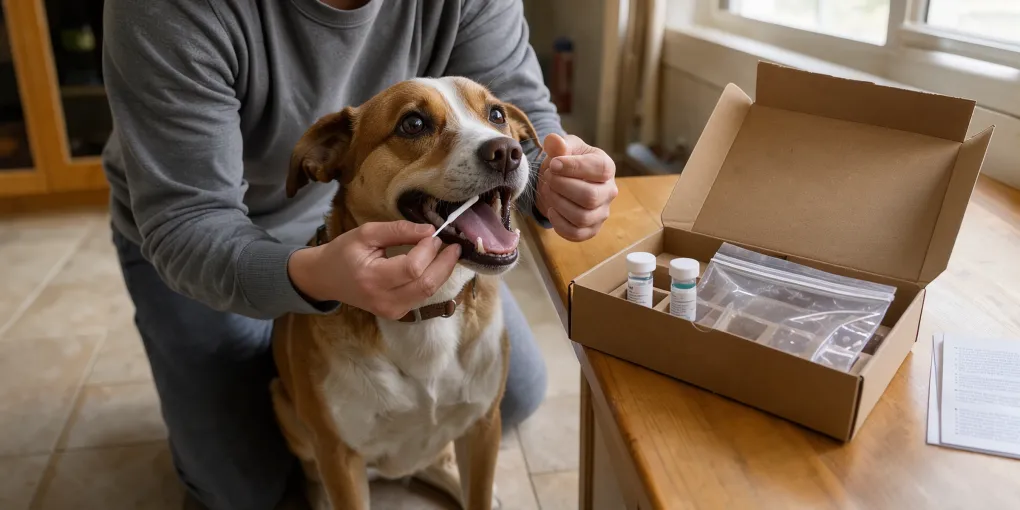
The kit’s most common failure mode is on the owner’s side. A low DNA concentration is the most common reason an Embark test comes back inconclusive, so the company’s protocol is worth following exactly: rub the inside of the cheek pouch and under the tongue for 30-60 seconds — the full 60 is recommended — and do not let your dog eat for 30 minutes before swabbing. Afterward, activate the test online before mailing, and drop the pre-paid mailer in any USPS box; return shipping is free within the US.
Two clock rules from Embark’s own guidance deserve attention. Collected samples stay stable for at least six months, but the test itself expires two years after purchase, so a kit parked in a drawer has a deadline. And for puppies: results never change with age, but the company advises waiting until a puppy is at least 2 weeks old and separating it from the dam and littermates for at least an hour before swabbing, to minimize contamination. Results for the Breed + Health test are typically ready within 2-4 weeks after the lab receives the sample, per the company’s FAQ.
Who should buy it, and who should wait
The kit fits three readers well. Adopters of mixed-breed dogs who want a breed estimate and a baseline of genetic risk flags to bring into routine vet care. Breeders weighing matings, for whom carrier status is exactly the kind of known-variant information Embark screens for. And owners of breeds with documented hereditary risks where an at-risk flag would change what they monitor with their veterinarian.
Wait, or skip, in a few cases. A symptomatic dog needs veterinary diagnostics, not a screening panel — the company says so itself. Anyone hoping for certainty about a dog’s future should temper expectations: risk is not disease, penetrance varies, and the panel sees only known variants. And if the behavior report is what attracted you, price the upgrade, not just the kit.
The honest pitch for Embark is the one the company makes in plain language: know what to watch for, act early instead of reacting late, and take the report to your vet. That is worth something — provided you actually follow through on the veterinary half of the deal.
This review draws on Embark’s published methodology, validation, and support documentation and the company’s listed research publications; accuracy and coverage figures are the company’s own reports, and the limits they carry are noted above.
Further reading
Sources
- Embark product page for the Breed + Health Dog DNA Test Kit (kit contents, activation and shipping steps, sample stability and expiry, behavior-insights upgrade): https://www.embarkvet.com/products/breed-and-health-dog-dna-test-kit
- Embark health insights page (270+ conditions, 55 traits, Allergy Risk Scores, at-risk and carrier definitions, “results are not diagnostic,” 99%+ per-condition genotyping accuracy, 3-in-4 and 1-in-3 company figures, Relative Finder 94%, 2-4 week turnaround): https://www.embarkvet.com/pages/health-insights
- Embark, “The most accurate dog DNA test” (99% breed ancestry accuracy, 400+ breeds including dingoes, coyotes, wolves, and village dogs, Supermutt and single-breed explanations, Illumina CanineHD/Broad lineage, ISO- and CLIA-certified laboratory, contamination re-swabbing): https://www.embarkvet.com/blogs/resources/most-accurate-dog-dna-test
- Embark, “How to swab your dog” (30-60 second swab, 60-second recommendation, 30-minute food window, low DNA concentration as top inconclusive cause, six-month sample stability): https://www.embarkvet.com/pages/how-to-swab-your-dog
- Embark, “When should I order my DNA test kit?” (puppy testing age, 2-week wait and 1-hour separation guidance): https://www.embarkvet.com/blogs/resources/when-should-i-order-my-dna-test-kit
- Embark, “How do dog DNA tests work?” (customized Cornell-partnered SNP microarray, multiple probes per condition, linkage-disequilibrium tests and penetrance-by-breed caveats, variant addition criteria): https://www.embarkvet.com/blogs/resources/how-do-dog-dna-tests-work
- Embark, “How it works” (Illumina CanineHD platform description, 2-4 week turnaround for Breed + Health results): https://www.embarkvet.com/pages/how-it-works
- Embark science and research page (database scale, partnership description, publication list): https://www.embarkvet.com/pages/science-and-research
- Hayward JJ, Castelhano MG, Oliveira KC, et al. Complex disease and phenotype mapping in the domestic dog. Nat Commun. 2016 Jan 22;7:10460. doi:10.1038/ncomms10460: https://pubmed.ncbi.nlm.nih.gov/26795439/
- Shannon LM, Boyko RH, Castelhano MG, et al. Genetic structure in village dogs reveals a Central Asian domestication origin. Proc Natl Acad Sci U S A. 2015 Nov 3;112(44):13639-44. doi:10.1073/pnas.1516215112: https://pubmed.ncbi.nlm.nih.gov/26483491/
- Sams AJ, Boyko AR. Fine-scale resolution of runs of homozygosity reveal patterns of inbreeding and substantial overlap with recessive disease genotypes in domestic dogs. G3 (Bethesda). 2019 Jan 9;9(1):117-123. doi:10.1534/g3.118.200836: https://pubmed.ncbi.nlm.nih.gov/30429214/
- Chu ET, Simpson MJ, Diehl KL, Page RL, Sams AJ, Boyko AR. Inbreeding depression causes reduced fecundity in Golden Retrievers. Mamm Genome. 2019 Jun;30(5-6):166-172. doi:10.1007/s00335-019-09805-4: https://pubmed.ncbi.nlm.nih.gov/31115595/
- Deane-Coe PE, Chu ET, Slavney A, Boyko AR, Sams AJ. Direct-to-consumer DNA testing of 6,000 dogs reveals 98.6-kb duplication associated with blue eyes and heterochromia in Siberian Huskies. PLoS Genet. 2018 Oct 4;14(10):e1007648. doi:10.1371/journal.pgen.1007648: https://pubmed.ncbi.nlm.nih.gov/30286082/
- Slavney AJ, Kawakami T, Jensen MK, et al. Five genetic variants explain over 70% of hair coat pheomelanin intensity variation in purebred and mixed breed domestic dogs. PLoS One. 2021 May 27;16(5):e0250579. doi:10.1371/journal.pone.0250579: https://pubmed.ncbi.nlm.nih.gov/34043658/
- Kawakami T, Raghavan V, Ruhe AL, et al. Early onset adult deafness in the Rhodesian Ridgeback dog is associated with an in-frame deletion in the EPS8L2 gene. PLoS One. 2022 Apr 6;17(4):e0264365. doi:10.1371/journal.pone.0264365: https://pubmed.ncbi.nlm.nih.gov/35385474/
Frequently Asked Questions
- No. The company states plainly that Embark results are not diagnostic and do not mean a dog has a disease. A health result says your dog is at risk (carrying variants associated with increased risk) or a carrier (one copy of a variant, unlikely to develop the disease but relevant for breeding). Follow up with your veterinarian either way; the company designed the report to be shared with them.
- Embark states 99% breed ancestry accuracy and 99%+ genotyping accuracy for each health condition, measured against its own platform and reference database. The company also discloses limits: some health results rely on linkage-disequilibrium tests it calls slightly less predictive, and whether a variant actually causes disease (penetrance) varies by breed and individual dog. Treat the headline numbers as manufacturer figures.
- Puppies can be tested at any age and the results will not change as they grow, but Embark advises waiting until a puppy is at least 2 weeks old and separating it from the dam and littermates for at least an hour before swabbing, to minimize contamination from the mother or siblings.
- According to Embark, low DNA concentration is the most common reason a test comes back inconclusive. Swab the inside of the cheek pouch and under the tongue for 30-60 seconds (the company recommends the full 60), and withhold food for 30 minutes beforehand. Collected samples stay stable for at least six months, but the test itself expires two years after purchase.
- No. The report screens for known genetic variants, and Embark says it adds a condition to the panel only when it has breed relevance and scientific agreement behind it. Conditions caused by genes outside the panel, or by non-genetic causes, are not detected, and some results are inferred from neighboring DNA rather than read directly.