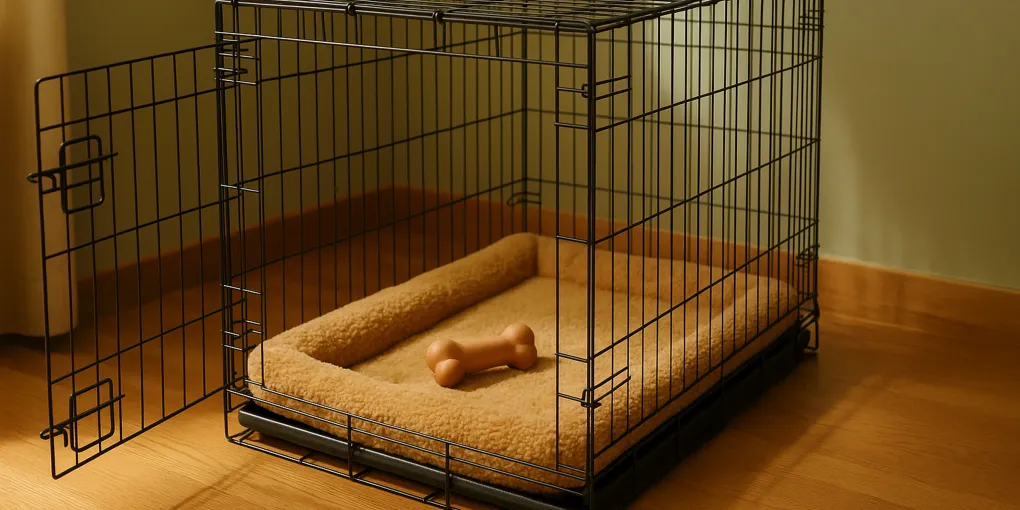
How to Crate Train an Adult Dog: A Step-by-Step Guide
ProtocolHow to Crate Train an Adult Dog: The Research-Based Approach
The fastest route to successful adult dog crate training is systematic desensitization combined with counterconditioning — gradual exposure to the crate at a pace the dog can tolerate, paired with high-value food rewards that build positive associations. Research on canine learning consistently shows that positive reinforcement-based training produces more reliable behavioral outcomes with less stress than methods using punishment or forced confinement (Fernandes JG et al., 2017, Applied Animal Behaviour Science, PMC7895348; Ziv G., 2017, PMC7743949).
TL;DR
- Core method: Systematic desensitization + counterconditioning with high-value food
- Timeline: 2–3 weeks for uncomplicated cases; 4–8 weeks for dogs with prior negative associations
- Key principle: Never exceed the dog’s current comfort threshold — progress at the dog’s pace
- Critical warning: Do not use a crate to manage active separation anxiety before the anxiety is addressed
How We Built This Protocol (PSR Composite)
| Criterion | Weight | Score | Weighted | Notes |
|---|---|---|---|---|
| Safety & Evidence Quality | 30% | 8.5 | 2.55 | Protocol grounded in canine learning research (PMC7521022, PMC7895348, PMC7743949); crate use caveats for separation anxiety explicitly included |
| Efficacy & Performance | 25% | 8.5 | 2.13 | Systematic desensitization + counterconditioning is the most evidence-supported training approach; positive reinforcement effectiveness documented in multiple studies |
| Real-World Pet Acceptance | 20% | 8.0 | 1.60 | Step-by-step graduated exposure protocol is owner-actionable; individual variation and rescue dog considerations addressed |
| Value | 15% | 9.0 | 1.35 | Crate training is low-cost once hardware is in place; prevents expensive destructive behavior and separation anxiety escalation |
| Transparency & Brand Trust | 10% | 9.0 | 0.90 | All behavioral claims attributed to peer-reviewed sources; limitations (separation anxiety contraindications, senior dogs) explicitly flagged |
| PSR Protocol Score | 8.5/10 |
Score notes: Crate training protocol scores highly when built on positive reinforcement principles supported by contemporary canine behavioral research. The protocol in this article follows the evidence-based approach. Individual dog responses vary significantly — escalation guidance to veterinary behavioral professionals is included.
The crate is a management tool and a safe space — not a punishment chamber. Adult dogs given the opportunity to build positive associations with a crate can genuinely seek it out voluntarily. This guide provides the step-by-step protocol to get there.
Why Crate Training Works: The Behavioral Science
Dogs are den-oriented animals that in natural conditions seek out enclosed resting spots. A crate leverages this preference — but only when the dog’s initial experience with the crate is positive. The behavioral mechanism is counterconditioning: pairing the neutral or mildly aversive stimulus (the crate) with something the dog values highly (food, praise) until the crate itself becomes a conditioned positive stimulus.
Research on separation anxiety management (Sherman BL, Mills DS., 2008, Veterinary Clinics, PMC7521022) notes that once properly acclimated, crate-trained dogs “rarely engage in the stress-related behaviors exhibited by dogs that have free access during periods of separation.” The crate effectively reduces the environmental complexity that contributes to stress-related destruction and vocalization.
Important caveat from the research: Confining a dog with pre-existing separation anxiety to a crate before adequate behavioral intervention can increase lip licking, yawning, and escape behavior — markers of heightened stress. Dogs showing severe separation distress should receive veterinary behavioral assessment before intensive crate training begins.
What You Need Before You Start
Choose the Right Crate Size
The crate should be large enough for your dog to stand, turn around, and lie down comfortably — but not so large that a corner becomes a toileting area.
| Dog Weight | Recommended Crate Size |
|---|---|
| Under 25 lbs | 24-inch crate |
| 25–50 lbs | 30–36 inch crate |
| 50–90 lbs | 42-inch crate |
| Over 90 lbs | 48-inch crate |
Wire vs. plastic: Wire crates provide more visibility and airflow — most dogs without anxiety prefer them. Plastic airline-style kennels create a more enclosed, den-like space some dogs prefer. If your dog shows stress signs (panting, pacing) in a wire crate, try covering three sides with a blanket to reduce visual stimulation.
View wire dog crates on Amazon
View plastic dog kennels on Amazon
Essential Crate Supplies
Orthopedic crate mat or pad: Comfort is non-negotiable for positive association building. A dog that associates the crate with discomfort will not voluntarily rest there.
High-value food rewards: The training protocol requires food that significantly outcompetes the dog’s apprehension. Use:
- Small (pea-sized) pieces of cooked chicken, cheese, or hot dog
- Freeze-dried meat treats
- Kong filled with peanut butter (xylitol-free), cream cheese, or canned pumpkin — frozen for extended engagement
View frozen Kong stuffers on Amazon
Your scent: An unwashed t-shirt or pillowcase placed in the crate speeds positive association for most dogs.
The Step-by-Step Crate Training Protocol
Phase 1: Introduction (Days 1–3)
Goal: The crate is not scary. The dog can be near it without stress.
Step 1.1 — Place the crate in a social area Position the crate where family activity happens — living room, home office, or bedroom. Open the door and let the dog investigate freely with no pressure to enter.
Step 1.2 — Toss treats near, then inside the crate With the crate door open and secured so it cannot swing shut:
- Toss a small treat near the front of the crate
- After the dog eats it and shows no stress, toss one just inside the door
- Over the next 5-minute session, toss treats progressively deeper into the crate
- End the session before the dog shows any reluctance
Step 1.3 — Feed meals near the crate Place the dog’s regular food bowl at increasing proximity to the crate over 2–3 meals:
- Day 1: Bowl placed at the crate door
- Day 2: Bowl just inside the crate
- Day 3: Bowl at the back of the crate (dog fully enters to eat)
Do not close the crate door during these feeding sessions. The dog must feel free to leave.
Signs to watch for: A dog that approaches voluntarily, eats without hesitation, and shows a loose, relaxed body is ready to progress. A dog that hesitates, approaches with a stiff body, or shows whale eye (whites of eyes visible) needs more time in the current step.
Phase 2: Door Introduction (Days 3–7)
Goal: The dog can be in the crate with the door closed briefly without stress.
Step 2.1 — Close the door for 5–10 seconds Once the dog is comfortable entering for food:
- Lure the dog inside with a treat
- Close the crate door gently while the dog is eating
- Open the door before the dog finishes the treat (5–10 seconds)
- Praise calmly and let the dog exit
Step 2.2 — Gradually increase closed duration Over 3–5 days of 2–3 sessions per day, extend the closed duration incrementally:
- 10 seconds → 30 seconds → 1 minute → 3 minutes → 5 minutes
Pass food treats through the crate bars every 20–30 seconds during longer durations.
Step 2.3 — Introduce the crate cue word Choose a consistent verbal cue: “Crate,” “Kennel,” or “Bed.” Say the cue as the dog enters, then reward. The cue becomes a conditioned reinforcer associated with the reward sequence.
Do not progress if: The dog paws at the door, whines, or shows any stress indicators (panting, yawning excessively, drooling). Return to the previous step and build duration more slowly.
Phase 3: Extended Duration Training (Week 2)
Goal: The dog tolerates 30–60+ minutes in the crate calmly.
Step 3.1 — Introduce a frozen Kong Before closing the crate for longer durations, give the dog a frozen stuffed Kong. The frozen texture extends engagement time from a few minutes to 20–30 minutes, providing sustained positive association during crate time.
Kong stuffing recipe for crate training:
- Mix canned food, kibble, and a small amount of peanut butter (xylitol-free)
- Fill Kong, add cream cheese to seal the opening
- Freeze for minimum 4 hours before use
Step 3.2 — Gradually increase duration Duration progression for week 2:
- Session 1–2: 5 minutes (Kong finishes; dog rests)
- Session 3–4: 10 minutes
- Session 5–6: 20 minutes
- Session 7–8: 30 minutes
- Session 9–10: 45 minutes
- Session 11–12: 60 minutes
Add 5–10 minutes per successful session, never exceeding your dog’s current comfort ceiling.
Step 3.3 — Practice while you’re home This step is critical and often skipped: practice crate time while you are present in the house. Dogs should not associate the crate exclusively with your departure — that creates pre-departure anxiety. Crate your dog periodically while you work, read, or watch TV.
Phase 4: Departure Training (Week 2–3)
Goal: The dog associates crate time with your departure calmly.
Step 4.1 — Desensitize departure cues Pre-departure cues (picking up keys, putting on shoes, grabbing a bag) often become conditioned anxiety triggers before the dog is even crated. Systematically decouple these cues from departures:
- Pick up your keys, carry them for a few minutes, set them down — don’t leave
- Put on your coat, walk to the door, return — don’t leave
- Practice these cues many times daily for 1 week without following through with actual departure
Step 4.2 — Short departures first
- Crate the dog with a frozen Kong
- Leave the house for 5–10 minutes
- Return calmly before the Kong is finished
- Do not make a big production of returning — calm greetings prevent reinforcing departure anxiety
Step 4.3 — Progressive departure duration Extend departure duration over the following week: 5 min → 15 min → 30 min → 1 hour → 2 hours → 3 hours → 4 hours
Maximum crate duration guidelines:
- Adult dogs: maximum 4–6 hours during daytime
- Dogs over age 7: consider limiting to 3–4 hours and checking for orthopedic comfort needs
- Overnight crating: most dogs can sleep 7–8 hours comfortably once acclimated
Phase 5: Overnight Crating (Week 3 onward)
Most adult dogs acclimate to overnight crating relatively quickly after they are comfortable with extended day durations.
Setup:
- Place the crate in or adjacent to the bedroom for the first 2–4 weeks
- Give the dog a potty opportunity immediately before crating
- Offer a frozen Kong or appropriate chew to initiate positive association
- Use a covered crate (blanket over 3 sides) to reduce external stimuli
Managing nighttime waking: Adult dogs with no pre-existing anxiety issues typically sleep through the night once acclimated. If your dog wakes and vocalizes:
- Wait 2–3 minutes before responding (brief vocalization usually self-resolves)
- If vocalizing continues, let the dog out for a brief potty opportunity without extended interaction
- Do not reward persistent night waking with extended social time — this reinforces the behavior
Common Mistakes and How to Avoid Them
| Mistake | Problem | Correction |
|---|---|---|
| Progressing too fast | Dog develops negative association with crate | Return to previous step; reduce duration by 50% |
| Using the crate as punishment | Crate becomes aversive; dog resists entering | Reserve crate for neutral/positive contexts only |
| Long durations too soon | Dog fails, vomits, soils, escapes | Follow the duration progression protocol strictly |
| Skipping home practice | Dog associates crate only with departure | Practice crating while home regularly |
| Dramatic departures/returns | Owner behavior heightens departure salience | Low-key, consistent routines |
| Too small or uncomfortable crate | Orthopedic discomfort creates negative association | Verify dog can stand, turn, stretch out fully |
When Crate Training Isn’t Appropriate
Crate training is not the right approach for every situation:
Dogs with active severe separation anxiety: Crating a dog in active anxiety distress can cause self-injury (broken teeth, torn nails, skin abrasions from escape attempts). Address the separation anxiety through behavioral modification — ideally with veterinary behavioral support — before intensive crate use.
Dogs with specific crate trauma history: Some rescue dogs have documented crate abuse history. These dogs require exceptionally gradual desensitization — often weeks of door-open exposure before any door closure is attempted. Progress is possible but requires patience.
Dogs with significant orthopedic conditions: Arthritis, hip dysplasia, and other musculoskeletal conditions may make sustained crating painful. Consult your veterinarian about duration limits and bedding appropriateness.
Recommended Products for Crate Training
Wire crate (36”–42” for medium dogs): View on Amazon
Orthopedic crate mat: View orthopedic crate pads on Amazon
KONG Classic (freezable): View KONG Classic on Amazon
Frozen Kong filler: View Kong filler treats on Amazon
Bully sticks (long-duration supervised chew): View bully sticks on Amazon
Frequently Asked Questions
How do I crate train a rescue dog that was never crated?
Rescue dogs with no prior crate experience often acclimate faster than dogs with negative crate history. The systematic desensitization protocol in this guide is designed for exactly this situation — start at Phase 1 and assess your dog’s response before progressing. Many rescue dogs are crate trained to comfortable 4-hour tolerance within 2–3 weeks. Be alert to signs of kennel-related anxiety that may not be apparent initially; some rescue dogs reveal stress markers only after 2–3 weeks in a new home as they settle in.
My dog cries in the crate — what should I do?
Brief vocalization (30–60 seconds) that self-resolves is normal during early training and should be ignored. Prolonged crying indicates you have exceeded your dog’s current comfort level — the duration or phase was too advanced. Go back to the previous step and rebuild. Do not return to a crying dog during training sessions, as this reinforces vocalization. If crying is accompanied by panting, drooling, or frantic movement, stop the session, let the dog settle, and consult a veterinary behaviorist about the underlying anxiety.
Is it cruel to crate a dog while at work?
An adult dog can comfortably and safely spend up to 4–6 hours in a crate during the day once properly trained. Beyond 6 hours, arrange a midday break (dog walker, doggy daycare, neighbor, or neighbor’s visit). A crate that is used appropriately — sized correctly, filled with comfort items, and accessed after proper training — is not cruel. A dog that is crate trained and finds the space genuinely comfortable may choose to rest in the crate voluntarily even when the door is open. What is cruel is using a crate for excessive durations, insufficient size, or as a punitive tool.
Can I crate an older senior dog?
Yes, though senior dogs may need orthopedic attention in crate bedding (memory foam or orthopedic pad rather than flat mat), more frequent breaks for toileting, and duration limits reflecting their bladder capacity and joint comfort. Senior dogs often respond to crate training as readily as younger adults — many appreciate the enclosed security.
Bottom Line: The Crate Training Approach That Works
Patience, high-value food, and systematic progression at the dog’s pace are the three non-negotiable elements of successful adult dog crate training. The behavioral research is consistent: positive reinforcement-based gradual exposure produces durable behavioral outcomes with minimal stress. Forced confinement or premature duration increases extend total training time and damage the positive association you’re building.
Follow the phase-by-phase protocol above, monitor your dog’s stress indicators at each step, and stay below the dog’s current comfort ceiling at all times. Most adult dogs — including rescue dogs — are comfortable in a crate for extended durations within 3–4 weeks of consistent daily training.
For dogs showing significant anxiety during any phase of crate training, consult a veterinary behaviorist. Behavioral modification support from a credentialed professional (DACVB or CAAB) significantly improves outcomes for dogs with anxiety-based resistance to crate training.