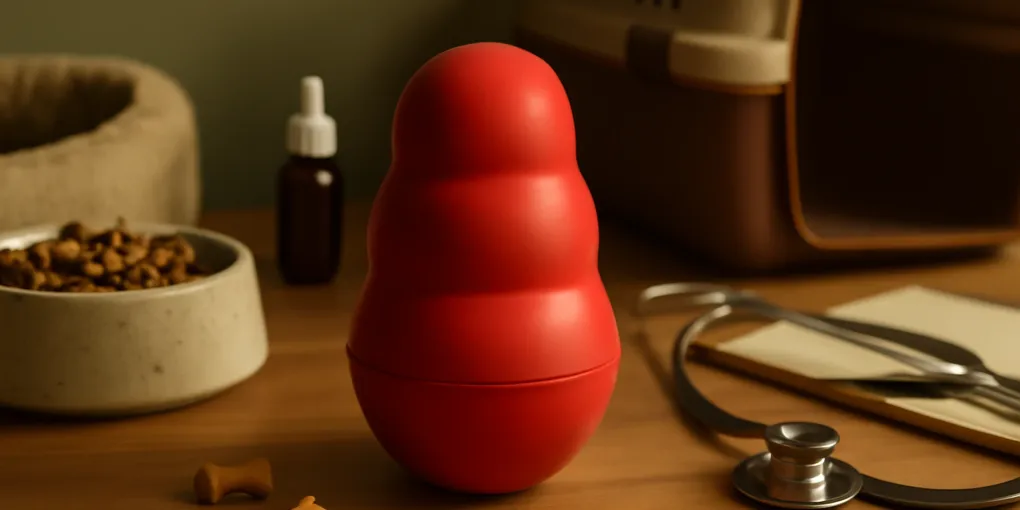
KONG Wobbler Review: Is This Treat Toy Worth It for Bored Dogs?
ReviewKONG Wobbler
Reviewed pickBest for: Dogs who eat kibble and need a durable, washable dispenser
$18–$30
Quick picks
| Product | Key Specs |
|---|---|
| See price on Amazon |
|
| See price on Amazon |
|
Product availability, certifications, and retailer details can change; check the current Amazon page before buying.
KONG Wobbler Review: Is This Treat Toy Worth It for Bored Dogs?
The KONG Wobbler is worth considering for dogs that eat dry kibble, enjoy pushing objects with their nose or paws, and need a washable food-dispensing toy that is harder to destroy than soft puzzles. It is not the right toy for every home. It can be loud on hard floors, frustrating for timid dogs, and inappropriate for power chewers left unsupervised.
Our practical verdict: use the Wobbler as a meal-slowing enrichment tool, not as an all-day chew toy. Fill it with part of the measured meal, place it on a rug or washable mat, supervise the first sessions, and put it away when empty. If your dog needs calmer licking or crate downtime, a rubber stuffing toy may be better. For broader scent-work enrichment, compare it with our dog snuffle mat setup routine.
Best fit
- Search Amazon for KONG Wobbler dog treat toy if your dog eats kibble, likes batting toys, and needs a durable dispenser.
- Search Amazon for KONG Classic dog toy if you want a quieter toy for stuffed and frozen food.
- Search Amazon for dog treat dispensing toy large breed if your dog is too large or too intense for the standard Wobbler size.
What the Wobbler does well
The Wobbler’s main strength is clarity. A dog hits it, it rocks, food falls out. That cause-and-effect loop is easier for many dogs than drawer-style puzzles or toys with hidden sliders. The weighted base keeps it upright enough to continue the game, while the screw-off body makes filling and washing simpler than many treat balls.
For fast eaters, the Wobbler can turn a thirty-second kibble meal into a five- to fifteen-minute task. That extra time matters for boredom and arousal. Dogs that spend the morning waiting for owner attention often benefit from a predictable food job after a walk. The toy asks for movement, problem solving, and persistence without requiring the owner to hide dozens of treats around the house.
It also has a cleaning advantage. Because it opens widely, owners can remove crumbs and wash the interior. Treat toys fail quickly when residue builds up inside narrow channels. A toy that is easy to wash is more likely to remain in rotation.
PSR G6 Composite Score for KONG Wobbler
| Factor | Weight | Score | Weighted contribution |
|---|---|---|---|
| Research fit | 30% | 4.3 | 1.29 |
| Evidence quality | 25% | 4.1 | 1.03 |
| Value | 20% | 4.2 | 0.84 |
| User signals | 15% | 4.0 | 0.60 |
| Transparency | 10% | 4.4 | 0.44 |
| Composite | 100% | 4.2/5 |
The score is not a medical claim. It reflects how well the product category or protocol maps to veterinary guidance, owner execution, replacement costs, and avoidable risk. A high score means the purchase or routine has a clear job and a low chance of causing new problems when used as directed. It does not mean every pet should use it or that it replaces veterinary care.
Where it falls short
Noise is the first drawback. On tile, hardwood, or an apartment floor, the Wobbler can bang and scrape. Use a rug, yoga mat, or washable runner to protect floors and reduce sound. If your dog tries to throw the toy, stop the session and choose a softer enrichment format.
The second drawback is frustration. Some dogs paw once, see no immediate reward, and quit. Others bark at the toy. Start with high-value, easy-to-release pieces and a partially filled toy. Do not pack it full of irregular treats that wedge in the opening. The first session should produce several wins quickly.
The third drawback is chew risk. The Wobbler is durable for a dispenser, but it is not an indestructible chew. If a dog pins it and gnaws the plastic seam, remove it. Supervision is especially important for adolescent dogs, bully breeds with intense chewing styles, and dogs with a history of eating toy pieces.
Size and food fit
Use the size that matches your dog’s mouth, paw strength, and kibble size. Too small can be unsafe or too easy to grab; too large can be discouraging for small dogs. Kibble should fall out with moderate effort. If every piece pours out in one minute, use larger kibble or mix in a few pieces that slow flow. If nothing comes out, the dog is learning frustration rather than problem solving.
Avoid greasy soft treats unless you plan to wash immediately. Dry kibble, freeze-dried pieces that do not crumble too much, or firm training treats work best. Count the calories. The Wobbler should dispense part of the meal, not bonus calories layered on top of the meal.
How to introduce it safely
Start after a short walk or play session, when the dog is alert but not frantic. Let the dog watch you drop a few pieces of kibble inside. Place the Wobbler on a mat and tip it once so food falls out. Then step back. If the dog interacts, praise calmly. If the dog barks, paws aggressively, or tries to chew the top, pause and reset with easier food or a different toy.
Keep the first session under ten minutes. End while the dog is still successful, not after frustration rises. Over several days, increase the meal portion in the toy. For multi-dog homes, separate dogs during use. Food toys can create guarding even in dogs that share normal bowls politely.
Wobbler versus rubber stuffing toy
Choose the Wobbler when you want movement, meal pacing, and visible problem solving. Choose a rubber stuffing toy when you want quiet licking, crate-compatible downtime, or frozen enrichment. Many homes benefit from both because they solve different problems. The Wobbler is an active puzzle; the rubber toy is a calming food project.
If your dog is recovering from surgery, has mobility limits, or slips on floors, the Wobbler may be too active. A stationary lick mat or stuffed rubber toy is safer. If your dog is overweight, either toy can work only if the food is measured. Enrichment calories are still calories.
Cleaning routine
Unscrew the toy after use, shake out crumbs, wash with warm soapy water, rinse thoroughly, and let it dry before closing. Inspect the seam and opening for sharp edges or chew marks. If the toy develops cracks, retire it. A damaged food toy can become a foreign-body risk.
Which dogs should skip it
Skip the Wobbler for dogs who guard food around people or pets unless a qualified trainer helps with the plan. A moving food toy can increase arousal and make guarding more likely. Also skip it for dogs recovering from orthopedic injury, dogs that slip on floors, and dogs that become frantic when food is delayed. Enrichment should lower stress over the day, not create a louder problem.
Very small dogs may find the toy too heavy or intimidating, while giant dogs may treat it like a chew object. The fit is best for dogs that are large enough to move it but not so intense that they try to crush it. If your dog has a history of foreign-body surgery, any hard plastic dispenser deserves extra caution.
Apartment and floor-protection tips
The Wobbler is much easier to live with when the play area is controlled. Put it on a thick washable mat, close doors to rooms where it can bang into baseboards, and use it during reasonable hours. If you live above neighbors, a rubber stuffing toy or snuffle mat may be a kinder choice. Noise is not just an owner annoyance; some dogs escalate when the toy clatters.
Choose kibble that dispenses smoothly. If pieces are too tiny, the meal ends too quickly and the toy becomes a noisy bowl. If pieces are too large, the dog may bark or bite the toy. Test with a quarter cup first. A good session sounds like occasional tapping and sniffing, not ten minutes of plastic slamming.
Value after the first month
The Wobbler earns its price if it stays in weekly rotation after the novelty fades. Owners often buy enrichment toys during a behavior crisis, use them twice, and then lose them in a cabinet. To avoid that, assign the Wobbler a specific job: breakfast on workdays, post-walk decompression, or rainy-day meal pacing. Wash it, dry it, and store it with the measuring cup.
Compared with many multi-part puzzles, the Wobbler has fewer small pieces and a longer useful life. Compared with a rubber stuffing toy, it requires less prep but creates more movement and noise. That tradeoff is why it should be one tool in an enrichment drawer, not the only plan for a bored dog.
Final verdict
Buy the Wobbler if your main problem is a bored, kibble-eating dog that benefits from active meal work and can use a hard plastic toy without chewing it apart. Skip it if your main problem is anxiety in the crate, noise sensitivity, food guarding, or destructive chewing. In those cases, quieter licking toys, training games, or a behavior plan will be safer.
The best version of this purchase is paired with a routine: measured meal, supervised session, quick wash, then storage. Used that way, the Wobbler can turn ordinary breakfast into a useful enrichment task. Used as an unsupervised object on the floor all day, it loses value and adds risk.
Buying checklist
Before ordering, confirm the size, floor surface, cleaning plan, and supervision plan. If the toy will be used on tile in an apartment, buy a mat at the same time or choose a quieter option. If the dog has a powerful chew history, plan for supervised sessions only and inspect the toy after every use.
Best owner use case
The strongest use case is a healthy adult dog that finishes meals too quickly and still wants a job after exercise. In that setting, the Wobbler is simple, durable, and easy to wash. It is less persuasive as a cure for separation anxiety or as a toy for dogs that need quiet rest.
FAQ
Is the KONG Wobbler good for puppies?
It can be useful for older puppies that are large enough for the toy and supervised closely. For very young puppies, choose softer, easier enrichment and avoid any toy they can chew apart.
Can I leave the Wobbler out all day?
No. Use it as a supervised meal or enrichment session, then pick it up. Leaving it out encourages chewing when it is empty and makes it less interesting over time.
What should I put in a KONG Wobbler?
Dry kibble is the best starting point. Add a few higher-value dry treats if needed, but keep the total within the daily calorie plan. Avoid sticky food that coats the inside.
Sources and veterinary references
- Ohio State University Veterinary Medical Center: toys and puzzles for pets, https://vmc.vet.osu.edu/sites/default/files/documents/behavioral-med-puzzle-toys-2024.pdf
- ASPCA: dog enrichment and food puzzle safety concepts, https://www.aspca.org/pet-care/dog-care
- WSAVA Global Nutrition Committee: calorie control and body condition resources, https://wsava.org/global-guidelines/global-nutrition-guidelines/