Senior Cat Arthritis Signs: What Changes Matter and How to Adapt the Home
Evidence ExplainerQuick picks
Low-entry open litter box
★ Top pick Best first home change- Note: Look for a front entry no higher than the cat can comfortably step over, a large floor area, and no cramped corner entrance.
Wide pet steps with nonslip treads
Best for favorite furniture- Note: Choose shallow rises, a stable base, and washable high-traction treads. Avoid steep foam stairs that buckle.
Washable low-profile warming bed
Comfort option- Note: Self-warming material avoids cords and active heat. The cat must be able to enter and leave easily.
Senior cat arthritis signs usually appear as changed choices rather than a dramatic limp. Watch for abandoned jumps, hesitation on stairs, sleeping in easier locations, reduced lower-back grooming, irritability, or toileting beside a high-sided box. Repeated mobility changes need a veterinary exam because osteoarthritis is painful and can resemble other senior-cat diseases.
When mobility changes need a veterinary exam
A senior cat with sudden inability to stand, open-mouth breathing, collapse, repeated vomiting, inability to urinate, a cold or painful hind limb, or severe distress needs urgent veterinary care. Never give a cat human pain medicine.
Home changes can reduce painful movements, but they do not replace diagnosis or pain control. The useful order is: document the change, arrange an exam, make access easier now, and review the cat’s response with the veterinarian.
Quick picks for easier access
- Low-entry litter box for the highest-priority daily route: Check low entry open litter box senior cat on Amazon.
- Wide nonslip pet steps for a favorite sofa or bed: Check wide pet steps nonslip senior cat on Amazon.
- Low-profile self-warming bed when a high bolster or electrical cord would be a poor fit: Check washable self warming cat bed low profile on Amazon.
The signs owners can actually see
Cats hide vulnerability and tend to adapt their route around pain. Watch repeated patterns across ordinary days.
| Change at home | Why arthritis could cause it | Other problems the vet may consider |
|---|---|---|
| Jumps up in stages or pulls up with front legs | Hip, knee, spine, or elbow movement may hurt | Weakness, neurologic disease, vision loss |
| Hesitates before jumping down | Landing creates a larger joint load | Poor depth perception, paw injury, fear |
| Sleeps in a new low location | The former bed may require stairs or a jump | Illness, temperature preference, cognitive change |
| Urinates or defecates beside the box | Entry, squatting, or turning may be painful | Urinary disease, constipation, kidney disease, diabetes |
| Matted lower back or long claws | Bending and scratching-post use may hurt | Dental pain, obesity, skin disease, systemic illness |
| Resists handling or avoids another pet | Anticipated contact can hurt | Fear, sensory decline, unrelated pain |
A phone video of the cat walking, taking stairs, entering the litter box, and stepping onto furniture can help. Do not force a painful jump to make the video.
What the veterinary visit should sort out
The veterinarian combines history, gait and posture, joint palpation, muscle condition, neurologic findings, and sometimes imaging. X-rays can support the diagnosis and rule out some alternatives, but the severity visible on an image does not always match the cat’s pain or function.
Bring a dated list of lost abilities. “Stopped using the bedroom windowsill on July 2” is more useful than “slowing down.” Note appetite, water intake, urine volume, stool, weight change, vomiting, and nighttime behavior because senior cats can have several conditions at once.
Treatment may include a feline-specific prescription pain plan, weight management when appropriate, rehabilitation, and environmental modification. Drug choice and monitoring are individual decisions. Cats process many medicines differently from people and dogs.
Make the litter box easier first
A litter box is a non-optional trip, which makes it the highest-value home change.
Choose an open, roomy box with one genuinely low entrance. The cat should be able to turn without twisting against a wall. Put at least one box on every level the cat uses and avoid a route that requires a gate, slick stairs, or a jump. Keep the familiar litter unless the veterinarian identifies a reason to change it.
Check low entry open litter box senior cat on Amazon, then compare the measured entry height and internal floor dimensions rather than shopping by the word “senior.” Some products advertised as low entry still have a high inner lip.
If urine output changes, the cat strains, cries, makes repeated unproductive trips, or licks the genital area excessively, contact a veterinarian promptly. Do not solve those signs by simply adding another box.
Build routes instead of removing favorite places
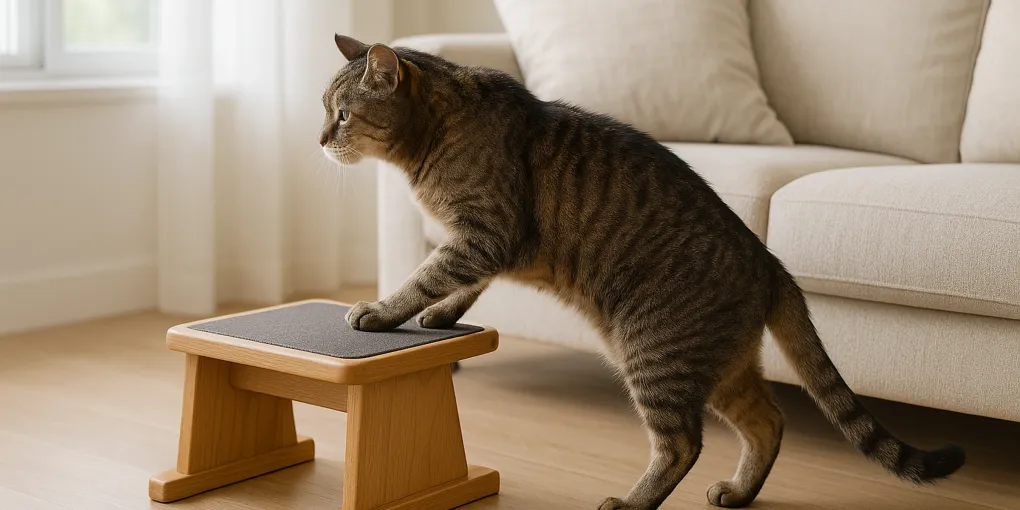
Keep the cat’s important destinations available with intermediate steps. A stable bench or wide stair beside a bed can turn one large leap into several shallow movements. The top surface should be broad enough for all four paws, and the base should not slide when the cat descends.
Check wide pet steps nonslip senior cat on Amazon, then compare rise height, tread depth, base stability, and washable traction. Narrow, steep stairs may be harder than the original jump. A ramp needs grip and enough horizontal space to produce a gentle slope.
Place food and water where the cat does not have to compete or climb. Raising a bowl is not automatically better; some cats prefer floor level. The practical test is relaxed posture, easy approach, and normal intake.
Improve grip without trapping claws
Slick wood, laminate, and tile make turning and takeoff harder. Connect the litter box, food, bed, and favorite resting place with rubber-backed runners or firmly secured carpet tiles. Loose towels and curling mats are trip hazards.
Trim overgrown claws with veterinary or grooming help if needed. Do not declaw, and do not use adhesive claw covers as a mobility treatment. Provide a scratching surface the cat can use without stretching vertically, such as a stable horizontal scratcher.
Comfort and heat: use the safe version
A soft bed with a low edge can reduce the effort needed to settle. Check washable self warming cat bed low profile on Amazon for material that reflects body heat without an electrical cord. Place it away from drafts and give the cat another cooler sleeping option.
Do not use an unregulated heating pad, hot-water bottle, or microwave pack against a cat who cannot move away easily. Reduced mobility and thin senior skin increase burn risk. If active heat is being considered, ask the veterinarian which pet-specific, thermostatically controlled product and setup is appropriate.
A seven-day function log
Once daily, record whether the cat:
- entered and turned in the litter box without hesitation;
- reached food, water, and the main bed;
- jumped, climbed in stages, or abandoned a destination;
- groomed the back and hindquarters;
- tolerated normal touch;
- slipped, stumbled, or placed a paw unusually;
- ate, drank, urinated, and defecated normally.
The goal is not a homemade pain score. It is a consistent record that shows whether access changes and veterinary treatment restore specific abilities.
What not to buy first
Skip joint supplements sold with vague “mobility support” promises until the veterinarian reviews the ingredients, dose, and evidence. Do not let a supplement delay effective analgesia. Avoid tall enclosed litter boxes, unstable foam steps, slick decorative ramps, and beds with high bolsters the cat must climb over.
The most useful purchase is often a correctly sized low-entry box or one stable intermediate step, not a bundle of arthritis-branded products.
Sources
- American Association of Feline Practitioners and International Association for Animal Hospice and Palliative Care, 2021 Feline Senior Care Guidelines: https://pubmed.ncbi.nlm.nih.gov/34167339/
- American Association of Feline Practitioners, 2022 Feline Pain Management Guidelines: https://pubmed.ncbi.nlm.nih.gov/34937455/
- US Food and Drug Administration, Frequently Asked Questions about Animal Drugs and People: https://www.fda.gov/animal-veterinary/safety-health/frequently-asked-questions-about-animal-drugs
Frequently Asked Questions
- No. Many cats reduce jumping, hesitate on stairs, sleep in easier locations, groom less, or become irritable without an obvious limp.
- Never give a human pain medicine unless the cat's veterinarian explicitly prescribed that exact drug and dose. Ibuprofen and acetaminophen can be life-threatening to cats.
- It can reflect pain, urinary disease, constipation, cognitive change, kidney disease, diabetes, or litter-box access. Arrange veterinary assessment rather than assuming spite or poor training.