We may earn a commission if you buy through our links.
Quick picks
| Product | Key Specs | Pros / Cons |
|---|---|---|
| See price on Amazon |
|
|
| See price on Amazon |
| — |
Take the Aivituvin when one cat (or two that get along) gets supervised window access on a deck, patio or wall you can measure to about 25 x 24 inches of footprint; take the PawHut walk-in when several cats need room you can enter yourself.
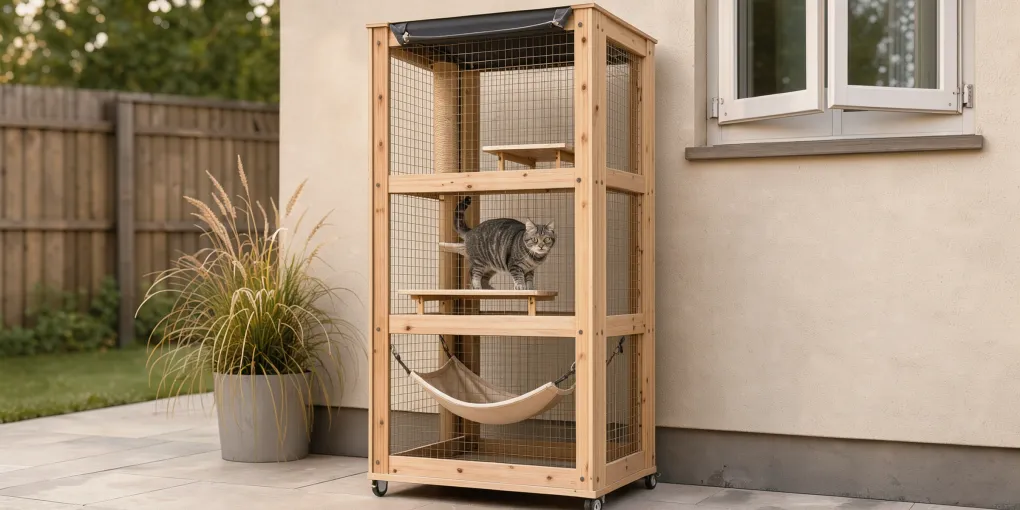
A catio that meets your window is a specific product, and the Aivituvin wooden cat house is a window-access catio built that way: a roughly 63-inch-tall wooden tower on wheels whose upper door rotates to line up with a window, sliding door or cat door. The listing and the maker’s AIR22-M page agree on the concept and mostly agree on the details - and the disagreements, plus the things neither one states, are exactly where this purchase gets decided.
Bottom line
This is a fit-and-supervision purchase. It suits one cat (or a bonded pair) getting supervised outdoor time beside a real opening, on a surface you can measure to about 25 x 24 inches of footprint with 63 inches of vertical clearance. The enrichment inside the box is genuinely good - three platforms, a hanging bed, a sisal post, a washable base, a removable waterproof roof, and wheels with brakes so the house can chase the shade. The work left to you is the containment itself: no mesh gauge, no latch spec and no anchor spec are published anywhere, so your own pre-use inspection is the safety system. And a catio does not make unsupervised outdoor access safe; it is a supervised tool, and the brand’s own peace-of-mind language is marketing copy.
The footprint, and the two dimension sets
The retailer listing states 24.4 x 23.4 x 62.4 inches; the maker’s product page states 24.5”L x 23.4”W x 62.8”H. The two agree closely, and the small disagreement lands right on the clearance edges: height differs by four tenths of an inch (62.4 versus 62.8) and length by a tenth (24.4 versus 24.5). The defensive move is simple: site the tower against the larger numbers. If you are tucking it under a deck overhang, beside a door hinge, or into a rail corner, measure to 62.8 inches of height and leave slack at the door swing, because the top half has to physically rotate 180 degrees during setup and possibly later.
Plan the landing surface too. The maker lists a 45.2-pound shipping weight; the listing adds four casters, two of them braked. Casters want firm, level paving or decking, and brakes only do their job on something flat.
What arrives, and how it goes together
Per the listing, the box carries the three-tier wooden house plus 3 platforms, a hanging cat bed, a sisal scratching post and a small interior lounge; the roof is removable and waterproof, and the base is removable PVC you can wipe out. For entry there are two large front doors and two small sliding doors with hooks.
The maker’s page describes the build as flat-packed panels with a pictorial manual and labeled parts, about an hour with two people and a screwdriver, drill optional. That is the maker’s estimate, not our test - but the parts worth reading about before you start are the mesh panels and the door hardware, because those carry the containment and they are the least documented.
The window connection: alignment, not plumbing
The clever trick is the 180-degree split: the upper section rotates so its door meets your window, sliding door or cat door, while the lower door slides open as the cat’s everyday entrance. Both sources describe this connection. Neither publishes a frame adapter, flashing, or a mounting kit that bolts the tower to the house. So read the design honestly: it positions the house so the openings align and the cat walks through; the structure itself is a free-standing tower you site and stabilize. If your window opens inward, sits above a sill taller than the tower’s door, or the screen can’t be removed and stored, the connection is cosmetic and the tower becomes a regular indoor-outdoor house. That is still useful - but order it knowing which one you are buying.
Where the tower leaves the work to you
The brand page pitches the catio as protection “from traffic, predators, and getting lost … all with complete peace of mind.” Attribute that line to the brand, and then look at what actually bounds the risk:
- Containment is only as good as its weakest seam. The American Bird Conservancy’s Cats Indoors program puts the outdoor risks plainly - being hit by cars, antifreeze poisoning, predator attacks, and a much higher incidence of injury, parasites and disease - and notes outdoor cats have significantly shorter lifespans than indoor cats. A catio cuts that exposure sharply compared with free-roaming, but only while it is actually intact: one loose mesh seam or unhooked door reopens every one of those hazards.
- Cover is not climate. The roof is a removable waterproof tarp-style cover over a wooden box. Neither source rates the interior for summer heat or winter cold. An unshaded wooden box with mesh panels can heat up in direct sun, and neither source publishes a safe outside temperature range for the inside of it. The practical answer is the four casters: roll it into shade or wheel it indoors - which means someone has to be there to roll it. This is general guidance, not veterinary advice; if your cat is elderly, flat-faced, overweight or unwell, ask your vet how much heat and outdoor time is safe.
- The gaps you must inspect yourself. Mesh gauge and opening size are not stated by the retailer listing or the maker’s page. Door hardware is described as hooks on sliding doors. No anchoring method is published. Before any solo session, put your hands on every panel, seam, hook and track, then watch your cat hunt the weak points for ten minutes with you in the room. If a latch or panel bothers you, fix or upgrade it - that is your job, and nothing in the listing does it for you. If your cat is a proven escape artist at the litter-box-flip level, treat it as a supervised lounge, and consult your vet about enrichment alternatives before defaulting to outdoor time.
When to size up instead
We may earn a commission if you buy through our links.
A footprint of roughly 25 x 24 inches, stacked three tiers high, is a one- or two-cat house. The listing itself says the design is expandable, and the maker sells the expansion as combining two sets - more money, more footprint. If the household has three or more cats, or you want to sit inside with them, a walk-in shape is a different and often saner product. The PawHut walk-in catio on Amazon runs about 49 square feet per its listing - room for a person and, it says, up to five cats - in galvanized steel with 420D Oxford fabric and a removable side net for the same kind of window connection. It trades the solid wooden house for a much bigger object that needs a level run of ground. The Aivituvin wins when the window wall is small and the cat is one; the walk-in wins when the catio is where the household hangs out. See the full best outdoor cat enclosures comparison for the rest of the field.
What affects the cost
The maker notes its price covers one set: expansion kits, any window-frame adaptation you invent, and assembly tools beyond a screwdriver are yours. Because prices move, compare the live offers at the retailer, and divide by the two things that actually scale - cats served and usable square feet - before concluding the narrow tower is cheaper than the walk-in per cat.
Sources
We may earn a commission if you buy through our links.
- Amazon product listing for the Aivituvin Catio Outdoor Cat Enclosure Wooden Cat Cage with Window Access: the product title, the five feature bullets (dimensions, 3-tier contents, 180-degree window installation, removable waterproof roof and PVC base, door count and hooks, four wheels with two brakes, expandable design) and the product-detail rows. Current listing on Amazon
- Aivituvin’s AIR22-M product page (model AIR22-M, Medium Cat Catio): the SPECS block (24.5”L x 23.4”W x 62.8”H, 45.2 lb shipping weight, about 1-hour assembly with 2 people, screwdriver, flat-pack with pictorial manual and labeled parts), the window/sliding-door/cat-door connection description, the waterproof tarp roof, the expandable-two-sets note, and the marketing protection claim quoted above. Aivituvin AIR22-M product page
- Amazon product listing for the PawHut Catio Outdoor Cat Enclosure, 95-Inch Extra Large Walk-in Cat House: the product title (7 jumping platforms, 2 resting boxes), and the feature bullets (about 49 sq ft of space, up to five cats, removable side net for window connection, galvanized steel frame with 420D Oxford fabric and waterproof cover). Current listing on Amazon
- American Bird Conservancy, Cats Indoors program: outdoor hazards for cats (vehicle strikes, antifreeze poisoning, predators, higher injury, parasite and disease rates), the shorter-lifespan finding, and the “indoors or safely under a person’s supervision” framing. Cats & Birds - ABC Cats Indoors
Frequently Asked Questions
- That depends on your window, not just the catio. The listing's design is a two-part tower: rotate the top half 180 degrees so its door lines up with the opening, and the lower door slides open for your cat's own route in and out. The maker's page says it connects to a window, a sliding door or a cat door. What neither source publishes is a window-frame adapter or a mounting kit, so the honest reading is alignment, not attachment: you site the tower against the wall so the opening meets the door, and you secure the tower itself. Measure your window sill height and how the sash or door actually opens before ordering.
- Treat this as a supervised space. Enclosure is not the same as safety: the removable roof is waterproof cover, not climate control, and neither the listing nor the maker rates the interior for heat or cold. Outdoor cats face real hazards - the American Bird Conservancy's Cats Indoors program notes that cats with outdoor access face vehicle strikes, predators, and a much higher rate of injury, parasites and disease, and have significantly shorter lifespans than indoor cats. A catio shrinks that exposure compared with free-roaming, but a stocked box of tools does not make an unattended enclosure weatherproof or escape-proof. Put the cat in, watch the first sessions, and take the cat in when the weather turns.
- Nobody can promise containment from these listings, because the details that decide it are not published: neither source states the wire mesh gauge or the size of the openings, and no latch specification appears on either. The doors are described as two large front doors plus two small sliding doors with hooks. Before leaving a cat inside even briefly, run your own checks: press every mesh panel and seam, confirm each hook holds under a paw swing, check the sliding doors cannot lift off track, and watch how your specific cat attacks the weakest point. Cats escape enclosures at joints, doors and corners, not through solid walls. Our [catio safety checklist](/blog/catio-safety-checklist) covers the same inspection from the outside.
- Plan against the bigger set. The retailer listing gives 24.4 x 23.4 x 62.4 inches and the maker's AIR22-M page gives 24.5 L x 23.4 W x 62.8 H - a difference of a few tenths of an inch, but exactly the kind of tolerance that turns a snug fit into a wedged one. Leave clearance past the eaves and at the door swing, and if you are fitting it under a low overhang or beside a hinge, measure twice against the 62.8-inch height. The maker lists a shipping weight of 45.2 pounds.
- The maker says about one hour with two people, a screwdriver (a drill is optional), flat-packed panels, a pictorial manual and labeled parts. That is an assembly estimate from the maker, not a test result; owners with a level outdoor surface and someone to hold panels will have an easier hour than someone assembling alone on uneven paving.
- Three things to budget for: the price is for one set, and expansion kits to combine two sets are a separate purchase; assembly tools beyond a screwdriver are yours; and the tarp roof and PVC base are removable parts you will want to rinse and dry, so cheap outdoor storage matters if it lives outside year-round. Compare cost per cat and per square foot of usable floor against a walk-in enclosure before deciding a tower that occupies about 25 x 24 inches of deck is the better buy for your household.