Quick picks
| Product | Key Specs |
|---|---|
| See price on Amazon |
|
| See price on Amazon |
|
| See price on Amazon |
|
Product availability, certifications, and retailer details can change; check the current Amazon page before buying.
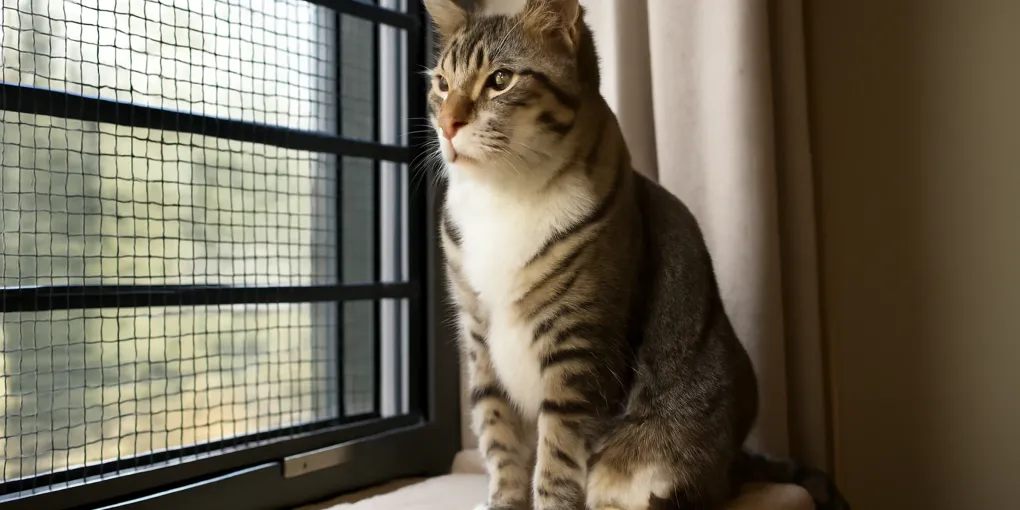
Indoor cats benefit from safe observation points. A sunny window can offer birds, leaves, sounds, and scent changes without letting the cat roam outdoors. The problem is that many owners treat an insect screen as if it were a barrier. It is not. A determined cat can bow mesh outward, pop a loose frame, claw a corner, or launch at a bird and turn an open window into an emergency.
Use this protocol when you want fresh air and enrichment but do not want to gamble on a screen. It pairs well with our cat window perch enrichment guide if the goal is a calmer viewing station rather than an open-window test.
The safer setup in one pass
Start with the window, not the product. Open it only as far as you can secure mechanically. Then add a guard or reinforced barrier where the cat can make contact. Finally, give the cat a perch or shelf that keeps body weight off the mesh.
A practical setup usually has three parts:
- A window restrictor, sash lock, or other limiter that prevents a wide opening.
- A pet screen guard or rigid insert over the lower screen area the cat can reach.
- A stable perch, chair, or shelf positioned so the cat watches from a solid surface instead of bracing against mesh.
Search Amazon for pet window screen guards if the lower screen is reachable. Search Amazon for window restrictors if the window opens farther than you can safely supervise.
Why cats make screens fail
Cats do not test screens politely. They stalk birds, swat insects, stretch against corners, and sprint toward sudden movement. A screen that survives wind or a casual hand press may still fail when a cat hits it with claws and body weight. International Cat Care recommends giving cats safe viewing and climbing opportunities indoors while avoiding hazards that allow escape or injury (International Cat Care environmental needs). ASPCA’s general cat-care guidance also emphasizes keeping cats safe indoors while providing appropriate resources and observation opportunities (ASPCA general cat care).
That is the central tradeoff: the window is enrichment, but the screen is a weak point. The answer is not to remove the window view. It is to make escape physically harder and the viewing position less stressful.
Step 1: inspect the window before buying anything
Close the window and look at the frame, track, latch, screen tabs, and mesh corners. If the screen rattles, bows, has brittle spline, or lifts out easily, assume a cat can exploit it. Push gently on the lower third of the screen from inside. If the frame moves, the cat should not have access to that screen while the window is open.
Measure the safe opening. For many cats, the safest opening is only a few inches with a limiter installed. Do not rely on “I only open it a little” if the window can slide wider when bumped. Use hardware that fixes the limit.
Step 2: limit the opening first
A restrictor or sash lock reduces the consequence of screen failure. If the screen pops but the window opening is too narrow for the cat’s head and shoulders, the event is less likely to become an escape. Choose hardware that matches the window material and your lease rules. Some products clamp onto tracks; others require screws. If you cannot install hardware, use the window closed and provide a perch behind glass instead.
For a rented home, look for non-permanent track locks only after measuring carefully. For a owned home with repeated cat pressure at the same window, a more permanent child-safety-style limiter may be worth discussing with a window professional.
Step 3: guard the reachable screen zone
A pet screen guard is not magic, but it can spread pressure and prevent direct clawing at the lower mesh. It should cover the area where the cat stands, paws, or leans. It should sit tightly enough that a paw cannot hook behind it. If the guard rattles, leaves a side gap, or only covers the wrong half of the window, keep shopping.
Avoid soft mesh patches as the only upgrade for a cat that lunges at birds. Stronger mesh can help with claw damage, but the screen frame and attachment points still matter. The safest approach is a rigid guard plus a limited opening.
Step 4: move the cat’s weight onto a stable perch
A window perch helps when it gives the cat a comfortable place to watch without bracing against the screen. Check weight limits, bracket security, suction cups, shelf depth, and whether the cat can turn around without pressing into the mesh. For large cats, seniors, and jumpy cats, a stable piece of furniture below the window may be safer than a high suction perch.
Place the perch slightly back from the screen if possible. The goal is a relaxed loaf, not a launch pad. If the cat chatters at birds, tail-lashes, and repeatedly pounces at the screen, close the window and use glass-only viewing during high-arousal times.
Step 5: supervise the first week
For the first several sessions, stay in the room. Watch whether the cat paws at the guard, bites mesh, wedges claws into the frame, or tries to squeeze into the opening. Close the window immediately if the cat treats the setup like a puzzle. A safe window station should produce watching, sniffing, and resting, not repeated attempts to defeat the barrier.
Use short sessions at first. Ten calm minutes are better than an all-day opening that teaches the cat where the weak points are.
When to skip open windows entirely
Skip open-window access for cats with a history of escaping, intense prey drive at windows, destructive chewing, recent stress, new-home adjustment, or poor recall after slipping outdoors. Also skip it in high-rise units unless the window has professionally appropriate safety hardware. “High-rise syndrome” injuries remain a recognized feline risk when cats fall from windows or balconies; VeterinaryPartner explains high-rise syndrome as a real cat-injury pattern after falls from windows, balconies, and high places (VeterinaryPartner: high-rise syndrome).
For those cats, closed-window enrichment is still useful. Use a perch, bird-safe visual access, puzzle feeding, wand play, and vertical space instead of fresh-air risk.
Cat window screen safety FAQ
Can pet-resistant screen mesh replace a guard?
It can reduce claw damage, but it does not solve every failure point. The screen frame, spline, track fit, and window opening still determine escape risk. Use stronger mesh as one layer, not the only layer.
What if my cat only sits quietly?
Quiet history helps, but it does not predict every bird, bug, storm gust, or startled jump. If the window opens, use a limiter and inspect the screen regularly.
Should I leave the window open when I am not home?
No. If the cat can reach the screen, unsupervised open-window time adds escape risk without anyone present to intervene. Close and lock the window before leaving.
Bottom line
Treat the screen as insect control, not cat containment. The safest cat window setup limits the opening, blocks direct pressure on the mesh, gives the cat a stable perch, and gets supervised until the cat proves calm around it. If any part of the setup depends on hope, close the window and use a perch behind glass.
Frequently Asked Questions
- No. Standard insect screens are not designed as pet barriers, especially when a cat jumps, claws, or leans on the mesh. Limit the opening and add a physical guard if the cat can reach it.
- Use the smallest opening that gives airflow, ideally narrower than the cat's head and shoulders. A restrictor is safer than relying on memory.
- A stable perch can reduce pressure on the mesh, but it does not make an unsecured screen safe. Use it with a restricted opening and hardware checks.