API Freshwater Master Test Kit Review: Reading Each Vial
We may earn a commission if you buy through our links.
Quick picks
| Product | Key Specs |
|---|---|
| See price on Amazon |
|
Weigh strips, standalone ammonia tests, and hardness kits in the linked guides before building your full testing stack.
Decision first: the API Freshwater Master Test Kit is the company’s full-panel liquid test set for freshwater aquariums, and its real value lives in the trend: ammonia, nitrite, and nitrate moving together across the same week, with pH read from two angles, on the same day. If you are cycling a new tank, troubleshooting a mature one, or simply tired of guessing from strips, that trend view is what you are paying for.
This review draws on API’s own published pages for this kit and its sister kits, plus university extension science on aquarium ammonia. Specs and protocols are from API; nitrogen-cycle thresholds are from UF/IFAS. Where the published record goes quiet — reagent shelf life in particular — we say so plainly.
What is actually in the box
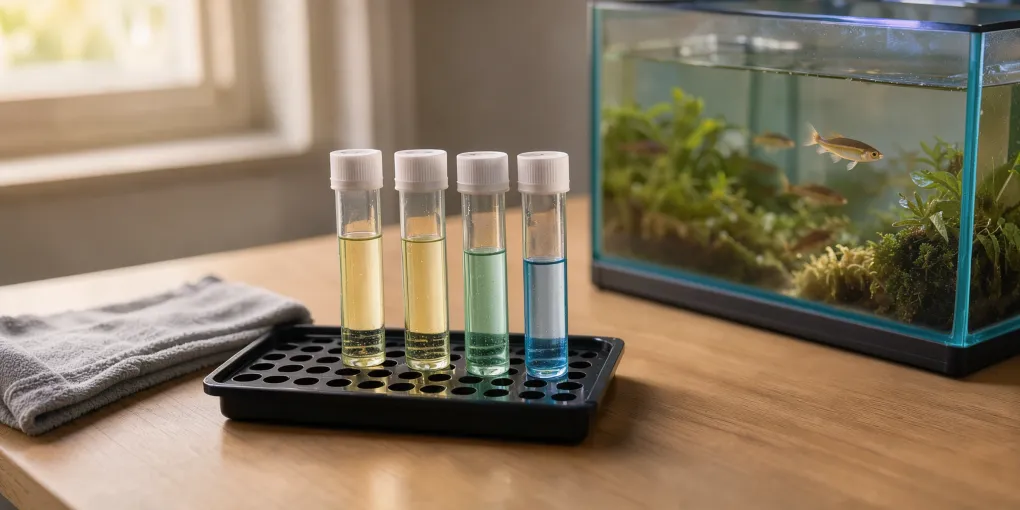
API lists the kit as seven test solutions, easy-to-read instructions, test tubes, and a color chart, and the product description specifies four test tubes, a holding tray, and a computer-calibrated, laminated color card. The seven solutions map onto five tests, because ammonia and nitrate each use a numbered pair of bottles. Safety data sheets for every solution (ammonia 1 and 2, high pH, nitrate 1 and 2, pH, and the kit overall) are linked directly from the product page.
We may earn a commission if you buy through our links.
Because listings, bundles, and sellers change, confirm the exact kit and seller on the product page before buying.
The five tests, vial by vial
Ammonia (two bottles)
Fish release ammonia continuously through their gills, urine, and solid waste, and uneaten food adds more. API is blunt about the stakes: even small amounts stress fish and suppress immune function, and sustained exposure damages gill membranes and harms respiration. The companion API ammonia kit reads from 0 to 8 ppm, and its protocol is representative of how the master kit’s ammonia test works: fill a test tube to the line with 5 ml of tank water, add 8 drops of bottle 1 and 8 drops of bottle 2 holding each dropper vertically, shake the capped tube for five seconds, wait five minutes for color to develop, then read against the freshwater side of the card in good light against the white background.
One FAQ answer worth knowing before you doubt your kit: the dropper tips are all the same size, but the liquids differ in viscosity, so drops from one bottle may look larger than the other. That difference is the viscosity talking, exactly as API explains in the kit FAQ.
Nitrite (one solution)
Nitrite is the intermediate step of the nitrogen cycle, and API treats any detectable level as a trigger to act, because nitrite hinders fish respiration and even low levels stress fish. The kit’s instruction booklet covers the exact dosing for this test. The response API recommends when nitrite shows up is unglamorous and effective: a partial water change.
Nitrate (two bottles)
Nitrate is the end product of bacterial oxidation, and it is where the “everything looks fine but the tank is slowly degrading” story usually starts. Nitrate climbs slowly, accumulating between water changes. Extension literature notes that nitrate was long considered relatively harmless up to around 200 mg/L, but newer research suggests fish suffer at lower concentrations, and closed systems can drift past 250 mg/L without water changes. A nitrate test that only gets consulted in emergencies misses its purpose: it is your water-change odometer.
pH (6.0 to 9.0) and high range pH (7.4 to 8.8)
The kit’s two pH tests are one tank, two lenses. API’s freshwater pH test spans 6.0 to 9.0; the high range card covers 7.4 to 8.8 and API explicitly routes livebearers, goldfish, African cichlids, marine fish, and invertebrate keepers to it. API also suggests a fresh weekly pH check because fish waste and uneaten food naturally pull pH around. Worth noting honestly: API’s own page for this kit advertises measuring “the six aquarium levels that are most important,” while its FAQ names the five tests above. The five named tests are what you actually perform.
Reading the results: the cycle is the story
A single day of readings is a snapshot; the nitrogen cycle is the movie, and UF/IFAS extension literature is the best free script for it. Two groups of bacteria run the show: ammonia-oxidizers such as Nitrosomonas convert ammonia to nitrite, and nitrite-oxidizers such as Nitrobacter and Nitrospira convert nitrite to nitrate. A new or disturbed biofilter commonly takes six to eight weeks to mature, which is why test-every-few-days during cycling and weekly after it are different assignments.
Three reading rules lifted straight from the extension science:
- An ammonia reading is a suggestion; the hazard depends on chemistry. Kits report total ammonia nitrogen, and the toxic form — unionized ammonia — is roughly 100 times more poisonous than its ammonium partner. Its share of the total rises sharply with pH and temperature, so the same 0.5 ppm reading is worse in a warm, high-pH cichlid tank than in a cool, neutral community tank.
- A rising trend can outrun the tank’s buffer. Nitrification consumes alkalinity. Below roughly 20 mg/L, the bacteria themselves slow down, ammonia and nitrite climb, and the tank can crash in what extension literature calls old tank syndrome. Nitrate creeping up while pH creeps down is the tell.
- Treat 0.10 mg/L of nitrite as a bright line. UF/IFAS cites that concentration as the level at which nitrite has been shown to be toxic to fish, which matches API’s “act when you detect it” posture.
For a first kit that covers exactly these parameters, see our best aquarium test kits for new tanks, and if you have just caught a surprise result, our guide to what to do when nitrite turns positive walks the response.
The honest fine print: reagents, cards, and shelf life
Reagent shelf life is the most asked question about any liquid test kit and the one API’s published materials answer least. The company links safety data sheets for every solution but publishes no in-use shelf life or opened-bottle expiration period on the kit page or in its FAQ. We will not invent a number. What the published record does support:
- Rinse the test tube immediately after each test; API notes that stained tubes compromise the clarity of later readings.
- Mix tube contents gently — inverting every second or two for the stated time — while shaking the reagent bottles themselves vigorously before dosing.
- Test on a schedule (weekly) rather than by feel, so a drifting reagent is caught by an inconsistent reading sooner.
One method-related caveat from the extension literature applies to liquid ammonia tests in general: the older Nessler ammonia method reads falsely high when formalin-based medications or ammonia-binding conditioners are present, while the salicylate method stays clean. If you dose conditioners or meds, confirm which method your test uses before trusting a post-dosing ammonia reading from any brand’s kit.
Who should buy this, and who should skip it
Buy it if:
- You are cycling a new tank and want the ammonia-to-nitrite-to-nitrate arc visible in one tray.
- Your tank is mature and you want objective water-change timing backed by readings, in place of a calendar guess.
- Fish behavior changes and you need same-day numbers to hand a veterinarian or talk to a shop.
Skip it if:
- You only test occasionally and strips genuinely fit your routine — a kit you never use beats an expensive kit you rarely open.
- You want continuous monitoring; this kit delivers manual snapshots, while inline probes handle the continuous view. For background, see our beginner’s guide to aquarium water test kits, which compares the main kit formats on those same parameters.
- Your main worry is hardness; that is a separate API General and Carbonate Hardness kit, and our ammonia test kit guide covers the standalone ammonia option.
Pros and cons
Pros:
- Five liquid tests in one kit cover every parameter the nitrogen cycle moves: ammonia, nitrite, nitrate, and pH from two ranges.
- Protocols are published, per-parameter, with safety data sheets linked from the product page.
- Two pH cards match the split between soft/acidic and hard/alkaline keeps instead of forcing one card on every tank.
- Weekly testing cadence is explicitly documented rather than left to guesswork.
Cons:
- No published in-use shelf life or opened-bottle expiration guidance accompanies the kit.
- “Six aquarium levels” marketing versus five named tests is a small but real mismatch on API’s own page.
- Manual color-matching is subjective; two people can read a borderline card differently.
- No independent lab comparison of this kit surfaced in the sources consulted for this review.
Sources
- API Fishcare, API Freshwater Master Test Kit (product page, description, usage instructions, FAQ, and SDS links): https://www.apifishcare.com/products/api-freshwater-master-test-kit
- API Fishcare, API Ammonia Test Kit (protocol, 0-8 ppm range, new-tank testing cadence): https://www.apifishcare.com/products/api-ammonia-test-kit
- API Fishcare, API pH Test Kit (6.0-9.0 range, species pH preferences, weekly pH testing): https://www.apifishcare.com/products/api-ph-test-kit
- API Fishcare, API High Range pH Test Kit (7.4-8.8 range, stock guidance): https://www.apifishcare.com/products/api-high-range-ph-test-kit
- UF/IFAS Extension, Ammonia in Aquatic Systems (EDIS FA16/FA031, revised 2022): https://ask.ifas.ufl.edu/publication/FA031
Frequently Asked Questions
- API's own instruction for this kit is to test each parameter weekly for best results, and the company's ammonia kit page suggests testing several times a week for the first 4-6 weeks of a new aquarium, then weekly once the tank is established. University extension guidance matches the weekly cadence and adds a rule worth following: test immediately whenever fish behavior changes, rather than waiting for the scheduled day.
- Use the card that matches your water. API's freshwater pH test covers a range of 6.0 to 9.0, while the high range card reads 7.4 to 8.8 and API directs keepers of livebearers, goldfish, African cichlids, marine fish, and invertebrates to the high range version. When one card reads out of range, match the card to your water before doubting the kit.
- This is where the published record runs out. API posts safety data sheets for every test solution in the kit, but the kit's product pages and FAQs do not state an in-use shelf life or expiration period for opened bottles. What API does publish is maintenance guidance: rinse the test tube immediately after each use so reagents do not stain the glass, and shake reagent bottles vigorously before dosing. Treat any vague date printed on a bottle as the only expiry signal you actually have, and let inconsistent color development between an old bottle and a fresh sister test be your warning.
- No. The kit tests pH, high range pH, ammonia, nitrite, and nitrate. Carbonate buffering shows up indirectly because nitrification consumes alkalinity, and UF/IFAS extension literature notes nitrifying bacteria become ineffective below roughly 20 mg/L of alkalinity, which is how a mature tank can crash. For a direct number, API sells a separate General and Carbonate Hardness test kit.