Best Ferret Harnesses for Escape Checks: Safer Outdoor Sniff Walks
Buyer's GuideMarshall Pet Products Ferret Harness and Lead
Best starter H-styleBest for: Average adult ferrets starting short supervised yard sessions
$8-$16
Quick picks
| Product | Key Specs |
|---|---|
| See price on Amazon |
|
| See price on Amazon |
|
| See price on Amazon |
|
Product availability, certifications, and retailer details can change; check the current Amazon page before buying.
Best ferret harnesses for escape checks
A ferret harness is not a tiny dog harness. Ferrets are flexible, low to the ground, and very good at reversing out of loose loops. The right pick is the harness your ferret can wear calmly after indoor training, not the one that looks strongest in a listing photo.
Start with an adjustable H-style harness or a soft-panel ferret harness that lets you check two things: whether the shoulder loop can slide forward over the front legs, and whether the leash attachment twists the harness when the ferret darts sideways. Ferrets need daily supervised exercise and safe enrichment, and the RSPCA notes that they are active, inquisitive animals that need secure housing and close supervision outside their enclosure (RSPCA). Merck’s ferret management guidance also emphasizes secure housing, environmental control, and careful handling rather than free-roaming risk (Merck Veterinary Manual).
If your ferret is still learning litter habits indoors, pair outdoor goals with our ferret litter box guide first. A harness walk is easier when the ferret already has predictable routines.
Quick picks
- Search Amazon for Marshall Pet Products ferret harness and lead if you want a simple adjustable H-style starter.
- Search Amazon for Kaytee Comfort Harness for Ferrets if your ferret objects to narrow straps but tolerates a soft chest panel.
- Search Amazon for Ware figure-8 ferret harnesses only if you can confirm the loops do not open during backing-up tests.
- Search Amazon for Kaytee Come Along small animal carrier for a backup exit plan before the first outdoor session.
What makes a ferret harness safer
The safest ferret harness has small adjustment increments, smooth hardware, and a leash ring that stays centered when the ferret turns. A strap that is merely small enough is not enough. The harness must stay in position when the ferret lowers its head, rolls, reverses, and braces all four feet against the ground.
Check the harness indoors before thinking about grass or sidewalks. Fit it with the ferret standing naturally. You should be able to slide a fingertip under the strap without seeing a loose loop. Then offer a treat and gently guide the leash backward. If the front loop rides over the shoulder blades, the harness is not safe for outdoor use.
H-style versus soft-panel harnesses
An H-style ferret harness uses separate neck and chest loops connected by a short back strap. It is light and adjustable, which helps with small adult ferrets. It also shows fit mistakes quickly: if one loop is loose, you can usually see it shift.
A soft-panel harness spreads pressure across more fabric. That can help ferrets that freeze or roll when thin straps touch them. The tradeoff is heat and sizing. A soft harness that looks cozy in a product photo can be too wide in the armpits, too warm in summer, or loose enough that the ferret backs out before you feel tension.
Figure-8 designs are the riskiest of the three unless they are very well fitted. Some tighten unevenly; others loosen as the animal twists. Use them only after a calm indoor pull-back test.
Fit test before every walk
Use the same sequence each time:
- Inspect stitching, buckles, clips, and the leash ring.
- Put the harness on before the ferret is excited.
- Check that the chest loop sits behind the front legs, not across the throat.
- Offer a treat and let the ferret walk on the floor for one minute.
- Apply gentle backward leash pressure while the ferret faces away.
- Watch for shoulder slippage, armpit rubbing, rolling, or panic.
- End the session if the ferret freezes, mouths hardware, or tries to bolt repeatedly.
A harness that passes on Monday can fail on Friday if a buckle moved, the ferret lost weight, or the handler clipped the wrong ring.
Outdoor safety rules
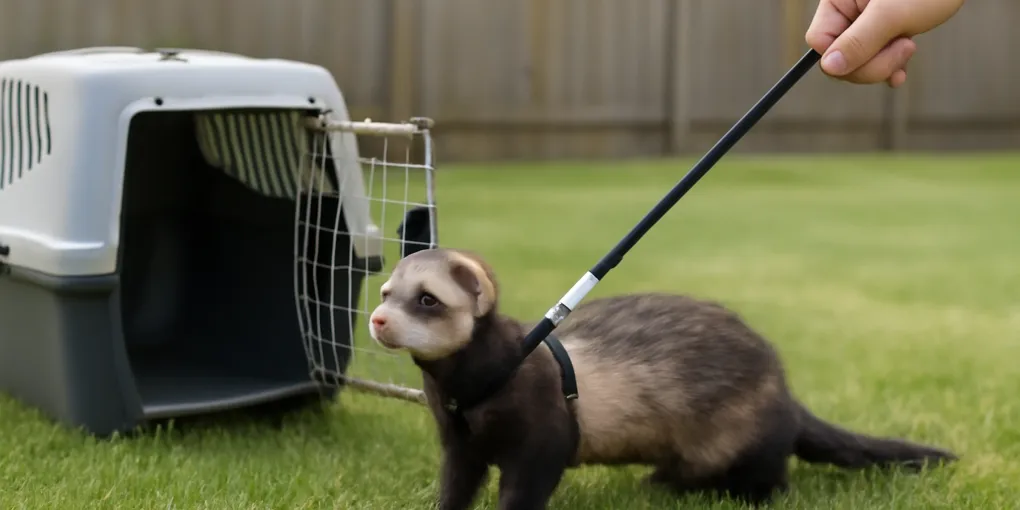
Outdoor time should start in a fenced, quiet area with a carrier within arm’s reach. Avoid dog parks, sidewalks with heavy traffic, pesticide-treated grass, standing water, bird-of-prey exposure, and hot pavement. Ferrets can overheat and can also disappear into holes, drainage gaps, sheds, or thick shrubs quickly.
Do not tether a ferret to furniture, a stake, or a porch rail. Harnesses are for supervised handling, not restraint while you step away. If you need both hands free, put the ferret in a secure carrier.
Sizing and buying details that matter
Measure around the neck base and the chest just behind the front legs, then compare those numbers with the current product chart. Do not buy only by weight. Two ferrets at the same weight can have very different shoulder width, coat thickness, and muscle condition. If the chart puts your ferret between sizes, choose the design with more adjustment range rather than assuming a loose harness will be safer or more comfortable.
Look closely at the closure. Tiny side-release buckles are convenient, but they must click fully and should not sit where the ferret’s elbow rubs. Hook-and-loop closures are quick, but hair, bedding, and outdoor debris can weaken the grip. Metal leash rings should be smooth and light. A heavy clip hanging over the shoulders can twist the harness and make the ferret roll.
Color is not only cosmetic. A bright harness is easier to see in grass, leaf litter, or under patio furniture. Reflective trim can help at dusk, but do not use low light as a reason to walk a ferret near roads or dogs. Visibility is a recovery aid, not a license for risky environments.
Training plan before the first yard session
Spend several days making the harness boring indoors. Day one can be as simple as placing the harness near a treat dish. Day two can be touching the harness to the shoulders, rewarding, and removing it. Later sessions can add one clipped loop, then both loops, then one minute of normal floor exploration. If the ferret rolls, bites the strap, backs frantically, or goes flat and still, end the session and return to an easier step.
Do not carry the ferret outside the first time the harness is clipped. That pairs new pressure, new smells, and open-space stress all at once. A better sequence is harness indoors, leash indoors, carrier to the doorway, then one tiny outdoor area with the carrier open nearby. The goal is a calm ferret choosing to sniff, not a dragged animal reaching the end of the leash.
Which ferrets should skip harness walks
Skip outdoor harness use for sick, underweight, overheated, newly adopted, very young, or medically fragile ferrets unless your veterinarian gives a specific plan. A ferret with diarrhea, coughing, hind-end weakness, severe itching, poor appetite, or recent surgery needs medical care and controlled housing, not a new outing.
Also skip walks when the environment is wrong. Free-roaming dogs, lawn chemicals, unknown plants, open deck gaps, storm drains, high heat, cold wind, and neighborhood pesticides all outweigh the enrichment value. Indoor tunnel games, dig boxes, scent trails, and supervised room exploration are safer substitutes when conditions are poor.
Comparing the main harness styles
Use this decision path:
- Pick an H-style harness when you want maximum adjustability, low bulk, and an easy visual fit check.
- Pick a soft-panel harness when narrow straps cause immediate rolling or rubbing, and you can confirm the panel is not too warm.
- Treat figure-8 harnesses as trial-only options unless the exact design stays stable during backward pressure.
- Avoid vest costumes, decorative wings, collar-and-leash sets, and anything marketed mainly for photos.
For escape-prone ferrets, the product category matters less than the pull-back test. If the ferret can reverse out in your hallway, it will reverse out faster under a shrub. Keep the receipt until the harness has passed several indoor sessions, because tiny fit problems often appear only after the ferret relaxes and starts moving normally. A returnable, adjustable harness is better than an expensive one you keep using despite shoulder slip.
Also check the leash hardware as carefully as the fabric. A heavy clip can pull a small harness sideways, while a stiff swivel can torque the back loop when the ferret changes direction. Choose a light leash that you can shorten quickly, and skip retractable handles because they add delay when the ferret dives under decking, patio furniture, or shrubs. For multi-ferret households, label each harness after fitting; swapping a harness between animals with different shoulder width is a common way to turn a passed fit check into a loose outdoor setup.
Ferret harness FAQ
Can I use a kitten harness on a ferret?
Sometimes, but many kitten harnesses are shaped for a deeper chest and different shoulder angle. If the harness can slide over the shoulders when the ferret reverses, it is the wrong shape even if the size label looks close.
How long should the first session be?
Think in minutes, not walks. A first outdoor session may be two minutes of sniffing near the carrier. Stop while the ferret is still calm rather than waiting for panic, rolling, or chewing.
What should I avoid buying?
Avoid retractable leashes, heavy metal clips, decorative costumes with leash rings, collar-only setups, and harnesses with vague size charts. Ferrets need a body harness that fits the individual animal.
Bottom line
The best ferret harness is adjustable, light, and boringly secure during a backward escape check. Buy the harness, train indoors, carry a backup carrier, and treat outdoor sniffing as supervised enrichment rather than a dog-style walk.
Sources
- RSPCA. “Ferrets.” https://www.rspca.org.uk/adviceandwelfare/pets/ferrets
- Merck Veterinary Manual. “Management of Ferrets.” https://www.merckvetmanual.com/exotic-and-laboratory-animals/ferrets/management-of-ferrets
- LafeberVet. “Basic Information for Ferrets.” https://lafeber.com/vet/basic-information-for-ferrets/
Frequently Asked Questions
- No harness is escape-proof on a determined ferret. A good harness reduces backing-out risk, but supervision, carrier backup, and indoor training matter just as much.
- Use a short, light leash for supervised exploring. Long lines can wrap around legs, shrubs, furniture, or the handler before you can react.
- It should sit snugly without pinching, allow normal breathing and movement, and resist sliding over the shoulders when the ferret backs up.