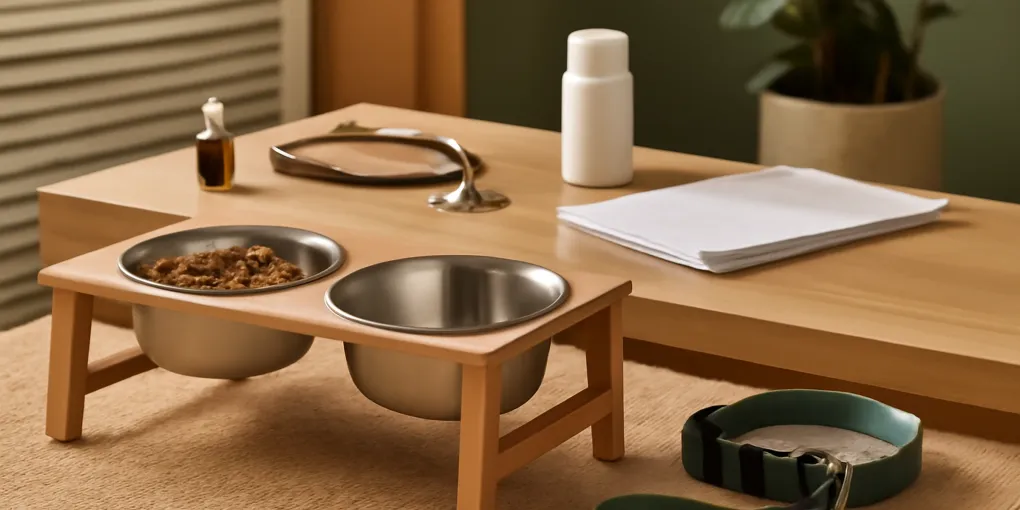
Do Elevated Dog Bowls Prevent Bloat? What the Evidence Actually Says
Evidence ExplainerQuick picks
Slow feeder dog bowl
★ Top pick Better first upgrade for fast eaters- Best for: Dogs that inhale meals and gulp air
- Key feature: Ridges slow eating without raising the bowl
- Caveat: Must be washed well and matched to muzzle shape
- PSR Score: 4.1/5
Adjustable raised dog bowl stand
Use for comfort, not bloat prevention- Best for: Dogs with veterinary-directed neck, mobility, or posture needs
- Key feature: Height can be changed instead of fixed too high
- Caveat: Do not buy as a proven GDV-prevention tool
- PSR Score: 3.4/5
Do Elevated Dog Bowls Prevent Bloat? What the Evidence Actually Says
Elevated dog bowls should not be bought as a proven way to prevent bloat. For large and deep-chested dogs at risk of gastric dilatation-volvulus, the evidence is not reassuring enough to treat raised feeders as protection. Some veterinary sources have raised concern that elevated feeding may be associated with higher GDV risk in certain dogs. If your dog is a Great Dane, German Shepherd, Standard Poodle, Weimaraner, Doberman, Irish Setter, or another deep-chested breed, talk with your veterinarian about individualized risk reduction and whether prophylactic gastropexy is appropriate.
That does not mean every raised bowl is dangerous in every case. It means the buying reason matters. Use a raised bowl for comfort only when there is a specific mobility, neck, or veterinary handling reason. For fast eating, search Amazon for a large-breed slow feeder bowl as a more defensible first product than a tall feeder marketed around bloat prevention.
For related large-dog care decisions, see our senior dog mobility plan and GPS dog collar guide.
Quick picks for feeding setup decisions
- Search Amazon for large-breed slow feeder bowl if the real problem is gulping meals.
- Search Amazon for adjustable raised dog bowl stand only if your veterinarian or your dog’s mobility needs justify height adjustment.
- Search Amazon for stainless steel dog bowl wide base if you need a stable, washable floor-level bowl.
PSR G6 evidence score
| Factor | Weight | Score | Why |
|---|---|---|---|
| Research fit | 30% | 3.8 | The question is clinically important, but consumer product claims overreach. |
| Evidence quality | 25% | 3.6 | GDV risk is multifactorial; feeding-height evidence is observational and cautious. |
| Value | 20% | 2.8 | Raised stands are poor value when bought only for bloat prevention. |
| User signals | 15% | 3.5 | Owners like tidy feeding stations, but comfort reviews do not prove medical prevention. |
| Transparency | 10% | 4.5 | The safest advice is to separate comfort use from prevention claims. |
| Composite | 100% | 3.6/5 | Useful as a comfort tool for selected dogs, not as a GDV prevention plan. |
What bloat and GDV mean
“Bloat” is often used loosely, but the dangerous emergency is gastric dilatation-volvulus. In GDV, the stomach fills with gas and can rotate, cutting off blood flow and rapidly becoming life-threatening. Signs can include a swollen abdomen, repeated unproductive retching, restlessness, drooling, weakness, pale gums, and collapse. This is an emergency, not a wait-and-see problem.
Large deep-chested breeds are at higher risk, but GDV can happen outside the stereotype. Family history, body shape, age, temperament, feeding patterns, and previous episodes may matter. No bowl can remove that risk.
Why raised-bowl marketing is confusing
Raised bowls feel intuitive. If the dog bends less, owners assume less air is swallowed and the stomach is safer. The problem is that plausible mechanics are not the same as outcome evidence. Veterinary discussions of GDV have repeatedly emphasized that the condition is multifactorial, and some older observational work found elevated feeding associated with increased risk in large and giant breeds rather than protection.
Because of that uncertainty, a raised feeder should not be framed as a GDV-prevention purchase. If a product page promises bloat prevention without nuance, treat that as a red flag.
When a raised bowl can still make sense
A raised bowl can be reasonable for a dog with arthritis, neck pain, neurologic weakness, post-surgical restrictions, or other veterinarian-directed comfort needs. The right height is usually modest: close to the lower chest, not a platform that forces the dog to reach upward. Adjustable stands are better than fixed tall stands because you can lower the setup if the dog braces, coughs, or eats awkwardly.
Even then, monitor meal speed, posture, vomiting, regurgitation, and reluctance to eat. Comfort is the goal, not a medical guarantee.
Better first purchases for fast eaters
If your dog gulps meals, start with a slow feeder, puzzle feeder, or meal-splitting routine. Choose a slow feeder that matches muzzle shape. Deep maze bowls can frustrate flat-faced dogs, while shallow designs may do little for long-nosed power eaters. Stainless steel or dishwasher-safe plastic is easier to keep clean than intricate soft materials.
Meal size and timing matter too. Ask your veterinarian whether multiple smaller meals, weight management, or diet changes are appropriate for your dog’s breed and history.
What to ask your veterinarian
Owners of high-risk breeds should ask about GDV risk before buying gear. Useful questions include: Is my dog’s body shape high-risk? Is there family history? Should we discuss prophylactic gastropexy, especially during spay/neuter or another planned anesthesia? Are there feeding or exercise restrictions specific to my dog?
Gastropexy does not prevent stomach distension, but it can reduce the chance of the stomach twisting. That is a veterinary procedure discussion, not an Amazon purchase.
Elevated dog bowl questions
Are elevated bowls bad for all dogs?
No. The concern is not that every raised bowl harms every dog. The concern is that raised bowls are not proven bloat-prevention devices and may be a poor default for high-risk dogs unless there is a comfort reason.
What bowl should I use for a Great Dane?
Ask your veterinarian first because Great Danes are a high-risk breed for GDV. Many owners should prioritize meal pacing, body-condition management, emergency awareness, and gastropexy discussion over buying a tall feeder for prevention.
Should a fast-eating Great Dane use a slow feeder instead of a raised bowl?
They are not guaranteed GDV prevention, but they can address fast eating, which is a more concrete behavior target. Choose a design your dog can use without frustration and keep it clean.
What are emergency signs after eating?
Repeated unproductive retching, a tight or swollen abdomen, pacing, drooling, weakness, pale gums, collapse, or severe distress after eating require emergency veterinary care.