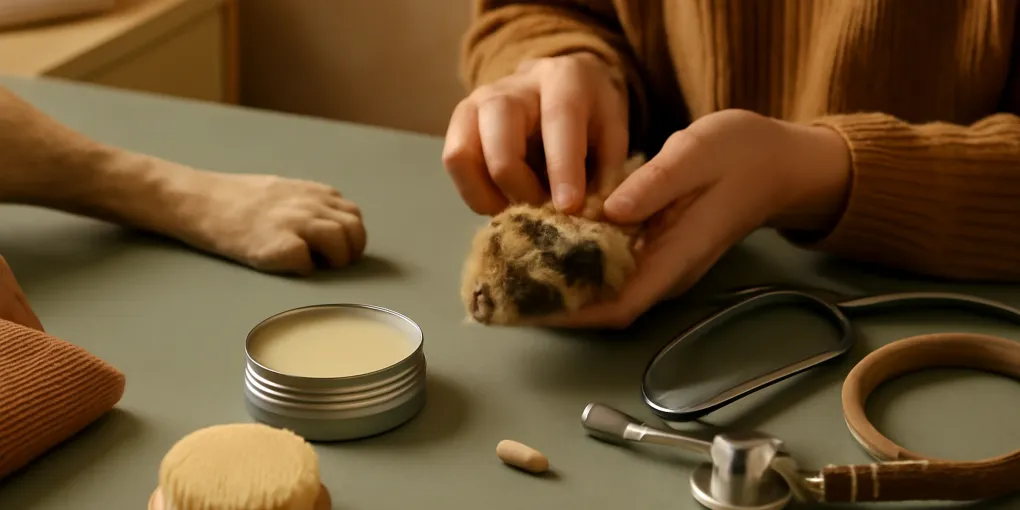
Best Dog Paw Balms for Winter Salt and Cracked Pads in 2026
Buyer's GuideMusher’s Secret Dog Paw Wax
Option 1Use case: See article guidance
Check current Amazon price
Quick picks
| Product | Key Specs |
|---|---|
| See price on Amazon |
|
| See price on Amazon |
|
| See price on Amazon |
|
Product availability, certifications, and retailer details can change; check the current Amazon page before buying.
Dog Paw Balm Winter Guide
Winter paw care is partly about comfort and partly about exposure management. Ice, road salt, rough crusted snow, cold pavement, and repeated wet-dry cycles can irritate paw pads. A balm can help as a temporary barrier or moisturizer, but it is not a treatment for deep cracks, burns, limping, infection, or allergy-related licking.
This guide compares paw balms and explains when boots, rinsing, route changes, or veterinary care are the better answer. Before buying, verify the exact size, ingredient list, seller, return policy, and whether the texture suits your dog’s licking and walking habits.
How we evaluated the recommendation
For paw balm, we favor products with a plausible barrier or moisturizing role, conservative claims, veterinary dermatology and toxicology support, complete ingredient lists, clear fragrance disclosure, and instructions owners can follow. Cost per ounce, mess, application tolerance, licking risk, staining, and container durability also affect the recommendation.
A high score means a balm is a reasonable winter-care tool for intact skin. It does not mean it can replace diagnosing pain, infection, contact dermatitis, or orthopedic injury.
Quick recommendation table
| Check price | Pick | Best for | Why it made the list |
|---|---|---|---|
| Check Amazon | Musher’s Secret Dog Paw Wax | Pre-walk barrier use | Widely known wax-style product for snow, salt, and rough surfaces |
| Check Amazon | Natural Dog Company PawTection | Owners wanting stick application | Convenient format for quick application before short walks |
| Check Amazon | Burt’s Bees Paw and Nose Lotion for Dogs | Light moisturizing needs | Familiar low-fragrance option to compare for mild dryness |
Who this article is for
This article is for owners whose dogs walk on salted sidewalks, icy paths, or cold dry pavement and come home with mildly dry pads. It is also for owners trying to decide whether a balm is enough or whether boots and route changes are necessary.
Skip the shopping step and call a veterinarian if your dog is limping, bleeding, chewing one paw intensely, has swelling between toes, smells yeasty, has a torn nail, or reacts painfully when you touch the foot. Those signs are not routine winter dryness.
Balm features that matter
Look for a short, understandable ingredient list and avoid strong fragrance. Dogs lick their feet, so the product should be labeled for dogs and used thinly. Waxes are better as pre-walk barriers; softer lotions may be better after a rinse-and-dry routine. Greasy products can make smooth floors slippery, so apply in a small amount and let the dog stand on a mat for a minute before walking indoors.
Packaging matters more than it seems. A tin can be economical but messy with gloves. A stick applicator can be faster but may be harder to use on furry feet. For long-haired paws, trim excess fur between pads with appropriate grooming tools or ask a groomer; balm smeared into wet fur can trap grit.
Winter paw protocol
Before the walk, inspect the pads and between toes. Apply a thin layer of balm only to intact skin if conditions are salty, icy, or abrasive. For extreme cold, sharp ice, or heavy salt, use properly fitted boots instead of relying on balm.
During the walk, watch for sudden lifting of paws, skipping, sitting down, or chewing at feet. Those are stop signals. Shorten the route or move to a cleaner surface.
After the walk, rinse or wipe paws with lukewarm water, dry between toes, and check for redness or trapped ice. Reapply a moisturizing product only if the skin is dry and unbroken. If irritation repeats after every walk, change the route, use boots, or ask your veterinarian about dermatitis and allergy possibilities.
Safety notes owners often miss
Do not use human medicated creams, essential-oil blends, or products containing ingredients unsafe for dogs unless your veterinarian approves them. More balm is not better; heavy layers invite licking and can soften pads too much. Keep containers away from dogs who might eat the whole tin.
Road salt is the bigger issue in many cities. Balm may reduce direct contact, but rinsing after exposure is still important. Also remember that paws are only one cold-weather risk. Thin-coated, small, elderly, or ill dogs may need shorter walks and body protection.
Product-by-product notes
Musher’s Secret Dog Paw Wax
Musher’s Secret is the classic barrier-wax comparison. It makes the most sense before walks on snow, salt, or rough winter pavement. The main downside is owner technique: applying too much can leave residue indoors and encourage licking.
Natural Dog Company PawTection
PawTection is attractive for owners who want a stick-style applicator. It may be easier to use quickly at the door, especially for dogs who dislike having each pad handled for long. Check the current ingredient list and choose the size that will not dry out before winter ends.
Burt’s Bees Paw and Nose Lotion for Dogs
Burt’s Bees Paw and Nose Lotion is a light moisturizing comparison rather than a heavy snow barrier. It is better for mild dryness after cleaning than for long exposure to salt or ice. If your dog licks lotions immediately, choose a different routine.
Evidence base and citations
The AVMA cold-weather pet safety guidance highlights winter exposure risks and the need to check paws after walks: https://www.avma.org/resources-tools/pet-owners/petcare/cold-weather-animal-safety. Cornell’s Richard P. Riney Canine Health Center discusses common skin and paw concerns and when veterinary care is appropriate: https://www.vet.cornell.edu/departments-centers-and-institutes/riney-canine-health-center. The ASPCA Animal Poison Control Center is a useful reference for ingredient and toxin concerns around products dogs may lick: https://www.aspca.org/pet-care/animal-poison-control. FDA animal-product safety resources are relevant for labeling and contamination awareness: https://www.fda.gov/animal-veterinary.
Internal reading
For winter routines that overlap with comfort and mobility, see our senior dog anti-slip boots guide and dog joint supplements guide. Both emphasize observing the dog rather than assuming a product fixes the underlying problem.
FAQ
Can paw balm replace dog boots?
Sometimes, for short walks on mildly irritating surfaces. Boots are better for sharp ice, heavy salt, very cold ground, injuries that need protection, or dogs with repeated paw irritation.
Is licking paw balm dangerous?
Small incidental licking of a dog-labeled product is expected, but heavy licking can upset the stomach and removes the barrier. Avoid strong fragrances and keep the container out of reach.
Should I apply balm before or after a walk?
Use waxy balms thinly before exposure and moisturizing products after paws are rinsed and dried. Do not seal salt or grit against the skin.
How are winter paw-balm picks kept independent?
Pet Science Review may earn a commission from qualifying Amazon purchases. The G6 score is based on research fit, evidence quality, value, user signals, and transparency, not commission rate. We use search links when direct product verification is not available, and we do not invent ASINs.
Choosing between balm, boots, and route changes
Use balm for mild exposure: a short salted sidewalk, dry cold pavement, or light snow that does not ball between toes. Use boots when the surface is sharp, chemically treated, extremely cold, or repeatedly causing irritation. Use route changes when the problem is predictable, such as one heavily salted block near an apartment entrance.
Boots require their own training. Let the dog sniff them, touch one paw, reward, and remove the boot before the dog panics. Build toward a few indoor steps before going outside. A dog who freezes in boots may still benefit from balm and cleaner routes, but a dog who repeatedly limps on salt needs stronger protection than wax alone.
Post-walk inspection routine
Make paw checks boring and consistent. Keep a towel, shallow rinse cup, and reward near the door. Lift each paw briefly, separate the toes, wipe grit, and dry the webbing. Look for redness, swelling, cracked edges, broken nails, or ice balls. Write down which routes cause trouble; this helps you distinguish a product failure from an environmental trigger.
If only one paw is affected, think beyond winter dryness. A foreign body, nail injury, interdigital cyst, allergy flare, or orthopedic pain can look like paw irritation. Repeated one-sided licking is a reason to get help rather than keep changing balms.
Value notes
The cheapest balm is not automatically the best value. A small tin that lasts all winter and prevents salt irritation can be excellent. A large jar that stains floors, smells strong, or makes the dog lick for ten minutes is poor value even if the ounce price is low. Buy the smallest reasonable size first, then reorder only after you know the texture works for your dog and your floors.
Owner observation log
For the first week, keep a simple note after each use: date, setup, pet response, cleaning burden, and any warning signs. This prevents wishful thinking. If the note repeatedly says “avoided,” “licked constantly,” “frustrated,” or “hard to clean,” the product is not earning its place. If the note says “calm,” “easy,” and “repeatable,” you have evidence that the routine fits your home.
A log also helps your veterinarian. Specific observations are more useful than saying a product “didn’t work.” Bring details about timing, symptoms, surfaces, food amount, travel length, or weather exposure so the next recommendation addresses the real problem.
Ingredient and household checks
Read the full label before the first use, especially if your dog has allergies, a history of pancreatitis, or a habit of eating non-food items. Paw products are usually used in small amounts, but a determined dog can consume a surprising quantity if the container is left on a low shelf. Store balms with grooming supplies rather than near treats.
Test texture indoors before a long walk. Apply a rice-grain amount to one pad, wait a few minutes, and watch for licking or slipping. If the dog skids on hardwood or immediately chews the foot, that product is a poor match even if the ingredient list looks reasonable.
Final fit check
Before deciding the routine works, repeat it on a normal busy day rather than only during a quiet test. Pets often respond differently when the doorbell rings, another animal is nearby, the owner is rushed, or the weather changes. A product that succeeds only under perfect conditions may still be useful, but it needs a backup plan. Write down that backup plan before you need it.
The best purchase is not the one with the most features. It is the one that keeps the animal calmer, makes owner behavior more consistent, and remains easy to clean or repeat after the first week.
Bottom line
Paw balm is useful when it is part of a winter routine: inspect, protect, shorten exposure, rinse, dry, and monitor. Persistent limping, cracking, redness, or licking is a veterinary problem, not a balm-shopping problem.