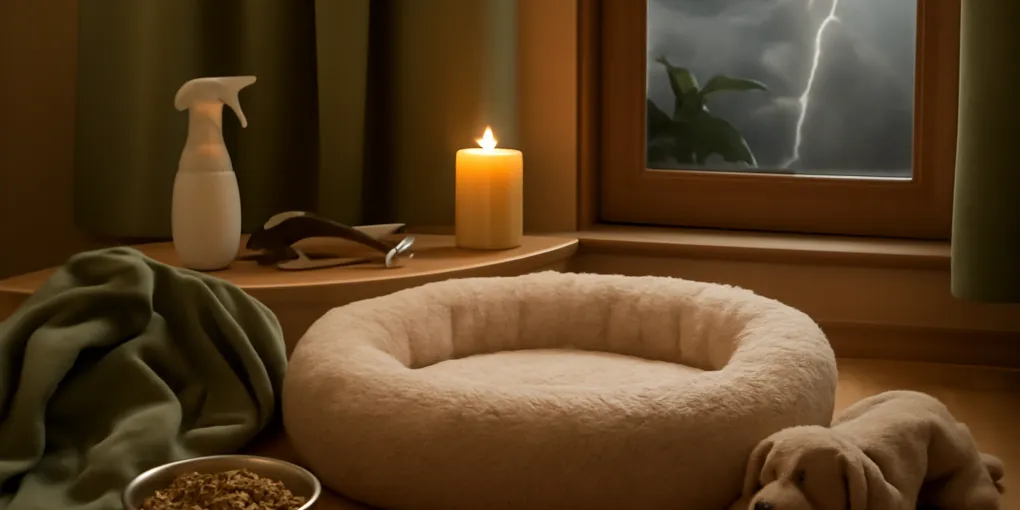
Dog Thunderstorm Safe Room Protocol: A Calmer Setup Before the First Rumble
ProtocolQuick picks
White noise machine or fan
★ Top pick Sound masking- Why it is included: Masks distant thunder and hallway noise without adding flashing lights; start at normal household volume before storms.
Adaptil dog pheromone diffuser
Optional support- Why it is included: Optional support for dogs who already settle in the room; not a rescue treatment for severe phobia.
Dog Thunderstorm Safe Room Protocol: A Calmer Setup Before the First Rumble
A dog thunderstorm safe room is a prepared indoor place where your dog can hide, hear less noise, avoid window flashes, and access water without being trapped. It works best when you build it on calm days, not when the sky is already cracking.
This protocol is for mild to moderate storm fear: pacing, panting, hiding, whining, or seeking contact. If your dog breaks crates, injures teeth or nails, urinates from panic, tries to escape through doors, or cannot recover after storms, call your veterinarian. Noise phobia can need behavior medication and a formal plan.
For related calming tools, see our dog calming treats evidence review and no-force crate training guide.
Recommended products for a dog thunderstorm safe room
- Search Amazon for white noise machines for dogs if thunder starts your dog before rain does.
- Search Amazon for Adaptil dog pheromone diffuser if you want a low-risk environmental support to test before storm season.
- Search Amazon for washable dog crate mat for a bed that can handle drool, damp paws, and stress shedding.
- Search Amazon for lick mat for dogs for a food distraction only if your dog can still eat calmly.
PSR G6 score for the protocol
| Factor | Weight | Score | Weighted contribution |
|---|---|---|---|
| Research fit | 30% | 4.2 | 1.26 |
| Evidence quality | 25% | 3.8 | 0.95 |
| Value | 20% | 4.5 | 0.90 |
| User signals | 15% | 4.1 | 0.62 |
| Transparency | 10% | 4.3 | 0.43 |
| Composite | 100% | 4.2/5 |
The score is strongest for preparation, safety, and cost. It is weaker as a standalone treatment for severe storm phobia because panic often needs veterinary behavior support.
Step 1: choose the room by sound and escape risk
Pick an interior room, hallway, laundry area, walk-in closet, or basement corner with few windows. The best safe room is not always the prettiest room. It is the place with fewer flashes, fewer exterior walls, and no easy access to a front door, dog door, balcony, or fragile screen.
Remove hazards before you add comfort. Put away cords, cleaning products, loose shoes, chewable blinds, and trash. If your dog claws at doors, use a baby gate outside the room only if it does not create a trap. A panicked dog should not be locked where it can injure itself trying to escape.
Step 2: make the room familiar on clear days
Feed a few treats in the room when the weather is normal. Place the washable mat there for naps, keep the water bowl in the same corner, and run the white noise machine or fan at low volume for 10-minute practice sessions while nothing scary is happening. The goal is predictable familiarity, not a dramatic storm bunker reveal.
If you use a crate, leave the door open during practice unless your dog already chooses the crate comfortably. A covered crate can help some dogs, but a closed crate can make others panic harder. Watch body language: loose body, normal breathing, and voluntary entry are good signs.
Step 3: mask sound without overwhelming the dog
White noise, a fan, or steady music can blur distant thunder. Start before the storm is overhead. Keep the volume at a level you would tolerate in the room yourself. Very loud sound can add stress, especially for dogs already sensitive to noise.
Close curtains before lightning becomes frequent. If window flashes are the trigger, a darker room may help more than another supplement or toy.
Step 4: add comfort items that do not create risk
Use a washable bed or mat, water bowl, and one safe chew or lick mat. Skip hard chews if your dog bites frantically during storms. Skip treat puzzles if food causes guarding between dogs. If you have multiple pets, separate them before arousal rises.
A pheromone diffuser is reasonable to test, but plug it in according to the label and give it time. Do not expect a diffuser to interrupt a full panic episode in five minutes.
Step 5: respond to the first signs, not peak panic
Move to the safe room when weather alerts, pressure changes, wind, or distant thunder first worry your dog. Invite rather than drag. Use a calm voice, dim the room, start sound masking, and offer a simple food activity if your dog can still eat.
Comforting a scared dog is not the same as rewarding fear. Quiet contact, sitting nearby, or letting the dog lean against you can be appropriate. Avoid frantic reassurance, punishment, or forcing the dog to face thunder at a window.
Step 6: track what happened after the storm
Write down the date, storm intensity, room used, tools used, and recovery time. A dog that returns to normal within minutes is different from a dog that pants for hours. This log helps your veterinarian decide whether situational medication, behavior modification, or referral is needed.
If storms are frequent in your region, ask about a pre-storm medication plan before the season peaks. Many medications work best when given before panic is extreme.
Common safe-room mistakes
The first mistake is waiting too long. Once a dog is in full panic, food, toys, and cues often stop working. The second is locking the dog in a crate because a crate feels tidy to the owner. The third is relying on one product while ignoring windows, sound, and escape routes.
Another mistake is treating thunderstorm fear as disobedience. A dog trying to hide in a bathtub or closet is communicating distress. Build around that preference if the location is safe.
FAQ
Should I close the crate door during thunderstorms?
Only if your dog already relaxes in a closed crate during mild stress. If the dog scratches, bites bars, drools heavily, or tries to escape, use an open crate or room setup and ask your veterinarian for help.
Do thunder shirts or anxiety wraps belong in the safe room?
They can be tested on calm days for dogs who tolerate body pressure. Remove the wrap if your dog freezes, overheats, chews at it, or seems more distressed.
Is a bathroom a good dog storm room?
Often, yes. Bathrooms may have fewer windows and muffled sound. Check for trash, medications, bath products, slippery floors, and toilet access before using one.
When is storm fear a veterinary problem?
It is veterinary-level when the dog injures itself, destroys exits, cannot eat or rest, panics before every forecast, or takes hours to recover. Medication can be humane when fear is intense.
Sources and veterinary references
- VCA Hospitals. Treating fear of storms and fireworks in dogs: https://vcahospitals.com/know-your-pet/treating-fear-of-storms-and-fireworks-in-dogs
- VCA Hospitals. Fears, phobias, and anxiety in dogs: https://vcahospitals.com/know-your-pet/fears-phobias-and-anxiety
- Merck Veterinary Manual. Behavior problems in dogs: https://www.merckvetmanual.com/dog-owners/behavior-of-dogs/behavior-problems-in-dogs