Dog Toy Rotation Bins for Small Homes
ProtocolWhen the dog-toy basket is full but the living-room floor is fuller, the collection needs fewer active choices, not another basket. Keep one open bin near the usual play area and move the rest into one or two reserve bins on a shelf or in a closet. At the next regular tidy, swap one group in and one group out.
The American Kennel Club’s indoor-playroom guidance uses the same basic idea: leave a small number of toys available and keep spares in a box. In a small home, the useful part is giving each container a fixed job and refusing to let the number of bins grow with the collection.
Cap the setup at three bins
Think of three containers as a ceiling, not a shopping list:
- One active bin holds the toys currently living in the room.
- Reserve bin one holds the next broad group.
- Reserve bin two holds the remaining group, if the collection needs it.
One active and one reserve bin may be enough for a smaller collection. The active container can be a low basket, fabric cube, or open box that is easy to reset. Reserve bins can have lids because they are opened only during a swap.
The containers do not have to match. What matters is being able to identify the reserve group without emptying everything onto the floor.
Sort for the next cleanup
Use broad labels that make sense from across the room: “soft,” “balls,” “ropes,” or “mixed.” They are storage labels, not claims about what a toy does for a dog.
Avoid a detailed inventory. If you need a long label to decide where an object goes, cleanup will slow down and the active bin will become the place for everything that feels ambiguous. Two or three familiar groups are enough.
Keep toys from the current group together in the active bin. When something clearly belongs to a reserve group, return it there at the next swap rather than letting the everyday basket expand into permanent overflow.
Give the active bin one parking spot
Choose a patch of floor that can hold the active bin without becoming an obstacle: beside a media cabinet, under the open end of a console, or at the end of a low shelf near the play area. Measure the available width and depth before settling on a container.
The active bin does not have to disappear from view. It has to return to the same place. That fixed endpoint lets everyone know when the room reset is finished.
Reserve bins belong somewhere less prominent—a cabinet shelf, closet, or storage bench. If floor space is scarce, place them side by side or stack them where the front labels remain visible. Keeping reserve storage out of the main room is what makes the active collection feel smaller.
Swap groups without making a new pile
Skip the rigid rotation calendar. Tie the swap to something that already happens: a weekend tidy, a living-room reset, or the moment the active basket stops being easy to put away.
Use one empty container as the handoff:
- Gather the current toys into the active bin.
- Carry it to the reserve-bin shelf.
- Empty the next reserve group into the active bin.
- Put the former active group into the newly empty reserve bin.
- Return the active bin to its parking spot.
This takes the couch, rug, and coffee table out of the process. There is no middle pile to finish later, and every toy that stays in the rotation ends the swap inside a container.
If something no longer belongs in the three-bin collection, take it out and decide on its next home separately. Do not create a fourth “maybe” bin beside the others.
Let the bins stay the same size
A new toy can join one existing group. When that group no longer fits, remove a few items from the rotation before adding more storage. The same rule works when a shared room changes or a household moves: keep the three familiar jobs and adjust their contents.
The AKC also describes a designated toy box as a clear destination during cleanup practice. Whether a person handles the reset or the box is part of an established household routine, one obvious endpoint is easier to maintain than several temporary piles.
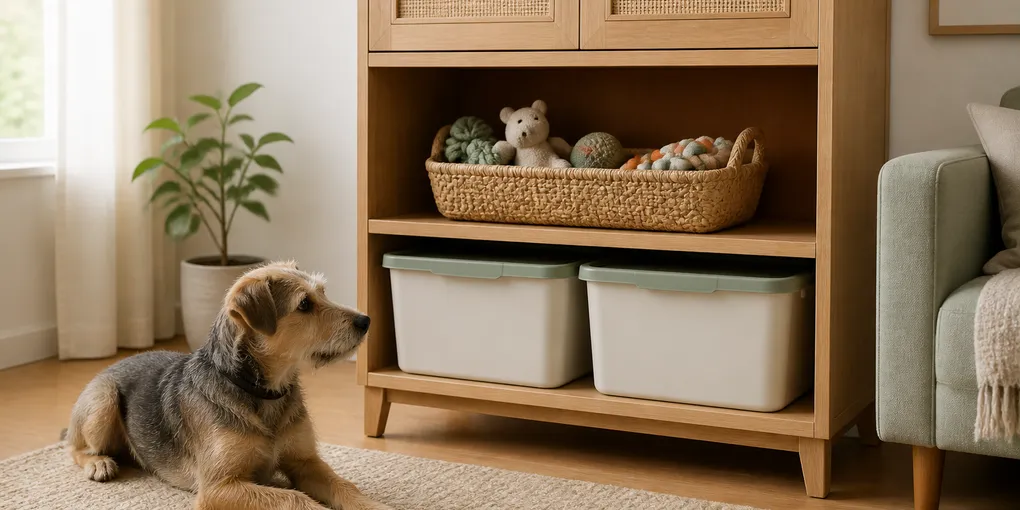
Picture a one-bedroom apartment with a low cabinet near the sofa. The open active basket parks beside the cabinet. Two labeled reserve bins sit on its lower shelf. A swap happens during the weekly room reset, and the same open basket returns to the same floor patch. The collection changes; the room arrangement does not.
Pet-care boundary
This is a storage routine for toys your household has already chosen. It does not evaluate a toy’s suitability, condition, or safety for a particular dog. Follow the product information and the guidance of the appropriate pet-care professional for those decisions.
FAQ
How many bins do I need for a dog toy rotation in a small home?
Three bins are enough for a compact setup: one active bin and two reserve bins. Use fewer if the collection is small.
Where should dog toy rotation bins go in a small apartment?
Put the active bin near the usual play area and reserve bins in a closet, cabinet, or another out-of-the-way storage spot.
Should the active dog-toy bin have a lid?
An open active bin makes the reset fast. Lidded reserve bins make the stored sets easy to identify and stack.
How often should I reset a dog toy rotation bin?
Reset it when the active set is no longer working for your household rhythm, such as at the end of a week or after a busy stretch.
Sources
- American Kennel Club: Create an indoor dog playroom
- American Kennel Club: Teach your dog to clean up toys