Quick picks
| Product | Key Specs |
|---|---|
| See price on Amazon |
|
| See price on Amazon |
|
Product availability, certifications, and retailer details can change; check the current Amazon page before buying.
How to Clean a Cat Water Fountain Without Biofilm Coming Back
A cat water fountain stays useful only if the pump, spout, bowl, and filter housing are cleaned on a predictable schedule. The practical rule is simple: rinse and refill daily, wash food-contact parts every two to three days, and deep-clean the pump weekly. If you can feel slime on the bowl wall or see cloudy strands near the pump, the fountain is already overdue.
Fountains can help some cats drink because moving water is more attractive than a stale bowl, but a dirty fountain does the opposite. Biofilm changes odor and mouthfeel, hard-water scale slows flow, and a clogged pump can heat the water slightly. For cats with urinary concerns, water access is part of the larger environment plan; see our senior cat care protocol for broader litter, mobility, and hydration checks.
Fast setup recommendations
- If your current fountain is scratched plastic, search Amazon for a stainless steel cat water fountain before replacing another filter pack. Scratches shelter biofilm.
- If you already own a fountain, search Amazon for cat fountain pump cleaning brushes. A sponge cannot clean the impeller chamber.
- Keep a second filter pack on hand, but do not rely on filters to rescue dirty water. Filters polish water; they do not sanitize a neglected pump.
The cleaning schedule that actually works
Daily: empty obvious debris, rinse the bowl, refill with fresh water, and check that the flow sounds normal. A pump that suddenly gets louder is often pulling air because the reservoir is low or the intake is slimed.
Every two to three days: unplug the fountain, remove the bowl and top tray, wash with fragrance-free dish soap, rinse until no slickness remains, and dry with a clean towel. Cats are sensitive to smell, so perfumed soap residue can reduce use.
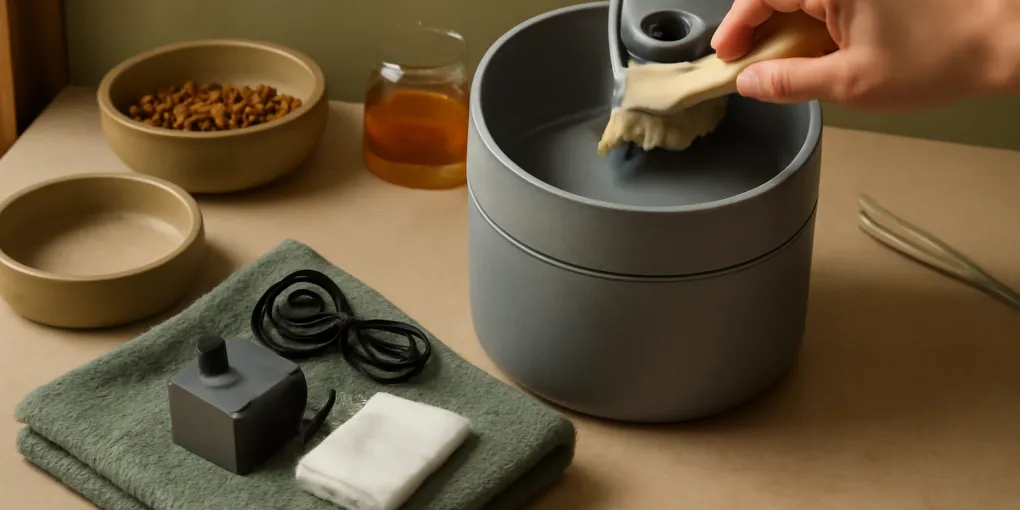
Weekly: disassemble the pump. Remove the cover, lift out the impeller if the model allows it, scrub the impeller well with a narrow brush, rinse tubing or spouts, and wipe mineral scale before it hardens. This is the step most owners skip. Unfortunately, the pump is also where warm, low-flow, nutrient-rich water makes biofilm hardest to remove.
Monthly: inspect the cord, pump suction cups, silicone seals, and any plastic parts for cracks or roughness. Replace filters according to the manufacturer’s schedule or sooner if flow slows after cleaning. If the bowl smells clean but the water still foams or clouds quickly, the pump may need replacement.
PSR G6 Composite Score for cat fountain hygiene
| Factor | Weight | Score | Weighted contribution |
|---|---|---|---|
| Research fit | 30% | 4.3 | 1.29 |
| Evidence quality | 25% | 4.1 | 1.03 |
| Value | 20% | 4.2 | 0.84 |
| User signals | 15% | 4.0 | 0.60 |
| Transparency | 10% | 4.4 | 0.44 |
| Composite | 100% | 4.3/5 |
The score is not a medical claim. It reflects how well the product category or protocol maps to veterinary guidance, owner execution, replacement costs, and avoidable risk. A high score means the purchase or routine has a clear job and a low chance of causing new problems when used as directed. It does not mean every pet should use it or that it replaces veterinary care.
Step-by-step deep clean
- Unplug first. Never disassemble a running fountain, and do not pull the pump by the cord.
- Discard the water. Do not top off dirty water and call it clean. Biofilm fragments remain in the reservoir.
- Separate food-contact parts. Bowl, lid, spout, filter tray, and silicone gaskets should be removed if the design allows.
- Wash smooth parts. Use warm water, mild dish soap, and a dedicated sponge or brush. Rinse until the surface squeaks rather than feels slick.
- Open the pump. Most small pumps have a faceplate and impeller cover. Photograph the assembly once so you know how it fits.
- Brush the impeller chamber. Use a tiny bottle brush or interdental-style brush. This is where gray slime hides.
- Remove scale. For hard-water buildup, soak non-electrical plastic or stainless parts in a diluted white-vinegar solution, then rinse thoroughly. Do not soak the electrical pump body unless the manufacturer says it is safe.
- Dry and reassemble. Let parts air-dry briefly, reassemble, fill to the correct line, then plug in. Confirm normal flow before offering it to the cat.
Stainless, ceramic, or plastic?
Stainless steel is the best default for most homes because it is durable, less porous than plastic, and often easier to wash. Ceramic can also be hygienic if the glaze is intact, but chips create cleaning problems and the bowl can be heavy. Plastic is cheaper and quiet, but scratches matter. Once the surface is rough, washing removes visible grime while leaving protected niches for biofilm.
The material does not exempt the pump. A stainless bowl with a neglected pump is still a dirty fountain. When comparing fountains, inspect how easily the pump comes apart, whether replacement pumps are available, and whether the spout has hidden cavities. A pretty fountain with inaccessible channels is worse than a plain fountain you clean consistently.
Filter mistakes that make water worse
A carbon filter is not a cleaning substitute. It can reduce odor and catch debris, but once it is saturated it becomes another wet surface inside the fountain. Rinse new filters before use to remove carbon dust. Replace them on schedule, and replace sooner in multi-cat homes, homes with long-haired cats, or homes where food crumbs land near the fountain.
Do not use a filter that smells sour, feels slimy, or sheds particles. Also avoid stacking extra filters to stretch maintenance intervals; extra restriction can stress the pump and reduce flow. If filters are expensive or hard to find, factor that into the purchase before buying a fountain. A fountain that requires proprietary filters you cannot get reliably may become a stagnant bowl.
Where to place the fountain
Place the fountain away from food bowls and litter boxes. Many cats prefer water that is separated from feeding and elimination areas. Put it on a waterproof mat, but avoid a mat with deep grooves that traps spilled water and hair. If a cat is cautious, start with the fountain running next to a familiar still bowl, then remove the still bowl only after you see consistent use.
Noise matters. A rattling pump can scare a cat or signal low water. Keep the reservoir filled to the correct line and set the fountain on a level surface. If your cat drinks less after a cleaning, suspect soap smell, pump noise, changed location, or a filter that was not rinsed.
Troubleshooting common fountain problems
If the pump rattles after cleaning, check water level first. Many pumps become noisy when the reservoir is even slightly low. Next, reseat the impeller and cover. A tiny misalignment can create vibration that makes the fountain seem broken. If the pump hums but does not move water, unplug it, open the faceplate again, and remove hair wrapped around the impeller shaft.
If the water smells metallic, inspect stainless parts for residue and rinse again. If it smells sour, suspect the pump, tubing, or filter tray rather than the bowl. Odor that returns quickly usually means one hidden part was not opened during cleaning. If the cat suddenly stops using the fountain, offer a plain water bowl while you troubleshoot so hydration access does not depend on one device.
If hard-water scale keeps returning, use filtered water if practical and clean before the scale becomes crusty. Scale is not just cosmetic; it creates rough surfaces where biofilm is harder to wipe away. A fountain in a hard-water home may need a vinegar-scale step weekly, while a soft-water home may need it monthly.
Multi-cat and kitten adjustments
In a multi-cat home, one fountain may not be enough. Resource competition can happen quietly: one cat sits near the water, another avoids the area, and the owner never sees a fight. Provide more than one water station in different rooms, especially if one cat is senior, timid, or bullied. Cleaning also needs to be more frequent because hair and saliva load increase.
For kittens, choose a shallow, stable fountain and keep a still bowl available. Kittens investigate with paws and mouths, so cords should be routed safely and the fountain should not tip when climbed. Avoid complicated fountains with tiny parts that can be chewed. The first goal is safe water access, not maximum filtration.
For senior cats, place the fountain where it does not require jumping or stair climbing. Arthritis can reduce water intake indirectly if the only appealing water is hard to reach. A quiet stainless fountain on the main living level is usually better than a decorative fountain on a counter.
Replacement signs and purchase timing
Replace a fountain when the pump remains noisy after cleaning, the bowl surface stays slick after washing, replacement filters are unavailable, or the cat avoids it despite fresh water and a familiar location. Do not wait for complete pump failure if the fountain is your cat’s preferred water station. Keep a plain bowl available during any transition so the cat never has to choose between a strange device and thirst.
When buying a replacement, prioritize cleanability over decorative shape. A wide bowl, removable pump, simple spout, and available replacement parts matter more than lights or app features. If you cannot see how the pump opens from the listing or manual, assume cleaning will be harder than advertised. A quiet, plain fountain that you clean every week beats a complex fountain that hides residue.
The weekly pump-clean rule
If you would not drink from the part after touching it, your cat should not be asked to drink from it either. Smooth surfaces should feel clean, the pump should open, and the water should smell neutral. The weekly pump clean is the difference between a helpful hydration tool and a recirculating dirty bowl.
FAQ
How often should I clean a cat water fountain in a two-cat home?
Plan on washing the bowl every two days and deep-cleaning the pump weekly. More cats means more hair, saliva, and food crumbs entering the water.
Is vinegar safe for cleaning fountain scale?
Diluted white vinegar can help dissolve mineral scale on non-electrical parts, but rinse thoroughly afterward. Cats may avoid a fountain that smells acidic. Follow the fountain manufacturer’s pump instructions.
Why does slime return one day after cleaning?
The pump chamber, tubing, or scratched plastic surface is usually still contaminated. Open the pump, use a narrow brush, and consider replacing scratched plastic parts.
Sources and veterinary references
- Cornell Feline Health Center: encouraging water intake and monitoring urinary signs, https://www.vet.cornell.edu/departments-centers-and-institutes/cornell-feline-health-center
- AAFP/ISFM: environmental needs guidance for cat resource placement, https://catvets.com/guidelines/practice-guidelines/environmental-needs-guidelines/
- FDA: safe handling principles for pet food/water contact surfaces, https://www.fda.gov/animal-veterinary/animal-health-literacy/tips-safe-handling-pet-food-and-treats