How to Set Up a Dog Cooling Station Safely in Hot Weather
ProtocolQuick picks
| Product | Key Specs |
|---|---|
| See price on Amazon |
|
| See price on Amazon |
|
| See price on Amazon |
|
Product availability, certifications, and retailer details can change; check the current Amazon page before buying.
Quick verdict
A dog cooling station is a heat-risk control system, not a cute patio accessory. The safest setup combines shade, airflow, fresh water, cool walking surfaces, and a fast route indoors. Cooling mats and raised cots can help, but they do not prevent heatstroke if a dog remains outside during dangerous heat, humidity, or exertion.
Brachycephalic dogs, senior dogs, puppies, overweight dogs, dark-coated dogs, and dogs with heart, airway, or endocrine disease need extra caution. If a dog is panting hard, weak, vomiting, confused, collapsing, or has a very high rectal temperature, treat it as an emergency and seek veterinary care immediately.
How we evaluated
We compared these options by species-specific welfare guidance, the quality of supporting sources, durability, cleanability, owner-reported failure points, and clarity about materials, sizing, limits, and realistic use.
The station layout
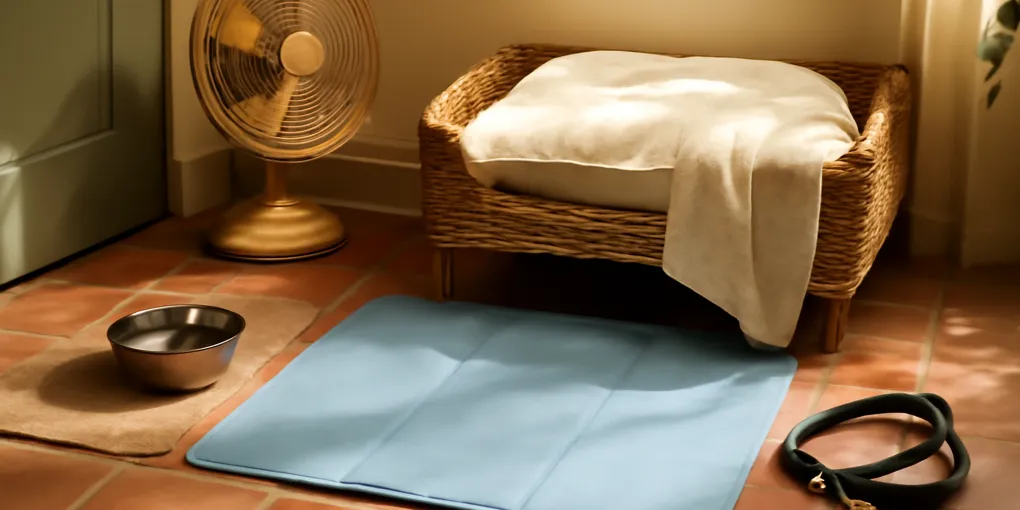
Pick the coolest practical location first. Indoors with air conditioning is best during heat alerts. If the station must be outdoors for supervised breaks, place it where shade is present at the actual time of use, not only in the morning. Add airflow from a fan if safely powered and protected from chewing. Put water where the dog can reach it without stepping onto hot concrete.
The surface matters. Asphalt, artificial turf, decks, and concrete can remain hot enough to burn paws. Use a raised cot, washable mat, or grass/shaded soil area, and test the ground with your hand. A cooling station should also have an exit: the dog must be able to leave the yard, crate, or patio and move into a cooler space.
Useful gear for a cooling station
| Check price | Item | Why it helps | Safety note |
|---|---|---|---|
| Check Amazon | Raised cooling cot | Airflow under the body reduces contact with hot ground | Check frame stability and fabric sag |
| Check Amazon | Heavy non-slip water bowl | Keeps water accessible and harder to tip | Refill often; warm water is less useful |
| Check Amazon | Shade sail or canopy | Creates predictable shade over the chosen rest zone | Recheck sun angle throughout the day |
| Check Amazon | Dog cooling mat | Gives a short-term cool surface indoors or in shade | Remove if chewed or punctured |
Compare current labels, prices, sellers, and return policies before buying.
Step-by-step setup
- Check the forecast, humidity, and heat index before planning outdoor time.
- Move exercise to early morning or skip it during heat alerts.
- Place shade, cot, water, and fan before the dog comes outside.
- Test the walking surface with your hand and avoid hot pavement.
- Supervise continuously; do not assume a dog will self-limit.
- Bring the dog indoors at the first sign of abnormal panting, weakness, glassy eyes, drooling, vomiting, or disorientation.
- Clean bowls and mats daily so the station does not become a bacteria or mildew source.
What not to do
Do not rely on a cooling vest or mat during strenuous play. Do not leave a dog tethered in the station. Do not shave a double-coated dog as a heat plan unless your veterinarian or groomer has a specific medical reason. Do not use ice baths as a home cure for suspected heatstroke; veterinary guidance commonly emphasizes controlled cooling and urgent transport.
Who needs a lower threshold
Flat-faced breeds, dogs with laryngeal paralysis, heart disease, obesity, Cushing’s disease, or previous heat injury can deteriorate faster. For those dogs, the cooling station is mainly for brief potty breaks and recovery, not outdoor lounging. A veterinarian can help set temperature limits for high-risk dogs.
Heat-risk triage before setup
Before buying anything, decide whether outdoor time is appropriate at all. Temperature alone is not enough; humidity, sun exposure, pavement temperature, wind, coat type, exertion, and the dog’s health all matter. If the weather service warns about dangerous heat, the safest cooling station is usually an air-conditioned room with water and potty breaks kept short.
A cooling station is useful for supervised transitions: after a short morning walk, during a shaded potty break, or while rinsing paws after being outside. It is not a license for midday fetch, long patio lounging, or leaving a dog outdoors while people are away. Dogs can deteriorate quickly because panting becomes less effective as humidity rises and as the dog becomes exhausted.
Building the station indoors
Indoors, choose a room with airflow and easy-to-clean flooring. Put the water bowl away from electrical cords and place a mat or cot where the dog already likes to rest. If using a fan, route the cord behind furniture or through a cord protector. If using a gel cooling mat, inspect it before each use and remove it if the dog scratches, digs, or chews.
Keep a thermometer in the room if the home does not have reliable air conditioning. During a heat event, power outages and poorly cooled rooms can become dangerous. Plan where the dog will go if the room becomes too warm: a basement, a neighbor’s cooled home, a car ride to a pet-friendly cooled building, or a veterinary clinic if symptoms appear.
Building the station outdoors
Outdoors, shade must cover both the dog and the water bowl for the whole session. Sun angle changes quickly. Test the station at the time of day you plan to use it. Use a raised cot on a stable surface, not on a slope where a senior dog can slip. Add a second bowl so water remains available if one spills. Keep the station close to a door so moving inside is easy.
Avoid misting systems or sprinklers for dogs that become frantic, inhale water, or stay overexcited. Water play can cool some dogs briefly, but it can also encourage more exertion. If the dog keeps running, barking, or chasing spray, end the session and move indoors.
Emergency recognition
Concerning signs include heavy uncontrolled panting, thick drool, weakness, stumbling, vomiting, diarrhea, collapse, seizures, glassy eyes, or confusion. If these appear, move the dog to a cooler area, begin cooling with cool water and airflow if safe, and contact a veterinarian or emergency clinic immediately. Do not wait to see whether a cooling mat fixes it.
Know your clinic options before summer. Save the nearest emergency hospital number and route. Heatstroke can damage organs even when the dog seems to improve, so veterinary evaluation matters.
Product limits
Cooling mats warm up as they absorb body heat. Raised cots help airflow but do not cool the air. Shade sails reduce sun exposure but do not remove humidity. Water bowls help only if the dog drinks and is not already dangerously overheated. Each product handles one part of the risk; none replaces supervision and conservative scheduling.
Senior and brachycephalic dogs
Older dogs and flat-faced dogs deserve stricter rules. Use shorter outdoor windows, avoid exertion, and keep the station closer to the door. Watch for delayed recovery after a walk. If the dog is still panting hard after several minutes in a cool room, that is a sign to reduce future heat exposure and consider veterinary advice.
Cleaning and seasonal maintenance
Wash bowls daily because warm water grows biofilm quickly. Dry mats and cots so mildew does not develop. Inspect shade hardware after wind. At the end of the season, discard punctured mats and cracked bowls rather than storing damaged gear. A cooling station should become a dependable routine, and dependable routines require boring maintenance.
Final pre-purchase checklist
Before purchasing, confirm five practical details. First, the product should match the animal’s current health rather than an idealized version of the animal. Second, the cleaning method should be realistic for a busy week, because dirty enrichment is not safe enrichment. Third, the product should have a clear stop rule: remove it if chewing, guarding, overheating, skipped meals, stool changes, or visible stress appears. Fourth, the product should fit the household layout so people can supervise first sessions and separate pets when needed. Fifth, the purchase should improve a daily routine you already understand instead of creating a complicated new routine that will be abandoned.
A useful way to test value is to run a seven-day observation log. Record when the item was offered, how much normal food or time was involved, whether the pet approached voluntarily, how the pet used it, and how the pet behaved afterward. Keep notes simple. If the item produces relaxed repetition, easier feeding management, better heat avoidance, or safer species-normal behavior, it may earn a place in the rotation. If it produces mess, conflict, chewing damage, missed meals, or owner frustration, return or retire it quickly.
Why citations do not replace observation
The linked veterinary and welfare sources support broad principles: animals need safe environments, feeding plans should respect biology, heat illness is urgent, and enrichment should match species-specific behavior. They cannot prove that one current Amazon listing is safe for every household. Manufacturing, sizing, materials, and quality control can change. Reader reviews can reveal patterns, but reviews are not medical evidence. Treat citations as the foundation for the decision, then use your own supervision to decide whether the specific item works for your pet.
Bottom line
Choose boring, inspectable, washable gear over dramatic claims. Use product links only as convenient search starting points, then read the current listing, dimensions, material notes, and recent reviews before buying. When in doubt, choose the simpler setup, shorten the session, or ask your veterinarian. The safest pet product is not the one with the strongest marketing; it is the one that fits the animal, supports a specific welfare goal, and remains easy for the household to use correctly.
References
- AVMA. Hot weather pet safety.
- AAHA. Heatstroke: what pet owners should know.
- VCA Hospitals. Heat stroke in dogs.
- RSPCA. Dogs in hot weather.
Practical reader notes for how to set up dog cooling station
Use the scoring notes above to narrow the practical choice: match the product or protocol to your space, risk tolerance, maintenance capacity, and the specific constraints described above.
For product comparisons, prioritize fit and repeat use over impressive feature lists. A cheaper item that is easy to place, clean, dose, adjust, or return often beats a premium item that adds friction. Check dimensions, serving size, material notes, warranty language, and whether replacement parts or refills are easy to find. For health and wellness topics, compare the article’s evidence notes with your own risk profile, medications, sleep schedule, training load, and clinician guidance. Stop using any protocol that creates pain, dizziness, allergic symptoms, digestive distress, or a behavior pattern that feels hard to control.
A useful first test is a two-week trial with a clear success metric. Choose one outcome that matters: fewer missed sessions, faster cleanup, less morning stiffness, better adherence, lower noise, easier travel, or a more predictable measurement routine. Keep the rest of the setup stable so you can tell whether the change helped. If the result is neutral, return or retire the item quickly instead of expanding the system around it. If it helps, document the settings, dose, location, or schedule that made it work so the benefit survives busy weeks.
Readers should also separate evidence strength from personal fit. Stronger evidence can justify trying a category, but it does not guarantee that a particular brand, accessory, or routine will be the best match. Weak or emerging evidence does not automatically make a topic useless; it means the trial should be lower cost, lower risk, and easier to abandon. This is why our recommendations emphasize transparent trade-offs, realistic setup instructions, and situations where skipping the purchase is the smarter move.
Finally, revisit the choice after the novelty period. If the product is not used, if the protocol creates more steps than it saves, or if the article’s safety caveats apply to you, the right answer may be to simplify. The goal is not to own the highest-scoring option. The goal is to solve the reader problem with the least friction and the most honest understanding of benefits, limits, and uncertainty.