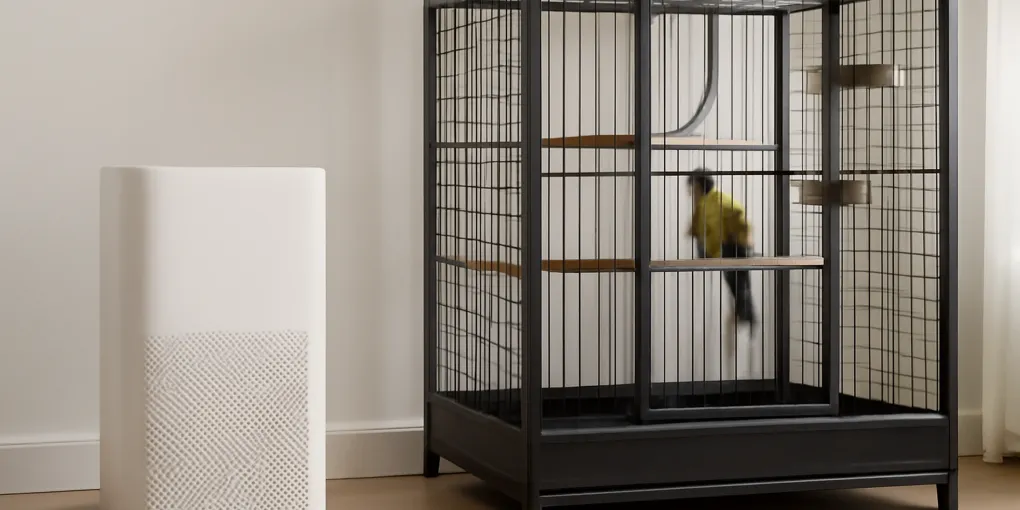
Best Air Purifiers for Bird Rooms: HEPA Picks Without Ionizer Guesswork
Buyer's GuideCoway Airmega Mighty AP-1512HH
Best for most medium bird roomsModel: AP-1512HH
Quick picks
| Product | Key Specs |
|---|---|
| See price on Amazon |
|
| See price on Amazon |
|
| See price on Amazon |
|
Product availability, certifications, and retailer details can change; check the current Amazon page before buying.
The Levoit Core 300-P is the simplest air purifier for a small bird room because it has published smoke CADR and no ionization. The Coway AP-1512HH Mighty suits a medium room if its optional ionizer stays off. The higher-airflow Honeywell HPA300 fits larger rooms when its cabinet size, noise, and three-filter replacement layout are acceptable.
Quick verdict
An air purifier is a particle-control tool, not a shield against fumes. Move birds to fresh air and seek veterinary guidance after smoke, overheated nonstick cookware, self-cleaning oven fumes, aerosol, or chemical exposure. Do not run an ozone generator in an occupied home.
How we sized the picks
Air cleaner marketing often quotes a maximum square footage based on only one air change per hour. Bird dander control usually benefits from repeated filtration, so compare clean air delivery rate, or CADR, rather than the largest number on the box.
Use this planning equation:
Required smoke CADR in cfm = room volume in cubic feet × desired air changes per hour ÷ 60
For a 12 × 12 foot room with an 8-foot ceiling, volume is 1,152 cubic feet. Five air changes per hour requires about 96 cfm before accounting for doors, alcoves, furnishings, filter loading, or low-speed operation. Buy enough capacity to run the unit at a tolerable medium speed, not only at its loudest turbo setting.
EPA advises using smoke CADR for fine particles and choosing a unit sized to the room. CADR is not a bird-safety certification. You must still inspect ionizer controls, placement, cords, and cleaning products.
Comparison at a glance
| Model | Published smoke CADR | Practical lane | Ionizer decision | Main tradeoff |
|---|---|---|---|---|
| Coway AP-1512HH Mighty | 233 cfm | Medium bird room | Separate bipolar ionizer; leave off | Strong airflow, but owner must control the optional feature |
| Levoit Core 300-P | 143 cfm | Small room | Manufacturer says no ions | Compact, but may need higher fan speed or a second unit in a larger room |
| Honeywell HPA300 | 300 cfm | Larger room | Conventional HEPA model; verify exact listing | Large cabinet, audible high speed, and three-filter replacement layout |
Published figures come from manufacturer specification pages and AHAM directory references. Models and manuals can change, so match the model number on the carton, product page, and replacement filter.
Best for most medium rooms: Coway AP-1512HH Mighty
The Coway AP-1512HH combines a published smoke CADR of 233 cfm with an automatic mode and washable prefilter. Check Coway Airmega Mighty AP-1512HH on Amazon. It has enough headroom for many medium bedrooms or offices without requiring maximum speed all day.
The important bird-room caveat is explicit: the AP-1512HH includes a separately controlled bipolar ionizer. Leave that feature off. After an outage, unplugging, or another person cleaning the controls, confirm that it remains off. If you do not want any chance of someone activating it, choose a model without the feature.
Best for: a measured medium room, a dusty species, and an owner willing to inspect the control state.
Skip it when: children or visitors may press controls, or the bird chews cords near floor-level equipment.
Best compact no-ionizer pick: Levoit Core 300-P
The Levoit Core 300-P is compact, uses a cylindrical filter, and has an AHAM smoke CADR of 143 cfm. Check Levoit Core 300-P on Amazon. Levoit states that Core-series purifiers do not produce ions, which removes one setup decision.
It is the cleanest fit for a smaller bird room calculated at roughly 100 to 140 cfm. In a larger room, do not rely on a one-air-change marketing area. Either choose more CADR or use two correctly placed units.
Best for: a smaller sleeping or bird room where simple controls and a small footprint matter.
Skip it when: the calculated airflow requires turbo speed continuously. Noise can lead owners to turn an undersized unit off.
Best higher-airflow pick: Honeywell HPA300
The Honeywell HPA300 publishes a smoke CADR of 300 cfm. Check Honeywell HPA300 on Amazon. That makes it the strongest single-unit option here for a larger room or a layout with more particle load.
The HPA300 uses multiple HEPA filter sections, so price the correct full replacement set rather than one panel. Measure the cabinet and required intake clearance. High speed is noticeable, and a purifier that blocks a walkway or frightens the bird will not stay in the right place.
Best for: larger rooms where the measured airflow requirement approaches 250 to 300 cfm.
Skip it when: floor space, operating noise, or recurring filter cost favors two smaller units.
Placement in a bird room
Put the purifier where room air can reach the intake and clean air can circulate without blowing continuously across the cage. Follow the manual’s wall clearance. Keep cords in rigid cord protection outside beak reach and do not place the unit inside a flight enclosure.
Avoid these positions:
- directly beneath the cage, where seed hulls can clog the intake;
- beside a humidifier, where moisture can load the filter;
- behind a curtain or furniture panel;
- in a draft that blows feathers and dust toward the bird;
- next to scented candles, plug-ins, diffusers, or aerosol products that should not be used around birds anyway.
Run the purifier before dust is visible. Vacuum the prefilter outdoors or away from the bird according to the manual, wear a mask if needed, and wash hands before returning to cage care.
Filter-cost checklist
Before ordering, price one year of genuine replacement filters at the interval in the manual. Heavy feather dust can shorten prefilter-cleaning intervals, though it does not justify replacing the HEPA filter without checking the indicator and condition.
Verify:
- exact purifier model number;
- exact replacement filter code and number of panels required;
- prefilter cleaning method;
- whether carbon is a thin odor sheet or a substantial media bed;
- noise at the speed you expect to use;
- behavior after power interruption;
- no ozone, ionizer, plasma, or UV feature active in normal use.
Do not spray fragrance or disinfectant onto a filter. A purifier can distribute volatile chemicals throughout the room.
Three room scenarios with the math shown
For a 10 by 10 foot room with an 8-foot ceiling, the volume is 800 cubic feet. Five air changes per hour requires about 67 cfm. The Core 300-P has useful published headroom, which lets an owner choose a quieter setting after confirming particle control in the actual room. A closed door, cage cover, and loaded filter can change performance, so the calculation is a starting point rather than a guarantee.
For a 14 by 14 foot room with an 8-foot ceiling, the volume is 1,568 cubic feet. Five changes per hour requires about 131 cfm. The Coway’s 233 cfm smoke CADR gives more operating margin than the compact Levoit. The ionizer control is the decisive caveat: a household that cannot reliably keep it off should choose a model without that option.
For a 20 by 15 foot room with a 9-foot ceiling, the volume is 2,700 cubic feet. Five changes per hour requires 225 cfm. The HPA300’s published 300 cfm smoke CADR fits on paper, but an open doorway, L-shaped plan, or multiple cages may justify two units. Two smaller purifiers placed apart can circulate air more evenly, while one larger unit is simpler to maintain.
Annual filter-cost worksheet
Do not compare purifier prices without the consumables. For each exact model, record the current price of a complete genuine filter change, the manual’s stated replacement interval, and the number of prefilters or HEPA panels in one change. Multiply full-set cost by expected changes per year, then add estimated electricity use at the fan speed you can tolerate.
The HPA300 requires three HEPA R filters for a complete HEPA change, a detail that makes a single-filter listing look artificially cheap. The Core 300-P uses one cylindrical assembly. The Coway uses separate prefilter, deodorization filter, and HEPA stages. Third-party filters may fit physically without matching the original pressure drop, sealing, or published performance. If you choose them, the product’s original CADR is no longer direct evidence for that altered configuration.
Check filter availability before buying a discontinued color or marketplace bundle. A purifier with strong specifications but unavailable filters becomes an expensive fan.
What a purifier cannot fix
Fine feather dust on shelves may decrease with enough HEPA airflow, but cage papers, food debris, and dried droppings still require safe cleaning. Wet-clean dusty surfaces rather than sweeping particles into the air. Use ventilation and bird-safe cleaning guidance from an avian veterinarian.
Persistent tail bobbing, voice change, nasal discharge, open-mouth breathing, weakness, or reduced activity requires prompt avian veterinary assessment. Buying a larger purifier is not a respiratory treatment.
Sources
- US Environmental Protection Agency, Guide to Air Cleaners in the Home: https://www.epa.gov/indoor-air-quality-iaq/guide-air-cleaners-home
- ENERGY STAR certified room-air-cleaner results for Coway AP-1512HH: https://www.energystar.gov/productfinder/product/certified-room-air-cleaners/results?search_text=AP-1512HH
- ENERGY STAR certified room-air-cleaner results for Levoit Core 300-P: https://www.energystar.gov/productfinder/product/certified-room-air-cleaners/results?search_text=Core%20300-P
- ENERGY STAR certified room-air-cleaner results for Honeywell HPA300: https://www.energystar.gov/productfinder/product/certified-room-air-cleaners/results?search_text=HPA300
Recommendations are based on published EPA guidance, ENERGY STAR model data, and the operating controls documented for each exact model.
Frequently Asked Questions
- Birds have sensitive respiratory systems. Avoid ozone-generating devices and leave optional ionizer or plasma features off. Confirm behavior after power loss and firmware changes.
- HEPA captures particles such as dander and feather dust, not gases. Activated carbon can help with some odors, but persistent odor calls for cage cleaning and ventilation, not fragrance.
- No. A purifier recirculates room air. It does not remove carbon dioxide or every gas and cannot make smoke, overheated cookware fumes, aerosols, or household chemicals safe for birds.