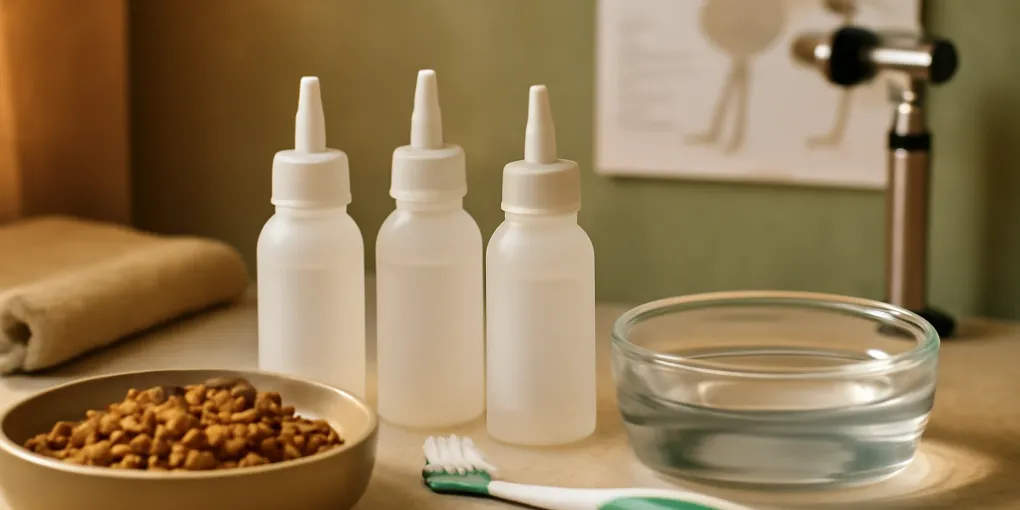
Best Cat Dental Water Additives in 2026
Buyer's GuideVet-formulated cat dental water additive
Best overall categoryBest use: mainstream daily oral-care support
Check current Amazon price
Quick picks
| Product | Key Specs |
|---|---|
| See price on Amazon |
|
| See price on Amazon |
|
| See price on Amazon |
|
| See price on Amazon |
|
Product availability, certifications, and retailer details can change; check the current Amazon page before buying.
Best Cat Dental Water Additives in 2026
An evidence-focused guide to cat dental water additives for breath and plaque support, including ingredient cautions, palatability, and PSR/G6 scoring. This guide is written for owners who want a practical answer without pretending that a product or routine can replace veterinary care. We separate what is strongly supported, what is plausible but product-dependent, and what should be treated as marketing until the label or your veterinarian confirms it.
Quick internal reading: see our related guides to best cat litter, best cat water fountains, best calming beds for anxious dogs, and best slow feeder bowls for dogs when comparing adjacent comfort, hygiene, and enrichment decisions.
Quick picks
Use the structured comparison card above as the quick-pick set for this guide:
- Best overall category: search Amazon for a vet-formulated cat dental water additive for mainstream daily oral-care support when the label is cat-specific and the bottle gives exact dilution directions.
- Best for picky cats: search Amazon for a flavorless cat dental water additive when scented water causes refusal or a fountain already changes the bowl smell.
- Best breath support: search Amazon for an enzymatic cat dental water additive for mild odor when the cat is still eating normally and has no mouth-pain signs.
- Best for multi-pet homes: search Amazon for a cat-and-dog dental water additive only when the label clearly includes cats and every pet tolerates the bowl routine.
A useful buying rule: do not choose by breath claims alone. Choose the product your cat will drink consistently, that does not reduce total water intake, and that gives you an easy stop signal if taste, vomiting, diarrhea, drooling, or bowl avoidance appears.
How we evaluated the recommendation
This recommendation is not based on popularity alone. We prioritize fit with veterinary and animal-welfare guidance, source quality, repeat-use practicality, owner failure points such as cleaning burden or refusal, and clear labels with realistic limits.
| Category | Weight | Batch score | Rationale |
|---|---|---|---|
| Research | 30% | 27/30 | The guidance is grounded in veterinary welfare, behavior, oral-health, hygiene, or safety sources rather than brand claims alone. |
| Evidence Quality | 25% | 21/25 | Strong sources support the general principles, while exact product performance still depends on formulation, fit, and owner use. |
| Value | 20% | 18/20 | The recommendations favor repeatable routines and products owners can maintain without waste or risky shortcuts. |
| User Signals | 15% | 13/15 | We account for the common reasons these products fail in real homes: palatability, chewing, cleaning burden, overuse, and avoidance. |
| Transparency | 10% | 9/10 | Claims are limited to what the evidence can support, and veterinary red flags are called out. |
Overall PSR/G6 rating: 88/100 for a well-matched owner using the guidance as directed.
What water additives can and cannot do
Dental water additives may help with breath odor and plaque-control support when the formula is appropriate and the cat drinks enough treated water. They cannot remove established tartar, clean below the gumline, treat tooth resorption, or replace dental exams.
Tooth brushing remains the strongest home-care approach when a cat tolerates it. Dental diets, treats, gels, and water additives can be adjuncts, especially if they have transparent active ingredients and realistic claims.
If your cat has red gums, drooling, pawing at the mouth, facial swelling, dropping food, weight loss, or sudden food refusal, skip the product trial and call your veterinarian. Cats often hide oral pain.
Safety and palatability
The best product is useless if the cat drinks less water. Start with a partial dose, keep plain water available during the trial, and watch urine clumps, appetite, and behavior. Hydration comes before dental supplementation.
Avoid xylitol, human mouthwash, dog-only products, and vague essential-oil blends. In multi-pet homes, choose only products specifically labeled for cats and dose according to the label. Cats with kidney disease, heart disease, urinary issues, diabetes, or prescription diets need veterinary input.
Flavorless formulas often work best for picky cats. Fountains may need extra caution because additives can interact with filters or leave residue in pumps.
How to judge value
Calculate cost per treated bowl, not just bottle price. Measure the bowl volume before dosing. Daily-use products need to be affordable enough that you will not skip doses or stretch dirty water.
Look for clear active ingredients, exact dilution instructions, manufacturer contact information, and claims limited to breath or plaque support. Be skeptical of products claiming to cure gum disease or replace cleanings.
Reassess after four to six weeks. If your cat dislikes the water or breath does not improve, stop and choose a different oral-care strategy.
Which additive type fits your cat?
A vet-formulated daily additive is the safest starting point for a healthy adult cat with ordinary breath concerns, visible plaque, or an owner who cannot brush every day. Buy the smallest bottle first, confirm the dilution in teaspoons or capfuls per bowl volume, and avoid products that only say “freshens breath” without listing active ingredients. If the label is vague, skip it.
A flavorless additive is the better first purchase for cats that already reject new foods, scented litter, or fountain filter changes. The win condition is not a stronger ingredient list; it is a cat that keeps drinking. Start below the full label dose for two or three days, keep a second plain-water bowl out, and stop if urine clumps shrink or the cat begins visiting the bowl less often.
An enzymatic formula can make sense when breath odor is mild and the mouth otherwise looks comfortable. Avoid using it to mask severe odor, drooling, one-sided chewing, pawing at the mouth, or food dropping. Those signs can point to oral pain, resorptive lesions, infection, or another medical problem that a water additive cannot solve.
A shared cat-and-dog additive is convenient only if the label explicitly gives cat directions. Dog-only dental products, human mouthwash, essential-oil blends, and anything containing xylitol are automatic skips for cats. In a multi-pet home, dose for the actual water volume and watch every animal, because one pet avoiding the shared bowl can turn a convenience product into a hydration problem.
Bowl and fountain setup checks
Use dental additives in a clean, non-porous bowl and change the water daily. If you use a fountain, check the pump and filter instructions before adding anything; some additives can leave film, shorten filter life, or create odor in tubing. A wide ceramic or stainless bowl is easier to monitor during the first week because you can see whether the water level is changing normally.
Do not combine several oral-care products at once. If you add a water additive, keep food, treats, brushing attempts, and dental chews stable for the first trial so you can tell whether the additive changed drinking, breath, stool, or appetite. For cats with kidney disease, urinary history, diabetes, heart disease, prescription diets, or current medications, ask your veterinarian before changing the water routine.
Red flags that should change the purchase
Skip the additive and book a dental exam if bad breath is sudden, severe, or paired with drooling, pawing, blood on toys, head shyness, one-sided chewing, food dropping, facial swelling, or weight loss. Those are not normal shopping problems. Also skip any product whose label hides the active ingredient, uses dog-only dosing, asks you to add product to every water source without a plain-water backup, or makes disease-treatment claims. For an older cat, a product that quietly reduces drinking can be more harmful than mild plaque, so hydration and pain screening come before breath improvement.
Evidence notes and citations
The practical limits in this guide come from veterinary dental guidance and cat-hydration priorities rather than from brand promises. The American Veterinary Medical Association dental-care guidance explains why home care supports but does not replace veterinary dental assessment: https://www.avma.org/resources-tools/pet-owners/petcare/pet-dental-care. The Veterinary Oral Health Council lists accepted oral-care products and is a useful cross-check for claim strength: https://vohc.org/. Cornell Feline Health Center resources are useful for recognizing cat oral-pain and hydration concerns: https://www.vet.cornell.edu/departments-centers-and-institutes/cornell-feline-health-center. FDA xylitol guidance is dog-focused but reinforces why xylitol-containing products should not be used around pets: https://www.fda.gov/animal-veterinary/animal-health-literacy/paws-xylitol-toxic-dogs.
Bottom line
The best cat dental water additive is the one that keeps your cat drinking normally while adding a modest oral-care layer. Start flavorless if your cat is picky, choose cat-labeled products with exact dosing, keep plain water available during introduction, and treat persistent bad breath or mouth discomfort as a veterinary problem, not a shopping problem.
FAQ
Do cat dental water additives work?
They can help some cats with breath and plaque-control support, but results vary and they do not replace veterinary dentistry.
Are they safe for cats?
Many are safe when labeled for cats and used as directed. Avoid xylitol, dog-only formulas, and human mouthwash.
Can they replace brushing?
No. Brushing physically disrupts plaque and remains preferable when tolerated.
Should I keep plain water available?
Yes during introduction, because hydration is more important than supplementation.
When should I call a vet?
Call for red gums, drooling, pawing, food dropping, facial swelling, weight loss, or very foul breath.