How Often Should You Replace Cat Litter?
ProtocolQuick picks
| Product | Key Specs |
|---|---|
| See price on Amazon |
|
| See price on Amazon |
|
| See price on Amazon |
|
| See price on Amazon |
|
Product availability, certifications, and retailer details can change; check the current Amazon page before buying.
How Often Should You Replace Cat Litter?
A practical, science-based cat litter replacement schedule for clumping, non-clumping, crystal, paper, pine, natural litter, and multi-cat homes. This guide is written for owners who want a practical answer without pretending that a product or routine can replace veterinary care. We separate what is strongly supported, what is plausible but product-dependent, and what should be treated as marketing until the label or your veterinarian confirms it.
Quick internal reading: see our related guides to best cat litter, best cat water fountains, best calming beds for anxious dogs, and best slow feeder bowls for dogs when comparing adjacent comfort, hygiene, and enrichment decisions.
Quick picks
| Check price | Pick | Best for | Why it stands out |
|---|---|---|---|
| View on Amazon | Unscented clumping cat litter | single-cat homes with daily scooping | Best daily routine with a PSR score of 90/100 |
| View on Amazon | Stainless steel litter scoop | clean clump removal | Best cleaning upgrade with a PSR score of 88/100 |
| View on Amazon | High-sided open litter box | odor control and easy inspection | Best ventilation helper with a PSR score of 86/100 |
| View on Amazon | Cat litter disposal bags | sealed daily scooping | Best waste handling with a PSR score of 80/100 |
How we evaluated the recommendation
This recommendation is not based on popularity alone. We prioritize fit with veterinary and animal-welfare guidance, source quality, repeat-use practicality, owner failure points such as cleaning burden or refusal, and clear labels with realistic limits.
| Category | Weight | Batch score | Rationale |
|---|---|---|---|
| Research | 30% | 27/30 | The guidance is grounded in veterinary welfare, behavior, oral-health, hygiene, or safety sources rather than brand claims alone. |
| Evidence Quality | 25% | 21/25 | Strong sources support the general principles, while exact product performance still depends on formulation, fit, and owner use. |
| Value | 20% | 18/20 | The recommendations favor repeatable routines and products owners can maintain without waste or risky shortcuts. |
| User Signals | 15% | 13/15 | We account for the common reasons these products fail in real homes: palatability, chewing, cleaning burden, overuse, and avoidance. |
| Transparency | 10% | 9/10 | Claims are limited to what the evidence can support, and veterinary red flags are called out. |
Overall PSR/G6 rating: 88/100 for a well-matched owner using the guidance as directed.
The practical schedule
For one cat using clumping litter, scoop at least once daily and fully replace the litter every two to four weeks. Non-clumping clay often needs a full change every five to seven days. Crystal litter may last two to four weeks if solids are removed and urine capacity is not exceeded.
Paper pellets often need replacement every five to ten days. Pine pellets usually need a full reset every one to two weeks depending on how often sawdust is sifted. Corn, wheat, grass, and walnut litters vary, so moisture and odor are better indicators than marketing promises.
Replace sooner whenever odor remains after scooping, the bottom is damp, clumps crumble throughout the box, residue sticks to the pan, or your cat hesitates to use the box.
Multi-cat and health adjustments
More cats means faster replacement unless you add more boxes. The common behavior rule is one box per cat plus one extra, placed in separate locations. Two cats sharing a favorite box can overload litter that would last weeks for one cat.
Cleaning also helps health monitoring. Large urine clumps, frequent tiny clumps, blood, diarrhea, constipation, or urinating outside the box can be early warning signs. Male cats straining to urinate need urgent veterinary care.
Do not use scented litter to compensate for a dirty box. Many cats prefer unscented substrates, and fragrance can mask a maintenance problem while making the box less appealing.
Full replacement protocol
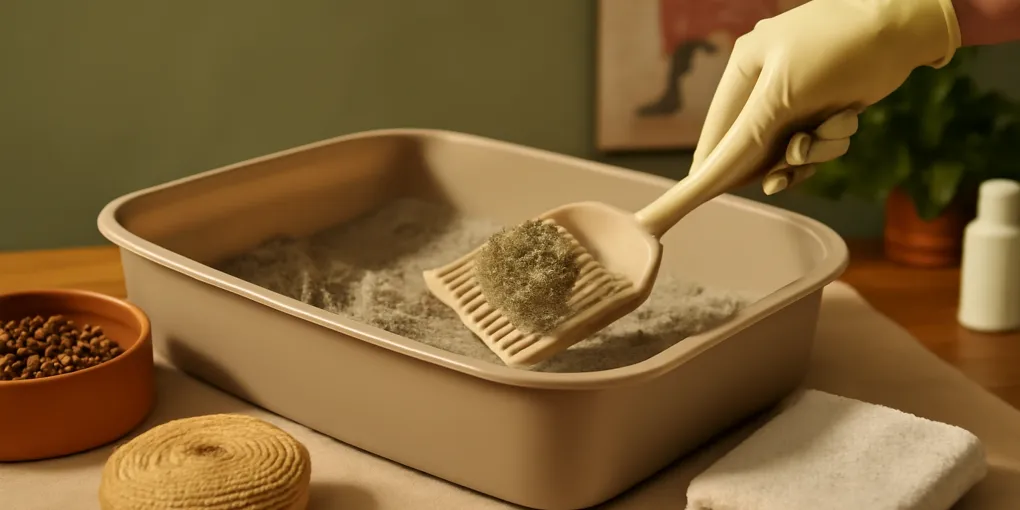
Empty the entire box into a trash bag, scrape residue gently, wash with mild unscented soap and water, rinse well, dry completely, and refill to the label-recommended depth. For many clumping litters, two to three inches is a practical starting point.
Avoid harsh cleaners and strong scents unless your veterinarian recommends a pet-safe disinfecting protocol. Fresh litter poured into a wet box can stick to the bottom and lose performance immediately.
Replace the box itself when scratches, retained odor, cracks, warped corners, or broken parts make it hard to clean. Plastic boxes do not last forever, especially in multi-cat homes.
Extra practical checks
The best replacement schedule is the one that keeps the box acceptable before your cat complains. Build the habit around observable triggers: odor after scooping, damp corners, crumbling clumps, residue on plastic, dust buildup, and changes in your cat’s approach. Some cats tolerate a wide range of substrates, while others reject a box after one strong fragrance or a sudden texture change. When changing litter types, offer the new litter beside the old one instead of forcing an overnight switch. In multi-cat homes, spread boxes across different rooms so one cat cannot guard the entire resource. Cleaning frequency, box number, and location work together.
Before you buy or change the routine
Use a small trial before committing to a large purchase or permanent habit. Confirm the product dimensions, current label, cleaning instructions, return policy, and any warnings that apply to puppies, seniors, cats with medical conditions, dogs that chew, or multi-pet homes. Introduce one change at a time so you can tell whether the pet accepted the product or whether avoidance, odor, digestive upset, thirst changes, soreness, or stress appeared after the change. Keep the routine boring and repeatable: measure, observe, clean, and reassess. If the result depends on daily maintenance, choose the option you will actually maintain on a tired weekday, not the option that sounds most impressive in a product listing.
A sensible purchase also leaves room for veterinary judgment. Products can support comfort, hygiene, enrichment, or prevention, but they cannot diagnose pain, dental disease, urinary problems, orthopedic injury, panic, or heat illness. When signs change suddenly, when your pet avoids a normal routine, or when symptoms persist despite a cleaner setup, stop treating the product as the answer and get medical guidance.
Evidence notes and citations
Key sources used for this guide include veterinary and animal-welfare references rather than only manufacturer pages. Relevant sources include the American Veterinary Medical Association animal welfare resources at https://www.avma.org/resources-tools/animal-health-and-welfare/animal-welfare, AVMA warm weather pet safety guidance at https://www.avma.org/resources-tools/pet-owners/petcare/warm-weather-pet-safety, the American Animal Hospital Association dental care guidelines at https://www.aaha.org/resources/2020-aaha-dental-care-guidelines-for-dogs-and-cats/, Cornell Feline Health Center dental and house-soiling resources at https://www.vet.cornell.edu/departments-centers-and-institutes/cornell-feline-health-center, the Veterinary Oral Health Council at https://vohc.org/, International Cat Care litter tray advice at https://icatcare.org/advice/litter-trays/, and FDA pet safety warnings such as xylitol guidance at https://www.fda.gov/animal-veterinary/animal-health-literacy/paws-xylitol-its-dangerous-dogs. Product links in this article are shopping links with the site affiliate tag so readers can compare current labels, prices, sellers, and return policies before buying.
FAQ
How often should I completely change clumping litter?
Every 2 to 4 weeks for one cat if you scoop daily; sooner for odor, damp residue, broken clumps, or multiple cats.
Is scooping enough?
Scooping is necessary but not enough forever because dust, fragments, and residue build up.
How often for two cats?
Often weekly to every two weeks for a heavily used box, but adding boxes is better than relying on deeper litter.
Should I wash the box?
Yes, wash during each full replacement and dry completely before refilling.
Should I use scented litter?
Usually no. Unscented litter plus better cleaning is typically more cat-friendly.
Bottom line
For how often should you replace cat litter, the best choice is the one that fits the animal in front of you: age, health, temperament, environment, and owner consistency matter more than a product headline. Use the PSR/G6 score as a decision aid, verify the current label before buying, and stop if your pet avoids the setup, seems painful, overheats, guards food, drinks less, or shows any medical red flag.
Practical owner notes
This recommendation depends on observation, consistency, and willingness to adjust when your pet gives feedback. Check the setup daily, keep records when a problem is changing, and do not ignore avoidance, pain, appetite change, drinking change, limping, overheating, guarding, or house-soiling. A product that looks convenient for people is only successful when it remains safe and acceptable for the animal.
Practical reader notes for how often replace cat litter
Use the scoring notes above to narrow the practical choice: match the product or protocol to your space, risk tolerance, maintenance capacity, and the specific constraints described above.
For product comparisons, prioritize fit and repeat use over impressive feature lists. A cheaper item that is easy to place, clean, dose, adjust, or return often beats a premium item that adds friction. Check dimensions, serving size, material notes, warranty language, and whether replacement parts or refills are easy to find. For health and wellness topics, compare the article’s evidence notes with your own risk profile, medications, sleep schedule, training load, and clinician guidance. Stop using any protocol that creates pain, dizziness, allergic symptoms, digestive distress, or a behavior pattern that feels hard to control.
A useful first test is a two-week trial with a clear success metric. Choose one outcome that matters: fewer missed sessions, faster cleanup, less morning stiffness, better adherence, lower noise, easier travel, or a more predictable measurement routine. Keep the rest of the setup stable so you can tell whether the change helped. If the result is neutral, return or retire the item quickly instead of expanding the system around it. If it helps, document the settings, dose, location, or schedule that made it work so the benefit survives busy weeks.
Readers should also separate evidence strength from personal fit. Stronger evidence can justify trying a category, but it does not guarantee that a particular brand, accessory, or routine will be the best match. Weak or emerging evidence does not automatically make a topic useless; it means the trial should be lower cost, lower risk, and easier to abandon. This is why our recommendations emphasize transparent trade-offs, realistic setup instructions, and situations where skipping the purchase is the smarter move.
Finally, revisit the choice after the novelty period. If the product is not used, if the protocol creates more steps than it saves, or if the article’s safety caveats apply to you, the right answer may be to simplify. The goal is not to own the highest-scoring option. The goal is to solve the reader problem with the least friction and the most honest understanding of benefits, limits, and uncertainty.