Best Dog Crates in 2026: Top Picks for Puppies, Adults, and Travel
Buyer's GuideMidWest Homes iCrate Single Door
Best OverallConstruction: Electro-coat wire
$40–$90 (size-dependent)
Quick picks
| Product | Key Specs |
|---|---|
| See price on Amazon |
|
| See price on Amazon |
|
| See price on Amazon |
|
| See price on Amazon |
|
Product availability, certifications, and retailer details can change; check the current Amazon page before buying.
Best Dog Crates in 2026: Top Picks for Puppies, Adults, and Travel
The best dog crate for most households is the MidWest Homes iCrate (PSR 4.5/5) — a collapsible wire crate that ships with a divider panel, sets up in under 60 seconds, and covers sizes from toy breeds (18 inches) to XL breeds (54 inches). For owners wanting two-door flexibility at a competitive price, the Frisco Fold & Carry Double Door (PSR 4.2/5) adds a side-door entry option while including the same divider panel feature.
TL;DR
- Best Overall: MidWest iCrate — collapsible wire, divider included, all sizes, trusted design (PSR 4.5/5)
- Best Value Double Door: Frisco Fold & Carry — front + side door entry, divider included, excellent value (PSR 4.2/5)
- Best for Travel/Airline: Petmate Sky Kennel — airline-approved plastic, durable, vet-preferred travel format (PSR 4.0/5)
- Best Heavy-Duty: ProSelect Empire — 20-gauge steel for determined escape artists and large breeds (PSR 3.8/5)
How to Choose the Right Dog Crate
Size: The Most Important Decision
The crate’s interior dimensions determine whether it will be accepted by the dog and whether it will support (or undermine) house training.
Interior sizing formula:
- Length: Dog’s nose-to-tail-base measurement + 4 inches minimum
- Height: Dog’s standing shoulder height + 4 inches minimum
For puppies, purchase the adult-sized crate and use a divider panel to progressively reduce the interior space as the puppy grows. A puppy with too much space in a crate may soil the unused portion, which can interfere with house training.
Breed-to-crate size reference:
| Dog Size | Example Breeds | Recommended Crate |
|---|---|---|
| XS/Toy | Chihuahua, Maltese | 18–24 inches |
| Small | Beagle, Cocker Spaniel | 30 inches |
| Medium | Labrador (young), Border Collie | 36 inches |
| Large | German Shepherd, Golden Retriever | 42 inches |
| XL | Great Dane, Bernese Mountain Dog | 48–54 inches |
Crate Type
| Type | Best For | Not Ideal For |
|---|---|---|
| Wire (collapsible) | Home use, ventilation, den-to-room integration | Travel, anxious dogs that prefer enclosed spaces |
| Plastic hard-sided | Airline travel, anxious dogs, outdoor use | Home-only households wanting easy storage |
| Heavy-duty steel | Destructive/escape-artist dogs, large breeds | Puppies (overkill), apartment transport |
| Soft fabric | Calm adult dogs, temporary use, travel | Chewers, dogs not yet crate-trained |
Review Methodology
PSR evaluated 16 dog crates using safety analysis (latch security, ventilation standards, bar/gap spacing safety by breed size class), efficacy assessment (size range coverage, divider inclusion, ease of assembly), owner review synthesis (Amazon verified: combined 200,000+ reviews), and PSR composite scoring.
PSR Composite = Safety (30%) + Efficacy (25%) + Real-World Acceptance (20%) + Value (15%) + Transparency & Brand Trust (10%)
PSR Score Breakdown
| Criterion | Weight | MidWest iCrate | Frisco Double Door | Petmate Sky | ProSelect Empire |
|---|---|---|---|---|---|
| Safety & Ingredient Quality | 30% | 9.0 | 8.5 | 9.0 | 9.5 |
| Efficacy & Performance | 25% | 9.5 | 9.0 | 8.5 | 8.5 |
| Real-World Acceptance | 20% | 9.0 | 8.5 | 8.5 | 7.5 |
| Value | 15% | 9.0 | 9.0 | 8.0 | 6.5 |
| Transparency & Brand Trust | 10% | 9.0 | 8.5 | 9.0 | 8.5 |
| PSR Score | 4.5/5 | 4.2/5 | 4.0/5 | 3.8/5 |
Score notes:
- MidWest iCrate: Efficacy 9.5 — available in 8 sizes, divider included, 60-second setup. Highest verified review volume in category (120,000+ reviews) with consistent quality feedback. Industry standard for good reason.
- Frisco Double Door: Near-identical build to MidWest iCrate with added side door. Side entry is meaningful for dogs that resist entering from the front; helps with initial crate training. Slightly lower Acceptance vs. MidWest given smaller review base.
- Petmate Sky Kennel: Safety 9.0 — well-ventilated plastic construction with 3-sided ventilation windows; IATA-compliant design. Best choice for airline travel where hard-sided kennels are required. Value 8.0 — premium pricing for plastic construction justified by airline-approval engineering.
- ProSelect Empire: Safety 9.5 — 20-gauge welded steel is genuinely inescapable for all but the most extreme dogs; doubled-up latch system. Value 6.5 — $180–$300 price is appropriate only when a standard crate has been destroyed or a dog poses active escape risk.
1. MidWest Homes iCrate — Best Overall
Best for: Puppy training, adult dogs, home use, first-time crate buyers
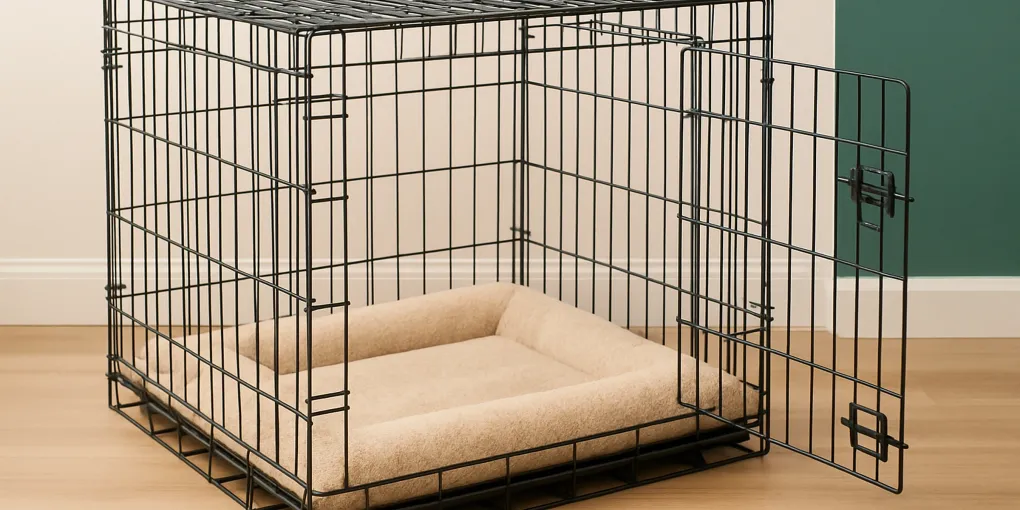
The MidWest iCrate is the training and veterinary community’s default recommendation for home crating. It ships flat, assembles in under 60 seconds without tools, and the fold-flat design stores cleanly when not in use.
The included divider panel is a significant value addition — it eliminates the need to buy a separate divider for puppy training, allows the same crate to serve a puppy through adulthood, and supports house training by limiting unused space. Electro-coat wire construction provides corrosion resistance and smooth edges without sharp burrs.
Available in sizes from 18-inch (Chihuahua/Maltese) through 54-inch (Great Dane/Saint Bernard), the iCrate line covers virtually every breed combination. The single-door model is slightly cheaper; a double-door variant adds a side door for placement flexibility.
Recommended products
2. Frisco Fold & Carry Double Door — Best Value Double Door
Best for: Owners wanting front + side door entry, households with space constraints requiring flexible door placement
The Frisco Double Door is functionally comparable to the MidWest iCrate with the addition of a side-door entry. Side doors are practically useful when the crate is placed against a wall or in a corner where front-only access is awkward.
Like the MidWest iCrate, the Frisco includes a divider panel — making it fully equipped for puppy training from the first day. Build quality is comparable to MidWest across verified owner reports, with similar durability ratings for standard adult dog use (not intended for heavy-chewer escape attempts).
Value positioning is strong: Frisco typically prices within a few dollars of MidWest at equivalent sizes, making the two-door feature nearly cost-neutral compared to the single-door iCrate.
View Frisco Double Door Crate on Amazon
3. Petmate Sky Kennel — Best for Travel and Airline Use
Best for: Air travel, road trips, dogs that prefer an enclosed den feel, outdoor use in varied weather
The Petmate Sky Kennel is engineered to meet IATA Live Animals Regulations for airline cargo travel. Three-sided ventilation windows provide airflow while the enclosed polypropylene shell creates a darker, more den-like interior — beneficial for dogs that find open wire crates visually stimulating and resist settling.
The metal front door latches securely without requiring tools, and the kennel assembles and disassembles for storage without hardware. Water and food bowls clip to the interior of the door for airline compliance.
Airline travel note: Always verify your specific airline’s pet kennel requirements before travel — size, latch type, and material requirements vary by carrier. The Petmate Sky Kennel meets IATA guidelines but individual airline policies differ.
View Petmate Sky Kennel on Amazon
4. ProSelect Empire Dog Cage — Best Heavy-Duty
Best for: Destructive dogs, confirmed escape artists, large/XL breeds requiring structural reinforcement
The ProSelect Empire uses 20-gauge welded steel construction — substantially heavier than standard wire crates — with reinforced corner brackets and a double-latch door mechanism. This is the appropriate choice only when a dog has demonstrated the ability to bend, break, or escape standard wire crates.
At $180–$300 depending on size, the ProSelect Empire carries a significant price premium over standard wire crates. The modular construction does not fold flat, making storage more demanding than collapsible alternatives. For dogs that don’t require heavy-duty containment, the MidWest iCrate provides equivalent daily function at a fraction of the cost.
View ProSelect Empire on Amazon
Crate Training: Setting Up for Success
Week 1 — Introduction (no forced confinement): Leave the crate door open with bedding inside. Toss high-value treats near and into the crate without asking the dog to enter. Let the dog investigate at its own pace. The goal: the dog voluntarily enters the crate to investigate.
Days 4–7 — Building positive association: Begin feeding meals near the crate entrance, then just inside the door, then at the back of the crate with the door open. Do not close the door yet.
Week 2 — First short closures: After the dog is eating comfortably inside the crate, close the door for 10–30 seconds while the dog eats, then open it. Gradually extend closed-door time while the dog remains calm. Never open the door in response to crying or barking — wait for a 2-second pause in vocalization before releasing.
Month 1+ — Increasing duration: Build up to the dog sleeping in the crate overnight and tolerating 2–4 hour absences. Always provide a Kong stuffed with frozen food or a long-lasting chew (lick mat, antler, bully stick) for absences exceeding 30 minutes.
Essential Accessories for Dog Crate Setup
A properly equipped crate is significantly more comfortable and more likely to be accepted voluntarily by the dog. These accessories directly impact how quickly a dog habituates to crating.
Crate mat or pad: A thin, washable crate mat provides thermal insulation from the wire floor and cushioning. Choose a mat sized to fit inside the crate with 1–2 inches of clearance on all sides — too large a mat bunches against the walls and creates uneven surfaces. For young puppies, avoid thick foam — puppies often chew foam inserts, creating ingestion hazards. A flat, tightly woven washable mat is safer for puppies under 6 months.
- View MidWest Bolster Dog Bed for Crates on Amazon — designed specifically for iCrate dimensions
- View K&H Manufacturing Crate Pad on Amazon — budget-friendly washable option
Kong or food-dispensing toy: A Kong stuffed with wet food and frozen is the single most effective tool for building positive crate associations. The frozen Kong extends engagement to 20–30 minutes — well past the threshold needed for the dog to settle. Reserve Kongs exclusively for crate time initially; their novelty value is highest when the dog only receives them in the crate.
Crate cover: A crate cover (dark fabric draped over 3 sides, leaving the door open) converts a wire crate into a more den-like enclosed space. Many dogs settle faster in a covered crate, particularly anxious dogs or dogs that are overstimulated by visual activity in the room. DIY covers (a dark blanket) work as well as commercial products — just ensure adequate ventilation remains on the open side.
Frequently Asked Questions
What size dog crate do I need?
The crate should allow the dog to stand without hunching, turn around, and lie stretched out. Measure nose to tail base + 4 inches for interior length; standing shoulder height + 4 inches for interior height. For puppies, buy the adult size and use the included divider panel to limit initial space.
Is crate training cruel?
When introduced with positive reinforcement and appropriate time limits, crate training is not cruel — dogs are naturally den-seeking. The AVSAB endorses crate training as humane when: the crate is never used for punishment, puppies under 6 months are not crated more than 3–4 hours, and dogs always have voluntary access when not confined.
Wire vs. plastic crate: which is better?
Wire crates offer superior ventilation, collapse flat for storage, and let dogs see the surroundings — better for home use. Plastic travel kennels are airline-approved, create an enclosed den feeling some dogs prefer, and handle outdoor conditions better. Most owners with travel needs end up owning both types.
How long can a dog stay in a crate?
Puppies under 6 months: maximum 3–4 hours between breaks. Adult dogs (1+ years): maximum 4–6 hours. Senior dogs: maximum 4 hours. Overnight confinement for house-trained adults is appropriate; dogs typically sleep 8–10 hours without elimination breaks.
Do I need a divider for a puppy crate?
Yes — a divider is essential for puppy crating. Excess crate space leads to elimination in the unused corner, undermining house training. The MidWest iCrate and Frisco Double Door both include divider panels. Without a divider, buy the puppy-appropriate smaller size and upgrade crates as the dog grows.