Quick picks
| Product | Key Specs |
|---|---|
| See price on Amazon |
|
| See price on Amazon |
|
| See price on Amazon |
|
Product availability, certifications, and retailer details can change; check the current Amazon page before buying.
Quick verdict
Cat puzzle feeders can improve daily enrichment for many indoor cats when the difficulty is introduced gradually. The best evidence-informed use is not making every meal hard; it is offering species-appropriate foraging opportunities without causing frustration, missed calories, or conflict between cats. This guide treats products as management tools, not medical treatment. If a pet has pain, appetite change, vomiting, diarrhea, heat stress, urinary changes, sudden fear, or any other concerning sign, use a veterinarian rather than a shopping list as the first intervention.
How we evaluated the options
| Factor | Weight | What we looked for | How it applies here |
|---|---|---|---|
| Research | 30% | Fit with veterinary, welfare, and behavior guidance | We favored setups that reduce risk while preserving normal species behavior. |
| Evidence Quality | 25% | Specific claims tied to credible sources | We avoided cure-style promises and separated evidence from marketing. |
| Value | 20% | Useful daily function for the cost | Durable, washable, repairable products scored higher than novelty items. |
| User Signals | 15% | Repeated owner reports about failure points | Reviews were used to identify slipping, cleaning, noise, chewing, and sizing issues. |
| Transparency | 10% | Materials, dimensions, limits, and warnings | Clear specifications and conservative safety language improved confidence. |
Product shortlist and shopping links
| Check price | Option | Best fit | Watch-outs |
|---|---|---|---|
| Search Amazon | Catit Senses 2.0 Digger | Beginner dry-food foraging | Some cats learn to tip it |
| Search Amazon | Doc & Phoebe indoor hunting feeder | Small distributed portions | Not ideal for wet food |
| Search Amazon | LickiMat Casper and Felix | Wet food licking enrichment | Must be cleaned very thoroughly |
| Search Amazon | Trixie activity board for cats | Varied low-stakes challenges | May frustrate cats if introduced too fast |
Before choosing a feeder, match the challenge to your cat’s current confidence, diet type, and frustration threshold. The best first option is usually easy to reset, simple to clean, and forgiving enough that the cat can earn food without pawing frantically or walking away.
Why foraging matters
Cats are predators with behavioral needs that include searching, pawing, manipulating objects, and controlling access to resources. Indoor life can be safe and comfortable, but it can also compress the day into sleeping, waiting, and eating from a bowl. A puzzle feeder adds work in a controlled way. That work should look like curiosity and calm persistence, not hunger stress.
Puzzle feeders are most useful when paired with a broader enrichment plan: predictable routines, vertical space, scratching, play, hiding places, clean litter boxes, and separate resources in multi-cat homes. A feeder cannot compensate for territorial stress or medical appetite changes. A useful way to evaluate the setup is to write down the baseline before changing anything. Note where the pet eats, rests, plays, drinks, hides, and asks for attention. Then change one variable at a time and observe the result for several days. This makes it easier to tell whether the product helped or merely looked organized in the room. It also prevents the common mistake of adding three new items at once and not knowing which one caused avoidance, chewing, overexcitement, or better calm.
Cleaning is part of safety, not a cosmetic detail. Food residue, saliva, dust, fur, and moisture change how a product performs over time. Smooth surfaces, removable parts, manufacturer cleaning instructions, and visible wear points matter more than a dramatic feature list. If an item cannot be cleaned at the frequency your household realistically maintains, choose a simpler option.
Supervision is still necessary during the first uses. Watch body language: loose posture, normal breathing, willingness to disengage, and normal appetite are reassuring. Hard staring, frantic pawing, repeated startle responses, guarding, panting unrelated to temperature, or refusal to approach suggest the setup needs to be easier, quieter, cooler, farther from traffic, or removed entirely.
Evidence and limits
Published enrichment literature and veterinary behavior guidance support the idea that food puzzles can increase activity and offer problem-solving opportunities. But evidence does not mean every product works for every cat. Age, arthritis, dental pain, anxiety, obesity, diet type, and household competition all change the risk-benefit balance.
The strongest practical rule is to preserve nutrition first. Start with a small portion of the meal in the easiest setting while the normal bowl remains available. If the cat engages voluntarily and eats normally, increase the portion slowly. If the cat walks away, paws frantically, vocalizes, guards, or loses weight, reduce difficulty or stop.
How to introduce one
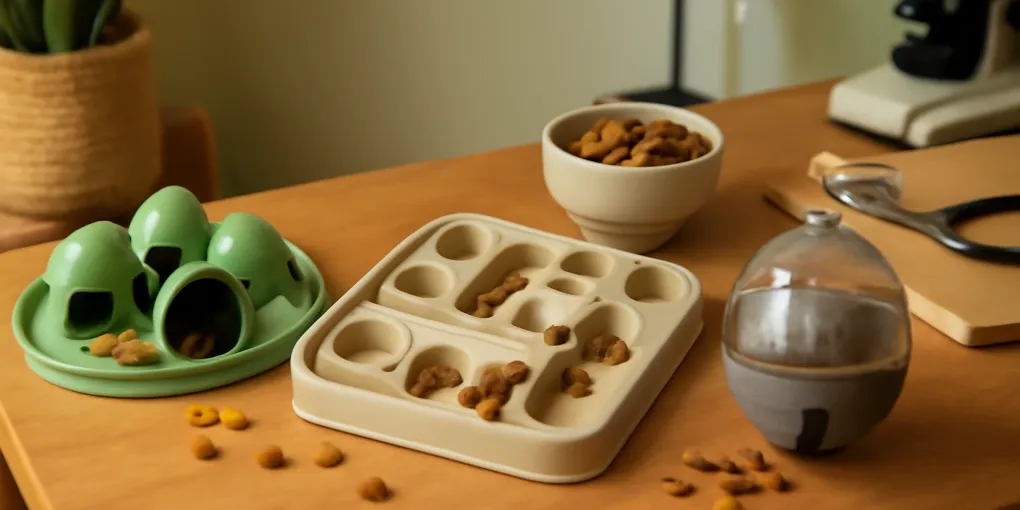
Choose a transparent or open feeder first so the cat can see and smell the food. Put high-value dry pieces or approved treats on top, then partly inside, then deeper only after success. Keep sessions short. For wet food, use lick mats or shallow trays that can be sanitized thoroughly rather than enclosed toys that trap residue.
In multi-cat homes, give each cat its own station. A confident cat can monopolize a puzzle, leaving a timid cat hungry. Place feeders out of corners so cats have escape routes. Watch the first several uses and remove the item when the food is gone.
Cleaning and safety
Small crevices collect oil and crumbs. Wash according to manufacturer instructions and retire cracked plastic, loose rubber, or splintered parts. Avoid string, feathers, or detachable pieces around unsupervised feeding. If a cat has a prescription diet, diabetes, kidney disease, gastrointestinal disease, or a weight-loss plan, ask the veterinary team before changing feeding mechanics.
Difficulty ladder for puzzle feeders
Treat a puzzle feeder like a training plan, not a bowl replacement. Begin with a saucer or open tray that requires almost no manipulation, then move to a shallow maze, then to cups or tubes only after the cat is consistently successful. The goal is to create controllable searching and pawing, not to make the cat solve a toy while hungry. Cats that stop eating, bat frantically, vocalize, or leave the room are telling you the puzzle is too hard or the reward is not worth the effort.
Dry-food puzzles are easiest to sanitize and portion. Wet-food enrichment can work with shallow lick mats, but enclosed wet-food toys are a poor first choice because residue hides in seams. For senior cats, arthritic cats, and cats with dental pain, low-friction licking or scattering a few pieces on a flat snuffle-style surface may be more humane than narrow tubes or high-force pawing.
Multi-cat feeding rules
In a multi-cat home, puzzle feeders change food access. A bold cat may monopolize the device while a cautious cat waits, and that can look peaceful until weight or litter-box patterns change. Set up one station per cat with visual separation, escape routes, and enough distance that no cat has to pass another to eat. During the first week, watch who actually consumes the food rather than assuming equal access.
Use timed sessions instead of leaving high-value puzzles out all day. Pick up uneaten food, clean the device, and record which cat used which puzzle. If one cat has a prescription diet, calorie restriction, diabetes, kidney disease, or a history of urinary issues, do not use shared puzzles without veterinary guidance.
Cleaning and wear checks
Food puzzles are handled with paws, noses, saliva, and sometimes teeth. Wash food-contact parts after wet use and at least every few dry-food sessions, following the manufacturer instructions. Retire cracked plastic, splintered wood, loose rubber feet, and any part that creates sharp edges or hidden food pockets.
Check the floor interaction too. A puzzle that slides across tile can frustrate a cat and scratch surfaces; a grippy mat underneath may solve that without increasing difficulty. If the puzzle becomes noisy enough to startle the cat, move it to a rug or choose a quieter design.
Decision matrix by cat profile
For a food-motivated adult cat with normal mobility, start with a clear plastic or ceramic puzzle that makes the food visible and easy to retrieve. Visibility matters because the cat can connect paw movement with food movement instead of simply smelling hidden kibble and becoming frustrated. For a timid cat, place a few pieces around the puzzle before loading the puzzle itself, then end the session while the cat is still relaxed.
For a senior cat or a cat with suspected arthritis, keep the working surface low, broad, and non-slip. Avoid tall tubes, narrow holes, and devices that require sustained reaching. A shallow lick mat or low maze may provide sensory variety without demanding awkward joint positions. If the cat hesitates to jump, misses landings, or changes grooming, solve the comfort issue before making meals harder.
For a cat that eats too quickly, the target is slower calm intake, not maximum difficulty. Choose a puzzle that spreads the ration across a larger surface and lets the cat pause. If the cat starts gulping the released pieces, split the ration into two sessions or use a lower-density treat only for training while the measured meal remains separate.
For a cat that needs more play, use the feeder after a short wand-toy session so the sequence resembles stalk, catch, eat, groom, and rest. That routine is often more meaningful than leaving a toy out all day. Rotate two or three easy puzzles rather than constantly escalating to harder ones. Rotation keeps novelty without turning feeding into a daily exam.
A useful purchase test is whether you can explain the first session in one sentence: “put five pieces where the cat can see them and stop after success.” If setup requires hidden tricks, tiny parts, or constant intervention, it is probably too complicated for a first puzzle feeder.
FAQ
Should every meal come from a puzzle feeder?
Usually no. Many cats do best when only a small portion of the daily ration is used for foraging while normal meals remain predictable. Preserve calorie intake and hydration first.
Are puzzle feeders good for overweight cats?
They can slow eating and add activity, but weight loss should follow a veterinary calorie plan. A puzzle feeder does not make extra calories disappear.
Which feeding routine pairs with puzzle feeders?
Use this article alongside our cat water fountain cleaning protocol because feeding enrichment and hydration routines both depend on cleaning, observation, and low-stress access.
Evidence notes and sources
- Food puzzles for cats have published veterinary behavior support and practical welfare cautions: https://journals.sagepub.com/doi/full/10.1177/1098612X16643753
- AAFP/ISFM environmental needs guidance supports foraging, choice, safe resource placement, and multi-cat resource distribution: https://journals.sagepub.com/doi/full/10.1177/1098612X13477537
- International Cat Care summarizes environmental enrichment and stress reduction for indoor cats: https://icatcare.org/advice/enriching-your-cats-life/
- WSAVA nutrition resources are useful when feeding mechanics intersect with calorie plans, medical diets, or weight management: https://wsava.org/global-guidelines/global-nutrition-guidelines/
Bottom line
A cat puzzle feeder is worthwhile when it adds voluntary foraging without reducing intake, increasing guarding, or creating cleaning problems. Start easier than the marketing suggests, watch each cat individually, and let the cat’s behavior decide whether to progress.