Quick verdict
A cat water fountain can help some cats drink more willingly, but the win comes from placement, cleaning, noise control, and gradual introduction rather than from the pump alone. Cats that already drink well from bowls may not need a fountain. Cats with urinary disease, kidney disease, diabetes, vomiting, weight loss, or sudden thirst changes need veterinary evaluation before product experiments.
Pair this protocol with our senior cat care protocol if your cat is older, has mobility limits, or recently changed appetite or litter-box habits. Hydration products are support tools, not diagnoses.
How we evaluated the options
| Factor | Weight | What we looked for | How it affected this article |
|---|---|---|---|
| Research | 30% | Alignment with veterinary, behavior, and welfare guidance | We prioritized tools that support normal drinking behavior without claiming medical benefits. |
| Evidence Quality | 25% | Claims tied to credible sources and clear limits | Health claims were restricted to guidance from veterinary or welfare sources. |
| Value | 20% | Daily usefulness relative to cost and maintenance | Simple, washable, measurable products scored above novelty features. |
| User Signals | 15% | Repeated owner reports about failure points | We used user reports only to identify sizing, cleaning, chewing, noise, and durability risks. |
| Transparency | 10% | Materials, dimensions, instructions, and warnings | Products with clear specs and conservative labels earned more confidence. |
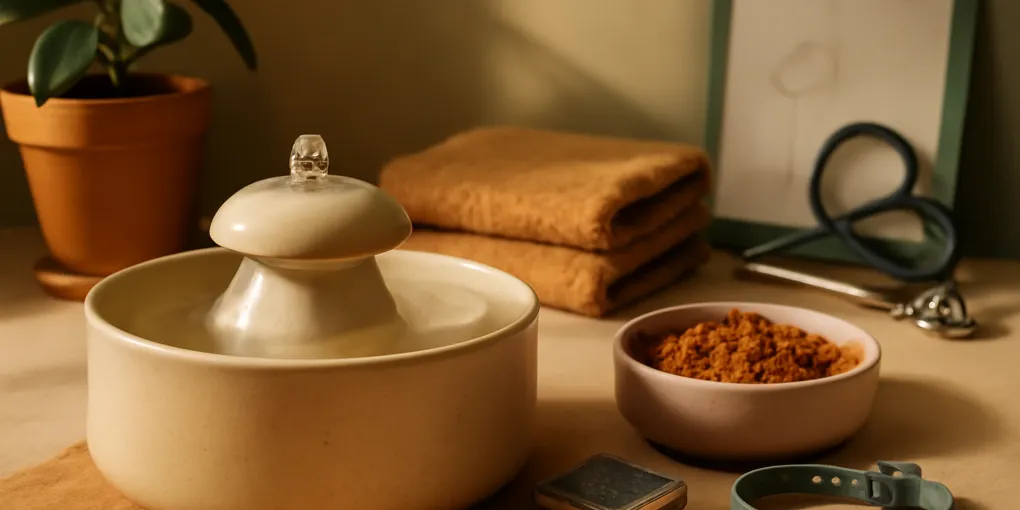
Recommended setup supplies
Recommended products
| Check price | Item | Why it helps | Watch-outs |
|---|---|---|---|
| View Amazon | Stainless steel cat fountain | Durable water-contact surface | Pump and filter still need cleaning |
| View Amazon | Ceramic cat fountain | Heavy and stable for calm cats | Breakable; check glaze quality |
| View Amazon | Replacement fountain filters | Keeps routine predictable | Filters do not replace washing |
| View Amazon | Bottle brush set | Cleans pump channels and corners | Must dry fully between uses |
| View Amazon | Quiet silicone mat | Reduces vibration and spills | Clean underneath weekly |
| View Amazon | Extra water bowl | Keeps a familiar backup | Do not remove too soon |
Step 1: choose the right location
Put the fountain away from litter boxes, loud appliances, dog traffic, and tight corners. Many cats prefer to drink where they can see the room and leave easily. A fountain next to food may be convenient for humans but not always preferred by the cat. Start with two stations: the familiar bowl stays in place, and the fountain goes in a quiet secondary location.
Use a grounded outlet and route the cord where the cat cannot chew it. Place the fountain on a washable mat, not directly against drywall or a wood cabinet. If the pump hums against the floor, move it to a heavier surface or add a vibration-dampening mat.
Step 2: introduce without pressure
Wash the fountain before first use, fill it, and run it while the cat is not cornered. Let the cat investigate. Do not pick the cat up and place paws near the water; that can make the station feel unsafe. For timid cats, leave the pump off for the first day so the fountain looks like a still bowl. Then run the pump briefly while you are nearby but not staring.
Keep the old bowl full. Removing the familiar option can reduce total water access, especially in multi-cat homes. After one to two weeks, decide based on observation rather than hope: does the cat drink from the fountain, avoid it, paw at it, or only use the old bowl?
Step 3: build a cleaning routine
Fountains fail when people treat filters as magic. Filters can catch particles, but saliva, biofilm, food dust, hair, and mineral deposits still build up. Empty, wash, rinse, and dry the reservoir and top pieces on a schedule that fits your water hardness and number of pets. Clean the pump and impeller because slime inside the pump can reduce flow and make noise.
Use mild dish soap and rinse thoroughly unless the manufacturer says otherwise. Avoid strong fragrances. If you see pink film, cloudy residue, floating hair, or a slower stream, clean sooner. If the pump runs dry, unplug it, clean it, and restart only after the reservoir is filled to the recommended line.
Step 4: monitor results
You do not need laboratory precision, but you do need a baseline. Note how often you refill bowls, how often you scoop urine clumps, and whether the cat’s appetite, weight, or energy changes. More drinking can be good if the cat simply likes moving water; it can also be a medical sign if it appears suddenly.
A fountain should make care easier to observe, not easier to ignore. In multi-cat homes, one cat may monopolize the station while another avoids it. Add stations rather than assuming a single premium fountain serves everyone.
Troubleshooting
If the cat avoids the fountain, try a quieter location, lower flow, still-water mode, or a different material. Some cats dislike splashing on whiskers. Others prefer a wide shallow pool rather than a waterfall. If the cat paws water onto the floor, use a larger mat and reduce the stream. If a dog drinks from it constantly, separate stations by species or height.
If the fountain becomes a chore, simplify. A clean stainless bowl refreshed twice daily is better than a neglected fountain with biofilm.
FAQ
How long should I keep the old bowl?
Keep it during the entire transition and often permanently. Redundant water stations improve access and reduce the chance that a pump failure leaves the cat without water.
Are stainless fountains better than plastic?
Stainless and ceramic models are often easier to inspect and clean, but design matters. Any fountain can become dirty if the pump and corners are neglected.
Can a fountain treat urinary problems?
No. It may support water access, but urinary straining, blood, pain, frequent trips, or sudden thirst changes require veterinary care.
Sources and evidence notes
- International Cat Care. Encouraging your cat to drink. Used for multiple water sources, location, and cat preference guidance.
- Cornell Feline Health Center. Feline lower urinary tract disease. Used for conservative urinary-warning language.
- AAHA/AAFP. Feline life stage guidelines. Used for preventive-care and monitoring context.
- WSAVA Global Nutrition Committee. Nutrition toolkit. Used for hydration and diet-change caution.
Compare current sizing, materials, seller details, and return policies before buying.
Multi-cat and small-apartment adjustments
In multi-cat homes, one fountain rarely solves water access by itself. Cats can block resources quietly by sitting in doorways, staring from nearby furniture, or rushing the station after another cat approaches. Put water in several locations and watch who uses each one. If one cat only drinks at night or only when another pet is closed away, the household has an access problem, not a fountain problem.
Small apartments need the same principle in miniature. A fountain beside the litter box may be physically convenient but behaviorally unattractive. A fountain next to a washing machine may vibrate. A fountain on a narrow counter may trap a cat between a wall and a person. Look for a quiet corner with a second exit path. Even a few feet of separation from food, litter, and noisy appliances can change whether the cat accepts the station.
If a dog shares the home, decide whether the fountain is a cat station or a shared station. Large dogs can drain a small fountain quickly, leave saliva in the reservoir, and make the cat avoid it. Use height, baby gates, microchip doors, or separate rooms when needed.
Maintenance calendar
Put fountain care on a calendar before the novelty wears off. Daily: check water level, sound, flow, and visible debris. Every few days: rinse hair from the top pieces and wipe the mat. Weekly, or more often with multiple pets: disassemble, wash, rinse, dry, and inspect the pump. Monthly: check filter supply, pump noise, mineral scale, and cord condition. Replace worn parts before they fail.
Hard water may require more frequent descaling according to the manufacturer’s instructions. Do not improvise harsh chemicals in a water-contact product. If you use vinegar for mineral buildup, rinse until no odor remains and let parts dry. Cats may reject a fountain that smells even slightly different.
Red flags during the trial
Track the cat, not the gadget. A cat that suddenly drinks much more, floods the litter box, loses weight, vomits, or begs for water from unusual places may have a medical problem. A fountain can make increased drinking easier to notice, but it should not normalize it.
Likewise, a cat that stops drinking from both the fountain and the old bowl needs attention. Check whether the pump noise changed, the water tastes stale, the location became crowded, or another animal is blocking access. If the cat seems ill, do not troubleshoot for days.
The best outcome is modest and measurable: the cat uses at least one clean water station reliably, the household notices refills and litter changes, and cleaning happens on schedule. If a simple bowl accomplishes that better than a fountain, the simple bowl wins.
Final buying filter
Before checkout, compare the product against three household realities: who will clean it, where it will live, and what you will do if the pet dislikes it. A good pet product should make the safe routine easier on an ordinary tired weekday. If it requires perfect supervision, unusual cleaning discipline, or a room layout you do not have, choose the simpler option.
Look for transparent dimensions, material descriptions, replacement-part availability, and a return window. Read negative reviews for patterns rather than drama: repeated reports of leaking, pump failure, chewing, staining, sharp edges, unstable bases, or impossible cleaning deserve attention. Positive reviews are useful when they describe the pet’s size, age, behavior, and setup because that lets you compare the reviewer’s home to yours.
Introduce one new product at a time. Keep the old routine available during the transition, take notes for a week, and decide based on the animal’s behavior rather than the product page. If the pet is calmer, safer, cleaner, and easier to monitor, the purchase is doing its job. If the product hides symptoms, increases conflict, or adds maintenance that no one completes, it is not evidence-based care.
A conservative plan also includes a stop rule. Decide in advance what would make you remove the product, call the veterinary team, or return to the previous routine. Stop rules keep normal trial-and-error from becoming weeks of avoidable stress. Useful stop rules include refusal to eat or drink, repeated vomiting, new house-soiling, destructive chewing, fear that lasts beyond the first introduction, guarding, limping, coughing, collapse, or any sudden change in appetite, thirst, weight, stool, urine, or behavior.
For households with several caregivers, write the rule where everyone can see it. Pet products often fail because one person understands the caution and another person only sees the convenience. Shared notes about cleaning, placement, refill dates, and behavior observations make the product safer and make veterinary conversations more specific if the plan does not work.