Do Rabbits Need Chew Toys? Teeth, Boredom, and Safe Materials Explained
Evidence ExplainerQuick picks
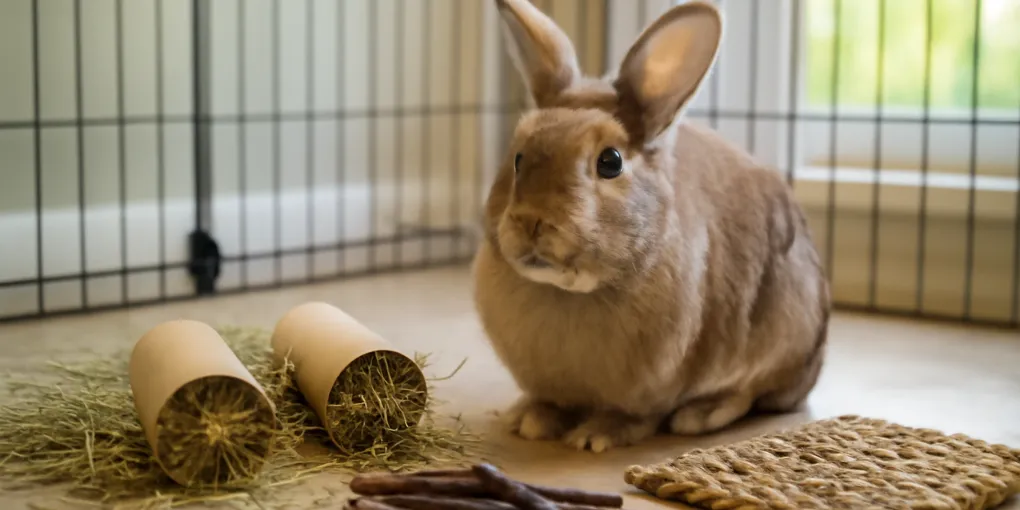
Untreated willow or applewood rabbit chews
★ Top pick- Why consider it: Best first toy category for rabbits that need a safe legal target for gnawing between hay meals.
Hay-stuffed cardboard tubes or forage boxes
- Why consider it: Best low-cost enrichment when the cardboard is plain, ink-light, and removed if the rabbit eats large pieces.
Seagrass or woven grass mats
- Why consider it: Best for rabbits that chew cage edges, dig corners, or need a floor-level texture near a favorite resting spot.
Rabbits do need safe things to chew, but chew toys should not be treated as magic dental equipment. The most important chewing activity for a rabbit is steady hay eating, because side-to-side grinding of fibrous hay helps wear the cheek teeth and keeps the gut moving. Chew toys fill a different role: they give the rabbit legal targets for gnawing, shredding, digging, and exploring so baseboards, cage bars, carpet edges, and electrical cords are less tempting.
A good rabbit chew setup combines unlimited grass hay, safe chew textures, room protection, and supervision. If a rabbit suddenly stops eating hay, drools, drops food, prefers soft foods, or seems painful while chewing, that is a veterinary problem, not a shopping problem.
Quick picks for rabbit chew toys
- Search Amazon for untreated willow and applewood rabbit chews.
- Compare hay-stuffed rabbit forage boxes on Amazon.
- See woven seagrass rabbit mats on Amazon.
For the feeding side of the setup, pair chew toys with a safer rabbit hay rack and daily fresh grass hay instead of asking toys to do the work of the diet.
What chewing does and does not do
Rabbit incisors and cheek teeth grow continuously. That does not mean every hard object is helpful. Dental wear depends on normal jaw movement, fiber intake, tooth alignment, and overall health. VCA’s rabbit-feeding guidance emphasizes hay as the main diet component, and the House Rabbit Society notes that chewing is normal behavior that needs safe outlets rather than punishment (VCA Hospitals, House Rabbit Society).
Chew toys help most when they redirect natural gnawing and encourage movement around the enclosure. A willow ball, grass mat, or stuffed cardboard tube gives the rabbit something acceptable to pull, toss, shred, and investigate. That is valuable enrichment, especially for indoor rabbits that do not have a yard full of safe vegetation to browse.
Chew toys do not correct dental disease by themselves. A rabbit with malocclusion, uneven cheek teeth, oral pain, or reduced appetite needs an exotic-animal veterinarian. Buying harder toys can make pain worse if the rabbit is already struggling to chew.
The safest first chew categories
Start with untreated willow, applewood, or other rabbit-marketed natural chews from brands that clearly describe the material. These work well for rabbits that like sticks, balls, rings, or loose bundles. Look for simple pieces without paint, fragrance, seeds glued to the surface, plastic beads, bells, or mystery coatings.
Plain cardboard can also be useful, especially when stuffed with hay. Toilet-paper tubes, small forage boxes, and packing-paper rolls let the rabbit shred and pull food through openings. Use plain, clean cardboard, remove tape and staples, and discard pieces once they become soggy or heavily eaten. Cardboard is an enrichment material, not a bulk diet.
Grass, seagrass, or woven mats can help rabbits that dig and chew floor edges. Place the mat where the behavior already happens, then make the protected furniture or carpet less available. A mat hidden in the opposite corner rarely competes with the baseboard the rabbit has already chosen.
Materials to avoid
Avoid cedar and aromatic softwood products, painted or pressure-treated wood, glossy cardboard, glue-heavy craft toys, fabric with loose threads, rubbery pieces that can be swallowed, and toys marketed for another species when the material list is vague. Also avoid hard mineral blocks as a default chew solution. Most healthy rabbits eating appropriate pellets, greens, and hay do not need a mineral block unless a veterinarian recommends one for a specific reason.
Electrical cords are never acceptable chew targets. Cover cords with rigid protection, move them outside the rabbit area, or block access completely. A chew toy near a live cord is not enough. The Rabbit Welfare Association and RSPCA both frame enrichment around safe opportunities to forage, dig, and chew inside a protected environment, not unrestricted access to household hazards (RSPCA rabbit enrichment).
How to set up a chew rotation
Give each rabbit two or three chew textures at once: one wood or willow item, one hay-based or cardboard foraging item, and one mat or diggable surface if the rabbit likes floor work. Put them near the rabbit’s normal traffic routes, resting area, and problem chewing spots. Rotate only some items each week so the enclosure changes without becoming stressful.
Use hay to make the toy worth investigating. A willow basket with hay threaded through it or a cardboard tube packed with hay encourages foraging first and chewing second. This is better than scattering many small novelty toys that the rabbit sniffs once and ignores.
Watch the waste pattern. Normal use looks like shredded pieces, tooth marks, hay pulled out, and occasional small fragments. Concerning use looks like the rabbit consuming large volumes of cardboard, swallowing fabric strings, chewing plastic, or ignoring hay in favor of toy material. In that case, remove the risky item and simplify the setup.
When chewing means something is wrong
Some chewing is normal. Sudden destructive chewing, cage-bar biting, or frantic carpet pulling can also signal boredom, pain, fear, confinement stress, or an enclosure that is too small. If the rabbit is also eating less, producing fewer droppings, hiding, grinding teeth in a painful way, or showing a wet chin, treat it as a health concern.
Chew toys are most effective when the rest of the rabbit’s life supports them: enough space, daily hay, social contact, hiding areas, traction, and predictable handling. If the rabbit only gets toys inside a cramped cage, the toy is being asked to compensate for an environment problem.
Quick buying checklist
Choose rabbit chew toys that meet these tests:
- The material is named clearly: willow, applewood, grass, seagrass, hay, or plain cardboard.
- There is no paint, fragrance, mystery glue, plastic trim, or small metal hardware.
- The size fits the rabbit’s mouth and play style without creating swallowable chunks.
- The toy can be placed where chewing already happens.
- The product works with hay, foraging, or digging instead of only sitting in the enclosure.
Skip products that look cute but do not name the material. Skip anything that relies on sugary coatings or seed clusters to get attention. Rabbits need fiber-rich foraging and safe textures, not dessert glued to a stick.
FAQ
Can chew toys replace hay for rabbit teeth?
No. Hay is still the main dental and digestive tool because rabbits grind it with their molars for long periods. Chew toys are enrichment and a safer outlet for gnawing, not the foundation of dental wear.
What wood is safe for rabbit chew toys?
Use untreated rabbit-marketed woods such as willow or applewood from a reputable source. Avoid cedar, pine shavings, painted wood, pressure-treated wood, glued craft pieces, and anything collected outdoors unless you can confirm it is safe and pesticide-free.
Is cardboard safe for rabbits to chew?
Plain cardboard can be useful for shredding and digging, but it should not become a bulk food. Remove glossy, heavily printed, taped, stapled, or glue-heavy cardboard and stop using it if the rabbit eats large amounts.
Why is my rabbit chewing furniture even with toys available?
The toy may be in the wrong location, too small, too hard, or less interesting than the furniture texture. Place safe chews directly beside the problem area, block the furniture temporarily, and add hay-based foraging so the rabbit has a better job to do.