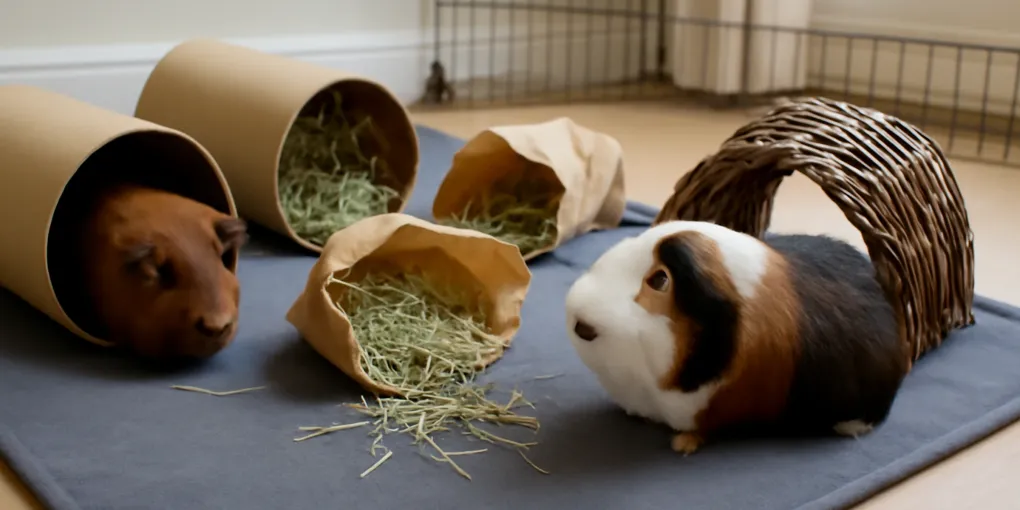
Guinea Pig Foraging Enrichment: A Safe Seven-Day Rotation
ProtocolQuick picks
Untreated cardboard tunnel set
★ Top pick Best low-cost base- Note: Choose plain, wide tubes with no staples, glossy ink, adhesive labels, plastic film, or tight openings.
Washable fleece forage mat
Best supervised scatter tool- Note: Use only if the guinea pig does not chew or swallow fabric, and remove it when damp or frayed.
Willow tunnel sized for guinea pigs
Best chewable shelter- Note: Confirm untreated willow, a pass-through diameter for the largest guinea pig, and no wire framework.
Good guinea pig foraging enrichment makes normal food take longer to locate without reducing intake or creating an obstacle course. Keep hay continuously available, then vary its location or route with a second pile in a tunnel, measured pellets scattered through clean paper, or leafy greens divided among several accessible stations.
The goal: more searching, not more treats
This seven-day rotation uses ordinary food and species-appropriate movement. It avoids exercise balls, harness walks, glued crafts, tiny openings, and novelty toys that require the guinea pig to bend or climb unnaturally.
A guinea pig who stops eating, produces fewer droppings, sits hunched, drools, breathes abnormally, or becomes unusually quiet needs prompt veterinary care. Do not interpret reduced foraging as boredom until illness and dental pain have been considered.
Quick picks for the rotation
- Untreated cardboard tunnels for a wide, two-exit hay station: Check untreated cardboard tunnels guinea pig on Amazon.
- Washable fleece forage mats, only for guinea pigs that do not ingest fabric: Check washable fleece foraging mat guinea pig on Amazon.
- Large willow tunnels after checking the internal diameter and confirming there is no wire frame: Check willow tunnel guinea pig large on Amazon.
Set the safety baseline
Before adding an activity, the enclosure needs unlimited grass hay, fresh water, a nutritionally complete guinea pig pellet in the measured amount recommended for the animal, and vitamin C from an appropriate diet. Guinea pigs are social animals, so enrichment does not replace compatible companionship or adequate space.
Every setup should pass five checks:
| Check | Pass | Reject |
|---|---|---|
| Opening size | Largest guinea pig walks through without compressing the body | Head fits but shoulders or hips catch |
| Material | Plain untreated cardboard, paper, hay, verified untreated willow, washable intact fleece | Staples, tape, glue blobs, glossy coating, foam, loose threads |
| Footing | Flat, dry, nonslip floor | Wire floor, steep ramp, unstable stack |
| Food amount | Drawn from the normal daily ration | Extra sugary treats added for every activity |
| Exit route | At least two ways out of shared structures | One guinea pig can trap another in a dead end |
Supervise a new item long enough to see whether it is explored, ignored, guarded, shredded, or eaten. Cardboard chewing is common, but remove pieces contaminated with urine and any material consumed in large amounts.
Build a small forage kit
You do not need seven commercial toys. Keep:
- several plain paper lunch bags with handles removed;
- untreated cardboard tubes cut open lengthwise if there is any fit concern;
- two or more cardboard boxes with two full-size exits;
- clean packing paper with no tape or staples;
- a spare hay tray;
- one washable forage mat, only for non-fabric chewers;
- a large untreated willow tunnel if both animals can pass freely.
Check untreated cardboard tunnels guinea pig on Amazon, then filter by measured inside diameter rather than a product photo. For willow tunnels, Check willow tunnel guinea pig large on Amazon, and reject hidden wire supports and chemically treated wood.
Day 1: two hay neighborhoods
Keep the main hay supply and add a smaller fresh pile inside an open-ended cardboard box. Cut two large doors at floor level. Place the box away from the main pile so the guinea pigs move between stations.
Observe whether one animal guards the box. If so, widen both doors, add a second station, or remove the enclosed pile. No guinea pig should have to pass a dominant cage mate to reach hay.
Day 2: paper parcel
Put a handful of hay and a few pellets from the normal ration in a plain paper bag. Remove handles, open the mouth fully, and crumple it loosely. The guinea pig should be able to push into it without becoming enclosed.
Do not tape or tie the parcel. Avoid printed gift paper and scented paper. Remove it after it becomes wet.
Day 3: scatter the pellet ration
Instead of serving all pellets in a bowl, scatter part of the measured ration across a dry fleece forage mat or several sheets of crumpled paper. Keep enough distance between pieces that the animals search rather than defend one pile.
Check washable fleece foraging mat guinea pig on Amazon only if supervision is available at first. Remove the mat if threads loosen or a guinea pig repeatedly eats fabric. A plain paper scatter is the safer default for fabric chewers.
Day 4: tunnel route
Connect two familiar parts of the enclosure with a wide tunnel, then put a small hay tuft at both ends. A pass-through tunnel is better than a single-entry hide because a guinea pig can leave if a companion approaches.
Keep the route level. Guinea pigs are not built for steep climbing, and a high tunnel stack adds fall risk without adding meaningful behavior.
Day 5: vegetable trail
Divide the day’s veterinarian-approved leafy vegetables into four or five small stations. Put one beside a hide, one near the hay, one inside an open box, and one in the open. This encourages movement without withholding food.
Introduce new vegetables gradually. A forage game is not the time to serve several unfamiliar foods. Remove leftovers before they wilt or soil the bedding.
Day 6: hay-filled open tube
Fill a wide cardboard tube loosely with hay and leave both ends open. Cut the tube lengthwise if there is any chance the animal could wedge inside. The point is to pull strands, not crawl through a tight cylinder.
Never use a toilet-paper tube as a head-sized ring. A longitudinal cut prevents the tube from becoming a rigid collar.
Day 7: familiar reset and floor time
Return to the normal layout, then offer supervised time in a secure floor pen with two familiar hides, hay, water, and nonslip footing. A reset day helps distinguish interest from stress and gives you time to wash or replace used materials.
Block electrical cords, houseplants, furniture gaps, and access by dogs or cats. Never put a guinea pig in an exercise ball. A floor pen should allow ordinary walking, short runs, hiding, and social choice.
Read the response, not the toy label
Useful enrichment produces sniffing, searching, pulling hay, short bursts of movement, and relaxed eating. Change the setup if you see persistent freezing, frantic escape attempts, repeated conflict, a trapped animal, or fabric and plastic ingestion.
Track three concrete outcomes for a week:
- Did both guinea pigs reach hay and water freely?
- Did normal food intake and dropping output continue?
- Did the activity create searching without guarding or hazardous chewing?
If the answer is yes, repeat the favored setups. Novelty is not the objective; safe, voluntary behavior is.
Sources
- RSPCA, Guinea pig behaviour: https://www.rspca.org.uk/adviceandwelfare/pets/rodents/guineapigs/behaviour
- RSPCA, Creating a good home for guinea pigs: https://www.rspca.org.uk/adviceandwelfare/pets/rodents/guineapigs/environment
- VCA Animal Hospitals, Feeding Guinea Pigs: https://vcahospitals.com/know-your-pet/guinea-pigs-feeding
Frequently Asked Questions
- No. Exercise balls can force an unnatural spinal position, restrict ventilation, and trap feet. Use a secure floor pen with hides instead.
- Use the guinea pig's normal hay, measured pellets, and veterinarian-approved vegetables. Sugary commercial treats should not drive the activity.
- Change one element at a time every day or two while keeping familiar hides and unlimited hay available. Constant total rearrangement can be stressful.