How to Fit a Dog Life Jacket for Swimming and Boating
ProtocolQuick picks
| Product | Key Specs |
|---|---|
| See price on Amazon |
|
| See price on Amazon |
|
Product availability, certifications, and retailer details can change; check the current Amazon page before buying.
Treat the first fitting as a safety rehearsal, not a photo opportunity: the vest should stay centered when the dog turns, sits, shakes, and walks before any dock, pool, or boat exposure.
A dog life jacket is not just a cute vest for lake photos. It is flotation and visibility gear that must fit securely around the chest, allow breathing and shoulder movement, keep the head easier to support, and give the handler a real grab point. A poorly fitted jacket can twist, rub armpits, trap heat, or give owners false confidence around water.
This protocol applies to recreational swimming, docks, paddleboards, and boating with healthy dogs. Dogs with heart disease, respiratory disease, seizures, severe arthritis, panic around water, or previous near-drowning need veterinary advice and a more conservative water plan. No jacket makes unsupervised swimming safe.
If your dog is older or has mobility issues, pair this with our senior dog mobility plan before asking the dog to climb docks, boat ladders, or slippery banks.
Fit-first product shortlist
- Best all-around search: dog life jacket with front float and rescue handle — useful for most recreational swimmers when sizing is correct. Search Amazon for dog life jacket front float handle.
- Best for deep-chested dogs: adjustable chest-panel life jacket — look for multiple girth straps and a long enough torso panel. Search Amazon for adjustable dog life jacket deep chest.
- Best for visibility: bright reflective dog swim vest — useful for dusk, busy lakes, and dark-coated dogs. Search Amazon for reflective dog life jacket.
- Best measuring helper: soft tailor tape — cheap and more accurate than guessing by breed. Search Amazon for soft measuring tape pets.
PSR Composite Score
Pet Science Review uses a safety-first scoring framework: safety and veterinary alignment 25%, evidence quality 20%, real-world usability 20%, value 20%, and transparency 15%.
| Criterion | Weight | Score | Weighted | Why it matters here |
|---|---|---|---|---|
| Safety and veterinary alignment | 25% | 8.5 | 2.13 | The article separates useful home gear from medical, welfare, or supervision problems that need a veterinarian or species specialist. |
| Evidence quality | 20% | 7.5 | 1.50 | Direct product trials are limited, so recommendations lean on veterinary, welfare, husbandry, and public-safety sources rather than marketing claims. |
| Real-world usability | 20% | 8.5 | 1.70 | The advice accounts for cleaning, sizing, ordinary owner time, and what happens when an animal ignores the setup. |
| Value | 20% | 8.0 | 1.60 | The preferred products are durable, washable, and easy to replace instead of novelty gear with weak welfare value. |
| Transparency | 15% | 8.5 | 1.28 | Limits, red flags, and affiliate incentives are stated clearly. |
| Composite Score | 8.2/10 | Useful when matched to the animal and maintained consistently. |
Step 1: measure girth before weight
Most life jackets are sized primarily by chest girth, then weight and back length. Measure around the widest part of the rib cage while the dog is standing. Measure neck where the front strap will sit, not high under the jaw. Measure back length from shoulder area toward the base of the tail only as a secondary guide.
Breed labels are unreliable. A lean forty-pound dog and a barrel-chested forty-pound dog may need different sizes. If your dog falls between sizes, read the product’s exact adjustment range and reviews from similarly shaped dogs. Do not choose a too-large vest to make the dog comfortable; extra fabric can rotate in water.
Step 2: check the chest and belly straps
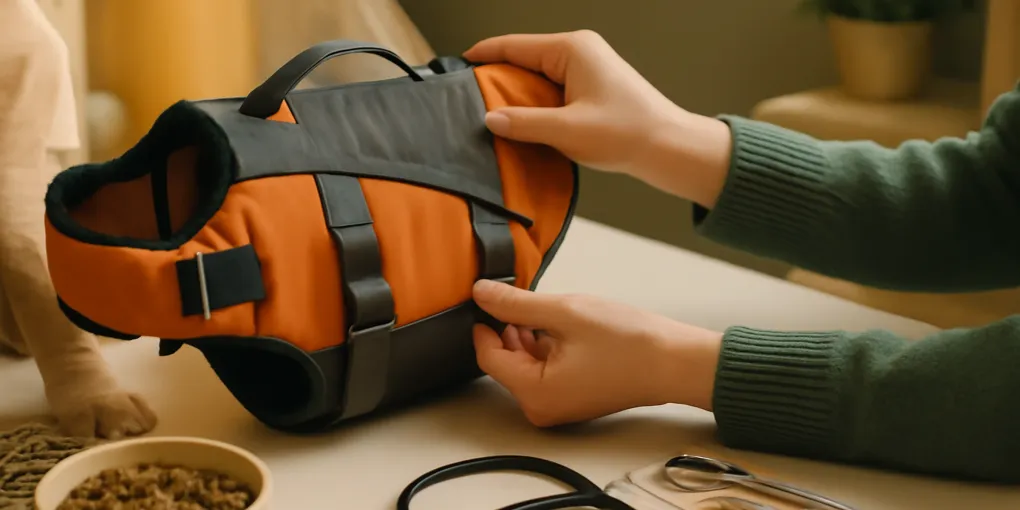
Put the jacket on dry. The chest panel should sit under the sternum, not on the soft belly behind the rib cage. Belly straps should tighten enough that two fingers fit under them, but the dog can still breathe and move. The jacket should not slide forward into the armpits when you gently pull the handle upward.
After tightening, walk the dog around for five minutes. Look for shortened stride, rubbing behind elbows, hunched posture, or repeated scratching. A dog that freezes may need slow conditioning, but a dog that cannot move normally may have the wrong cut.
Front-float dog life jacket
Best for: recreational swimming and boating where head support and visibility matter.
Why it helps: a front float or neck support can help keep the muzzle higher when the dog tires, while the top handle gives owners a safer way to guide the dog near a dock or boat.
Caveat: a handle is not a crane. Do not repeatedly hoist a heavy dog by a single handle unless the manufacturer specifically rates it for lifting and the dog is supported. Use ramps or two-hand support when possible.
Check current options: Search Amazon for dog life jacket front float handle.
Step 3: test buoyancy in shallow water
The first water test should be in shallow calm water where the dog can stand. Attach a leash to a harness or approved point as directed, not to a weak decorative loop. Let the dog step in; do not throw or drag the dog into water. Watch whether the jacket stays centered when wet.
A good fit keeps the dog level enough to paddle without the rear sinking dramatically or the vest rolling to one side. If the jacket rides up around the neck, rotates, or blocks shoulder movement, leave the water and readjust. Some dogs need a different model because body shape matters more than strap effort.
Step 4: plan the environment
Pools, lakes, rivers, and boats have different hazards. Pools need visible exits and training so the dog knows where steps are. Lakes need checks for algae, sharp rocks, hooks, and boat traffic. Rivers add current that can overwhelm even a strong swimmer. Boats add slippery decks, heat, noise, and sudden wake movement.
The American Kennel Club and boating-safety groups often remind owners that not all dogs are natural swimmers. Brachycephalic dogs, very short-legged dogs, seniors, puppies, and overweight dogs may tire quickly. A life jacket buys support; it does not erase anatomy or fatigue.
Reflective bright swim vest
Best for: dark-coated dogs, busy water, evening paddles, and owners who need fast visual tracking.
Why it helps: bright colors and reflective trim make it easier to see the dog against water, rocks, boats, and shade. Visibility is a real safety feature when multiple people are watching.
Caveat: reflective trim does not help if hidden under the dog or soaked under mud. Rinse after saltwater or lake use and inspect stitching around reflective panels.
Check current options: Search Amazon for reflective dog life jacket.
Step 5: dry, rinse, and inspect
After use, rinse sand, chlorine, salt, and lake debris from the jacket. Dry fully before storage so straps do not mildew. Check buckles, stitching, handle attachment, Velcro, foam panels, and fabric around the armpits. Replace the jacket if buoyancy foam compresses, straps slip, buckles crack, or the dog has chewed any part.
Recheck fit every season. Dogs gain weight, lose muscle, grow coat, or age into different movement. Puppies can outgrow a jacket quickly. A jacket that fit last summer may not be safe this year.
Breed and body-shape adjustments
Deep-chested dogs often need longer chest panels and more adjustment range than the size chart suggests. A vest that fits girth but ends too high behind the elbows can rub during paddling. Barrel-chested breeds may need broader belly support so the jacket does not roll. Very slim dogs may need a smaller size with enough back length rather than a large vest cinched to the limit.
Brachycephalic dogs deserve special caution. Short muzzles and airway limitations can make swimming harder even when the dog looks enthusiastic. Keep sessions brief, avoid heat, and favor shallow water with easy exits. A life jacket does not fix heat stress or breathing anatomy.
Conditioning before water
Let the dog sniff the jacket indoors. Touch it to the shoulders, reward, and remove it. Then buckle one strap for a few seconds, reward, and stop. Build to wearing it during a short walk before trying water. This sequence prevents the jacket from predicting immediate stress.
Practice handle touches separately. Gently hold the handle for one second, reward, and release. Later, apply light upward guidance without lifting. The dog should not learn that the handle means panic or being yanked. If you may need to help the dog onto a dock, teach that handling on land first.
Dock, pool, and boat exits
Every water plan needs an exit plan. In a pool, show the dog the steps repeatedly from inside the water. In a lake, choose a gradual bank rather than a steep wall. On a boat, identify whether the dog can use a ramp, swim platform, or two-person lift before the dog ever enters the water.
Exhaustion often appears before owners expect it. Watch for vertical body position, frantic splashing, wide eyes, repeated attempts to climb onto people, coughing, or slowing response to cues. End the session early. A successful first swim is short, controlled, and boring.
Common fit failures
If the jacket rotates, the girth is wrong, the shape is wrong, or the straps are uneven. If the neck panel pushes into the throat when the dog sits, the front is too tight or the design is too bulky. If the rear floats while the shoulders sink, the buoyancy distribution may not match the dog. If armpit fur rubs off after one outing, the cut is wrong even if the size chart said yes.
Do not solve every problem by tightening. Over-tightening can restrict breathing and movement. Sometimes the answer is a different model with a different chest panel, shorter body, or softer edge binding. Comfort and secure flotation have to be present together before the jacket belongs in open water or around busy docks safely.
Evidence notes
- AVMA travel and disaster-preparedness materials support planning, restraint, and environmental safety around pets.
- American Red Cross pet first-aid resources include water-safety reminders for owners.
- Center for Pet Safety principles about independent safety testing are relevant when evaluating marketing claims for travel gear.
Dog life jacket FAQ
Does every dog need a life jacket on a boat?
A life jacket is strongly recommended for most dogs on boats because falls, wakes, fatigue, and panic are unpredictable. Local rules may vary, but the practical safety case is strong.
Can a dog swim in a harness instead?
A regular harness does not provide flotation. Some harnesses help handling on land, but they are not life jackets unless designed and rated as flotation gear.
How tight should the straps be?
Snug enough that the jacket does not rotate or slide over the head, loose enough for normal breathing and movement. The two-finger rule is a starting point; shallow-water testing confirms fit.
What if my dog hates wearing it?
Condition it gradually on land with short sessions and rewards. If the dog remains panicked, skip water activities until you have a behavior plan. Forcing a fearful dog into water is unsafe.