How to Target Train a Betta Fish Without Overfeeding
ProtocolQuick picks
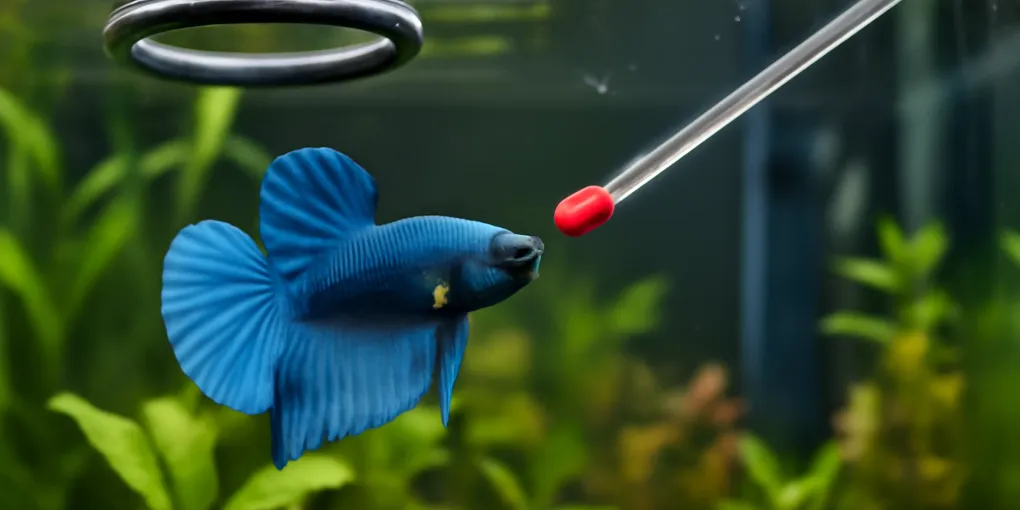
Aquarium feeding ring with suction mount
★ Top pick Best starting station- Note: Choose a smooth ring that stays at the surface without sharp seams; it gives the fish a consistent location without reducing swimming space.
Long acrylic aquarium target stick
Best hand-clear cue- Note: Use a smooth, non-painted tip reserved for this aquarium. A clean feeding pipette can serve the same role.
Digital gram scale with 0.01 g resolution
Best ration control- Note: Useful when tracking a tiny daily ration, but count and measure the actual food with guidance for the fish rather than chasing a universal gram target.
To target train a betta, pair one smooth visual target with a tiny piece of the fish’s normal food, then reward progressively closer approaches. Keep each session under a minute at first and take every reward from the daily ration. The exercise should add choice and movement, not extra calories or repeated chasing.
Before training, check the aquarium
Do not train around a husbandry problem. The betta needs an appropriately sized, heated, filtered, cycled aquarium with stable water parameters, a gentle current, cover near the surface, and room to reach air. Test ammonia and nitrite when behavior changes, and follow aquarium-veterinary or experienced aquatic-care guidance for the fish’s setup.
Postpone training if the fish is gasping, clamping fins, lying unusually, showing new spots or swelling, refusing normal food, rubbing, or breathing rapidly. A novel target cannot diagnose or treat illness.
Use the normal complete betta food as the reward. Decide the day’s ration before the session and move several tiny pieces into a separate cup. When the cup is empty, training is over. Do not add treats on top of the usual meal.
Quick picks for one-minute sessions
- A smooth suction feeding ring gives every reward a consistent destination away from the filter outflow. Check Suction Aquarium Feeding Ring Betta on Amazon.
- An acrylic aquarium target stick keeps fingers out of the water and is easier to disinfect than wood or a painted craft tool. Check Acrylic Aquarium Target Stick Fish on Amazon.
- A fine-resolution food scale helps document a tiny ration when pellet sizes vary, but it does not prescribe how much this fish should eat. Check Fine Resolution Scale Fish Food on Amazon.
The feeding ring is the best first item. A clean pipette can replace the target stick, and most owners can count consistent pellets without buying a scale.
Choose a target the fish cannot swallow
A good target is smooth, inert, larger than the fish’s mouth, and easy to remove. A clear acrylic rod with a colored solid tip or a clean feeding pipette works. Check Acrylic Aquarium Target Stick Fish on Amazon. Avoid paint that can flake, metal that can corrode, sharp skewers, laser pointers, and anything small enough to detach.
Reserve the target for this aquarium. Rinse it with aquarium-safe water and let it dry; do not wash it with soap. If there are multiple tanks, label tools so a wet target does not move pathogens between systems.
A feeding ring can create a stable first station. Check Suction Aquarium Feeding Ring Betta on Amazon. Place it away from the filter outflow and remove it if the mount, seam, or opening can trap the fish.
Stage 1: reward calm orientation
Present the target just outside the glass, several inches from the fish. Hold still. The instant the fish turns its head or body toward it, deliver one food piece at the feeding station.
Repeat two or three times and stop. Do not tap the glass, wiggle the target rapidly, or corner the fish. The first lesson is simply: noticing this object predicts food at a safe location.
Pass criteria: the betta turns toward the stationary target in three calm presentations across at least two sessions.
Stage 2: move the target inside the tank
Submerge only the clean tip near the feeding station. Keep your hand and sleeve from blocking light over the aquarium. Reward a calm approach within roughly one body length; contact is not required.
If the fish flares continuously, darts away, hides, or attacks the target repeatedly, remove it and return to outside-glass presentations another day. Brief inspection is expected. Sustained agitation means the step is too large or the target resembles a rival.
Pass criteria: the fish approaches the submerged target without frantic movement or prolonged flaring.
Stage 3: shape one gentle touch
Now wait for the nose to move very close to or lightly touch the target. Mark the exact moment by immediately moving the food to the station. The food, not a clicker sound, is the meaningful consequence underwater.
Do not require repeated bumps. One target touch followed by a short swim to the station is enough. End after three to five successful rewards or about a minute, whichever comes first.
| Response | Next action |
|---|---|
| Calm look but no approach | Move target farther from the fish’s territory and reward a smaller approach |
| Slow approach and touch | Reward once at the station |
| Repeated hard strikes | Remove target; change its color or shape next session |
| Hiding or rapid darting | End session and check environment |
| Food refusal | Stop and assess appetite, water, temperature, and health |
Stage 4: add a short follow
After the fish reliably approaches, move the target one or two inches at a slow, level pace. Reward following at the station. Over several days, increase the path gradually, keeping it away from the heater, filter intake, decorations, and tank walls.
Do not draw tight circles or make the fish sprint repeatedly. Bettas surface to breathe and should always be able to leave the exercise. One short S-shaped path is more useful than ten laps.
Stage 5: use training for practical care
Targeting can make ordinary care less disruptive. Teach the fish to move to the feeding ring while you inspect the body from above, or to enter a clear submerged container during a planned transfer. Never chase a sick fish around the tank to prove the behavior.
For a container transfer, start with the empty container resting open in the aquarium for brief supervised sessions. Reward looking toward it, then approaching its opening, then voluntarily entering. Keep the opening fully submerged and unobstructed. This is a separate multi-day behavior, not a same-session trick.
Ration control is part of the protocol
Small fish need small rewards. A 0.01 g scale can help document food use when the chosen pellet is too variable to count consistently. Check Fine Resolution Scale Fish Food on Amazon. The scale does not determine the correct ration; food energy, pellet size, fish condition, temperature, age, and veterinary advice still matter.
Track:
- food type and number or measured amount offered;
- rewards eaten versus missed;
- session duration;
- feces, abdominal shape, and appetite at the next meal;
- ammonia and nitrite after any uneaten food incident.
Remove missed food promptly. Target training that leaves pellets decomposing in the substrate is degrading the environment it is supposed to enrich.
A one-week schedule
Days 1 and 2: Two or three outside-glass orientations, once daily.
Days 3 and 4: One submerged approach session, 30 to 60 seconds.
Day 5: Shape one or two gentle touches.
Day 6: Follow the target one or two inches.
Day 7: Rest or repeat the easiest successful stage.
Keep familiar plants, hides, and feeding timing. Training should not become the only way the fish receives food. A betta that ignores the target must still receive appropriate nutrition and care.
Two betta-specific checks make this protocol different from training a mammal: every reward changes the aquarium’s nutrient load, and a colored target can trigger territorial flaring rather than curiosity. Ration accounting and a calm-response criterion address both.
Sources
- RSPCA, Creating a good home for fish: https://www.rspca.org.uk/adviceandwelfare/pets/fish/environment
- Brown C. Fish intelligence, sentience and ethics. Animal Cognition. 2015;18:1-17: https://pubmed.ncbi.nlm.nih.gov/24942129/
- Merck Veterinary Manual, Management of Aquarium Fish: https://www.merckvetmanual.com/exotic-and-laboratory-animals/aquarium-fish/management-of-aquarium-fish
Frequently Asked Questions
- Fish can learn associations and simple operant tasks. A betta can learn to approach a station or follow a target, but training should remain voluntary and should not involve jumping, tapping glass, or withheld basic care.
- Start with 30 to 60 seconds and only a few food rewards. End while the fish is still calm, and subtract rewards from the normal daily ration.
- Check water temperature and quality, appetite, breathing, posture, fins, and recent changes. A sudden behavior change can signal stress or illness, not a training problem.