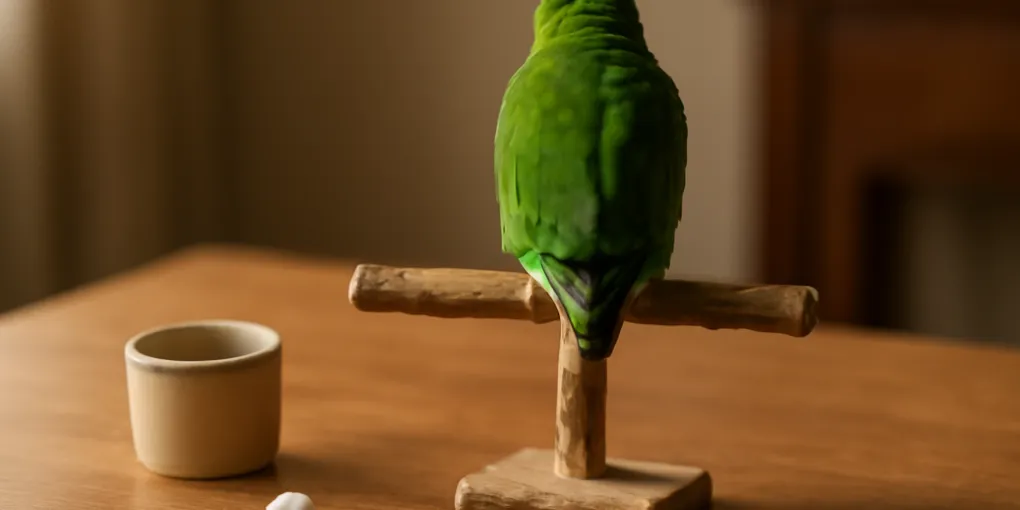
Parrot Station Training Protocol: Teach a Bird to Go to a Perch on Cue
ProtocolQuick picks
| Product | Key Specs |
|---|---|
| See price on Amazon |
|
| See price on Amazon |
|
| See price on Amazon |
|
Product availability, certifications, and retailer details can change; check the current Amazon page before buying.
The Goal
Station training gives a parrot one clear job: go to this perch and stay for a short moment. It is useful when you need to open a cage door, refresh bowls, move the bird away from a doorway, weigh the bird, or create a calm location during household activity.
The station is not punishment and not a place to park a bird for long periods. A successful station has a stable perch, a short cue, rapid reinforcement, and an easy release. The bird should be able to choose the behavior without being pushed, chased, or cornered.
What to Buy and What to Skip
A station can be a familiar cage perch, a tabletop perch, or a freestanding stand. For structured practice, search Amazon for a tabletop natural-wood parrot training perch with a broad base and a diameter appropriate for your species.
| Item | Choose | Avoid |
|---|---|---|
| Perch | Stable base, appropriate diameter, cleanable, visibly distinct | Wobbling stand, sharp hardware, loose caps, oversized slick dowel |
| Target | Smooth blunt end, easy to wash, long enough for calm handling | Pencil with paint, splintered chopstick, sharp pointer |
| Reward | Tiny portion of a food the bird already safely eats | Large nuts that end the session, new food during a stressful lesson |
| Location | Quiet, good footing, away from doors, fans, hot pans, and other pets | Kitchen cooking zone, open exterior door, unstable furniture |
If you use one, check current bird target-training sticks on Amazon. It should guide the bird’s beak toward a point and should never poke the chest, feet, or face.
Before Session One: Check the Bird and the Room
Do not train through signs of illness or distress. A bird that is fluffed for long periods, breathing with effort, tail bobbing, sitting low, weak, suddenly aggressive, or not eating needs avian-veterinary assessment. Sudden reluctance to step or perch can reflect foot pain, injury, arthritis, or weakness.
Close exterior doors and windows. Turn off ceiling fans. Remove dogs and cats. Keep hot drinks, pans, cords, and toxic plants out of reach. Decide where the bird can fly safely if it leaves the station.
Choose a reward from the bird’s normal diet or a small high-value food already known to be safe. The portion should be tiny enough to swallow quickly. Do not withhold normal meals to force cooperation.
Step 1: Make the Station Safe and Familiar
Place the station near a familiar area without asking the bird to touch it. Reward calm looking. If the bird leans away, slicks feathers tightly, freezes, climbs away, or alarm-calls, increase distance.
For a bold bird, this introduction may take a minute. For a cautious bird, it may take days. Progress is measured by relaxed behavior, not by the calendar.
Once the bird calmly approaches, reward one foot on the perch, then two feet. Use a marker such as a quiet “good” or a clicker only if the bird already understands it and is not frightened by the sound.
Step 2: Mark Two Feet on the Perch
Stand close enough that the next step is obvious. Present the target just beyond the station or lure with your hand position without touching the bird. The moment both feet land on the perch, mark and deliver the reward at the station.
Feed at the station rather than drawing the bird off immediately. This builds value for remaining in place.
After the reward, use a release word such as “okay” and offer a familiar return perch. At first, release after one second. A clear release prevents the bird from guessing how long the behavior lasts.
Step 3: Add the Cue
Add a verbal cue only when the bird is already moving to the station reliably. Say “station” once, pause, then present the same target or hand signal used during practice. Mark the arrival and reward.
Do not repeat “station, station, station.” Repetition teaches the bird that the first cue is optional. If the bird does not move, make the setup easier by reducing distance or lowering the distraction.
Run three to five repetitions, then stop. One clean minute is a complete session.
Step 4: Build Duration in Seconds
Increase duration slowly:
- Two feet on the station, one second, reward, release.
- Two feet, two seconds, reward, release.
- Two feet, one second, reward, then another two seconds, reward, release.
- Vary between one and five seconds so every repetition does not become harder.
Reward calm feet and neutral body language. If the bird begins pacing, leaning, lunging, screaming, chewing the perch frantically, or preparing to fly, release or simplify before the behavior escalates.
Do not race toward minutes. For bowl changes and doorway safety, a dependable 10 to 30 seconds may be more valuable than an unreliable five-minute stay.
Step 5: Add Distance Before Distraction
Take half a step away, return, reward, and release. Then try one full step. If the bird leaves, do not scold or grab. Reset at the last successful distance.
Distance changes the picture. A parrot that stations when your hand is beside the perch may not understand the cue from across the room. Train each new handler position as a small new step.
Only after distance is reliable should you add mild household actions, such as lifting an empty bowl or opening a cabinet. Keep exterior doors closed and the room flight-safe during every practice.
Step 6: Use the Skill for Real Tasks
Bowl changes
Cue the station before reaching into the cage. Reward while the bird stays away from the bowl door. Change one bowl, reward again, and release. This gives the bird an active way to cooperate instead of defending the access point.
Scale training
Place a stable gram scale under or beside a known perch according to the scale setup. Cue the station, reward a brief stand, and record the number only when the bird is settled. Our pet bird scale setup protocol covers stable weighing and trend tracking.
Doorway management
Use a station well inside the room before anyone opens an interior door. Station training is only one layer. Exterior doors, windows, and fans still need physical control.
Visitor management
A station can give the bird distance and predictability, but visitors should not reach toward the bird. If the bird shows fear or repeated alarm behavior, move the session farther away or end it.
Training Troubleshooting Matrix
| Problem | Likely setup issue | Next adjustment |
|---|---|---|
| Bird will not approach | Station is unfamiliar, unstable, too close, or associated with handling | Increase distance, stabilize it, reward looking, stop asking for steps |
| Bird steps on and leaves | Reward is delivered away from station or duration rose too fast | Feed on station, release sooner, alternate easy and slightly longer reps |
| Bird bites the target | Target is too close, reward timing is late, or biting was accidentally reinforced | Present farther away, mark gentle orientation, remove without drama |
| Bird screams when handler steps away | Distance jump is too large or separation is already difficult | Return to half-steps and very short duration; seek behavior help if distress is severe |
| Bird flies off during real tasks | Distraction was added before the cue was fluent | Practice the empty movement first, reduce task intensity, secure the environment |
What Station Training Cannot Fix
Station training is not a treatment for pain, reproductive behavior, sleep deprivation, severe phobia, chronic feather damaging behavior, or sudden aggression. It can improve communication around predictable tasks, but medical and environmental causes still need direct attention.
Avoid flooding, a method where the bird is kept close to a feared object until it stops reacting. A motionless bird may be overwhelmed rather than comfortable. Positive reinforcement depends on choices small enough for the bird to make successfully.
Parrot Station Training FAQ
Should I use a clicker?
Use one only if the sound does not frighten the bird and you can click at the correct moment. A consistent soft word can work as the marker.
Can the cage top be the station?
Yes, if it is stable, safe, and distinct enough for the bird to understand. A separate perch is often easier when you need the bird away from the cage door or bowls.
What if my parrot refuses the reward?
The bird may be full, stressed, afraid of the setup, or unwell. Reduce pressure and check body language. Persistent appetite change needs avian-veterinary attention.
Sources
- World Parrot Trust, Happy Healthy Parrot Care Guide: https://parrots.org/learn/care-guides/happy-healthy-parrot/
- World Parrot Trust, The Power of Positive Reinforcement: https://parrots.org/focus/improving-parrot-care/the-power-of-positive-reinforcement/
- World Parrot Trust, Teach Your Parrot to Target: https://parrots.org/reference-library/articles-by-subject/behaviour-training/reference-library-teach-your-parrot-to-target/
Frequently Asked Questions
- Station training teaches the bird to move to a specific perch or location and remain there briefly after a cue. The bird is rewarded for choosing the location; it is not forced or tied to the perch.
- Start with one to three minutes and stop while the bird is still engaged. Several tiny successful sessions are usually more useful than one long session that ends in avoidance or frustration.
- It can create safer movement options and reduce some handling conflict, but it does not diagnose or cure biting. Pain, fear, guarding, hormones, sleep, environment, and learned history may all contribute.