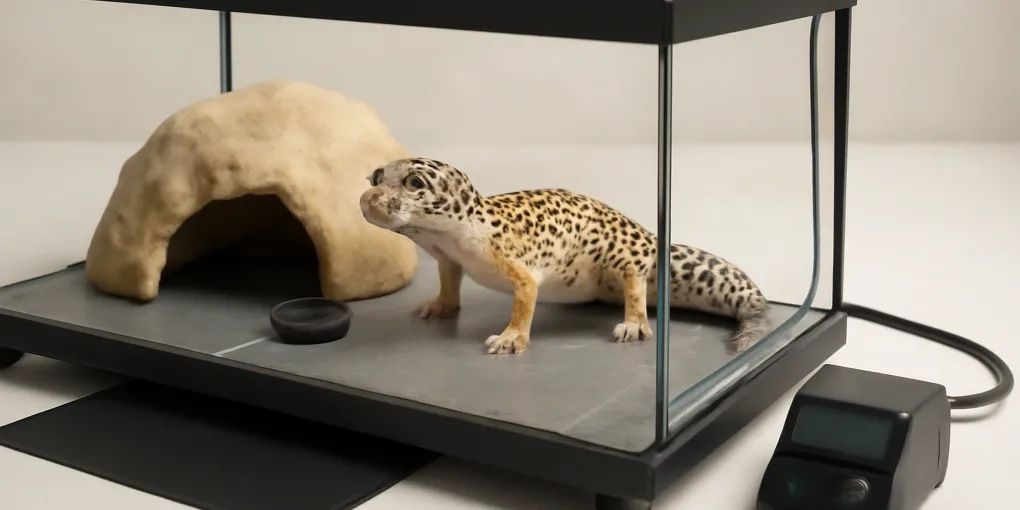
Leopard Gecko Heat Mat Thermostat Protocol: Safer Belly Heat Without Guesswork
ProtocolQuick picks
| Product | Key Specs |
|---|---|
| See price on Amazon |
|
| See price on Amazon |
|
Product availability, certifications, and retailer details can change; check the current Amazon page before buying.
Direct answer
A leopard gecko heat mat should be treated as a controlled heat source, not a plug-and-play pad. Use a reptile thermostat, secure the probe at the warm hide floor, verify the surface with an independent thermometer, and keep a cool hide and humid hide available. The thermostat controls the mat; the gecko controls its behavior by moving through the gradient.
ReptiFiles’ leopard gecko temperature guidance treats the heat gradient and surface-temperature measurement as central husbandry details (ReptiFiles). A thermostat is the practical tool that keeps a small heat mat from becoming an uncontrolled hot spot.
If you keep other reptiles, compare this setup with our broader reptile habitat controller guide.
Step 1: decide whether a heat mat fits the enclosure
Heat mats work best when they warm a specific floor zone under a warm hide. They are less useful when thick substrate blocks heat, when the enclosure needs overhead basking, or when the room is too cold for the whole habitat. Before installing one, confirm the species, enclosure material, ventilation, substrate depth, and target temperatures recommended by a qualified reptile veterinarian or current husbandry source.
Never sandwich a heat mat under furniture, carpet, towels, or an unventilated surface outside the manufacturer’s instructions. Trapped heat can build where you cannot see it.
Step 2: plug the mat into the thermostat first
The heat mat plugs into the thermostat. The thermostat plugs into the wall. The thermostat probe tells the controller when to turn the mat on and off. Do not test the mat by leaving it powered directly from the wall for daily use. Even a small mat can create a surface that is too hot for skin contact if the room, glass, substrate, or airflow changes.
Set the thermostat conservatively, then adjust based on measured surface temperature. Different probes and thermostats read differently, so the number on the controller is not automatically the number under the gecko’s belly.
Step 3: secure the probe where heat matters
Probe placement is the common failure point. For an under-tank mat, secure the probe at the warm hide floor or the controlled surface according to the device instructions. If the probe dangles in open air, the thermostat may keep heating while the floor gets too hot. If the probe is buried away from the gecko’s resting surface, it may not represent what the animal feels.
Use safe mounting methods that the gecko cannot eat, pull loose, or wrap around toes. Avoid loose tape inside the enclosure where heat, humidity, and claws can loosen adhesive.
Step 4: verify with a second device
Use a digital probe thermometer, infrared temperature gun, or both to check the actual warm hide floor after the mat has stabilized. Check again after adding substrate, changing hides, moving the tank, or turning room heat or AC on. A thermostat is a control system, but it is not a replacement for inspection.
Measure several points: the warm hide floor, the edge of the warm zone, the cool hide, and the humid hide. The goal is a usable gradient, not one perfect number.
Step 5: keep the gradient usable
A leopard gecko needs choices. The warm hide should be warm enough for digestion and normal behavior, while the cool side should allow retreat. The humid hide supports shedding and should not become a wet hot box. If every hide sits over the mat, the gecko loses control. If the warm hide is too exposed, the gecko may avoid it even when the temperature is right.
Watch behavior. Constant glass surfing, persistent cool-side hiding, refusal to eat, bad sheds, lethargy, burns, or unusual posture are reasons to reassess husbandry and consult a reptile veterinarian.
Buying notes
The two non-negotiable purchases are a thermostat and an independent thermometer. A search Amazon for reptile heat mat thermostats gives basic control; a search Amazon for reptile thermometers confirms the actual enclosure. Buy the mat size for the warm zone, not the whole tank floor. Covering the entire bottom removes the cool escape route.
Skip listings that advertise constant heat without mentioning thermostat use. Also avoid oversized mats, damaged cords, cracked insulation, and products with unclear wattage or mounting instructions.
Leopard gecko heat mat FAQ
Is belly heat required for every leopard gecko?
Not necessarily. Husbandry approaches vary, and some keepers use overhead heat with appropriate controls. The key is a species-appropriate gradient verified by measurement.
Can loose substrate be used over a heat mat?
It depends on the substrate depth, mat, thermostat, and enclosure. Thick or insulating substrate can make the mat heat the glass while the top stays cooler. Measure the surface where the gecko rests.
How often should I check temperatures?
Check daily during setup, after any equipment change, and during seasonal room changes. Once stable, keep a regular habit of quick visual and thermometer checks.
Product stack that actually solves the problem
The minimum safe stack is a heat source, a thermostat, an independent thermometer, and at least two hides. A search Amazon for reptile heat mat thermostats should come before decorative upgrades. A search Amazon for reptile thermometers confirms that the controlled zone matches the animal’s surface, not just the controller’s display.
A ceramic hide, slate, tile, or thick substrate can change how heat reaches the gecko. That is why copying another keeper’s dial setting is weak evidence. Your enclosure material, room temperature, mat wattage, substrate depth, and probe placement define the result.
Common failure scenarios
The first failure is probe drift. A probe that was taped neatly on day one can be moved by cleaning, digging, or a hide shift. If the probe moves away from the warm surface, the thermostat may overheat the mat. If it sits too close to the mat but not where the gecko rests, the warm hide may stay cooler than expected.
The second failure is seasonal room change. A setup that worked in spring may underperform in winter or overheat near a summer window. Measure after room heating, air conditioning, or sunlight patterns change. Do not place the enclosure where direct sun can add uncontrolled heat.
The third failure is treating one thermometer as truth. Cheap devices can be wrong. If behavior and readings disagree, verify with a second tool and inspect the hardware.
Cleaning and maintenance
Unplug and inspect equipment during routine deep cleans. Look for pinched cords, cracked insulation, stuck adhesive feet, scorch marks, moisture near plugs, and mats that are lifting from the glass. Replace damaged heat equipment rather than repairing it with tape.
Keep water dishes and misting away from electrical connections. Use drip loops where cords leave the enclosure area. Label the thermostat plug if several reptile devices share one power strip so a caregiver does not unplug the wrong controller.
Sources
- ReptiFiles: Leopard gecko temperatures and humidity
Frequently Asked Questions
- No. A heat mat can overheat the surface it touches. Use a thermostat and verify temperatures with a second device.
- Secure it at the warm hide floor or the surface being controlled, following the thermostat and heat-mat instructions. Do not leave it dangling in open air.