Measure a Dog Crate Tray Before Ordering a Replacement Pad
ProtocolThe crate may be labeled 36 inches, but the removable tray is the surface a replacement pad has to fit. Slide the tray out, measure the flat inside length and width, and compare those two numbers with the pad’s stated dimensions before ordering. A crate label is useful for identifying the setup; it is not a substitute for measuring the tray in front of you.
Start with the removable tray
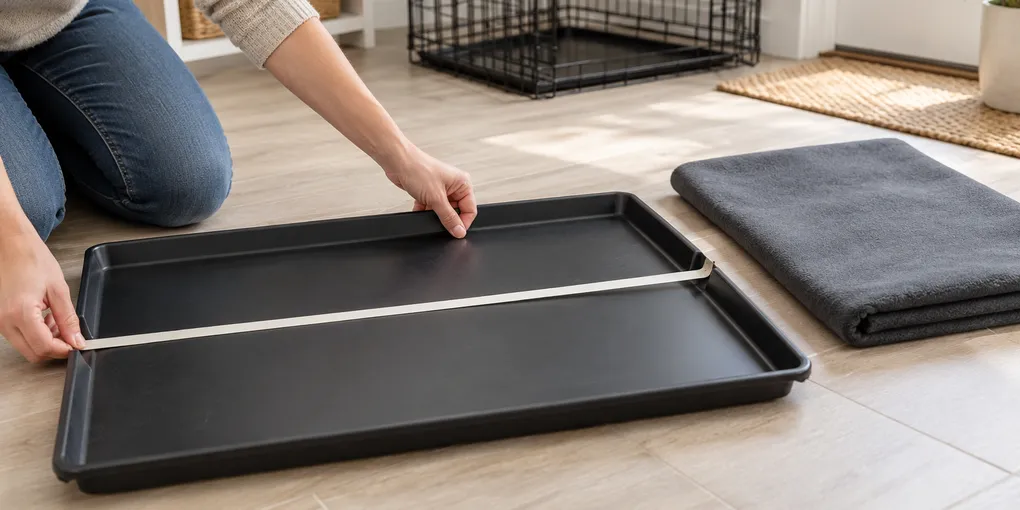
Pull the tray out and place it on a clear floor. On many wire crates, the tray is held by a pan stop near the bottom of the front panel; MidWest’s iCrate instructions describe releasing that stop before sliding the plastic pan out. If your crate has a different latch or tray arrangement, use its own instructions rather than forcing the tray.
Once it is out, you can see the measurement that matters: the uninterrupted floor inside the raised sides. Leave the crate itself assembled. Its outer frame, door opening, and advertised length may all be larger than that usable rectangle.
Measure the flat inside length and width
Use a rigid tape measure or a soft tape held straight. For the length, place the tape against the inside wall at one short end and run it to the opposite inside wall. Keep it on the tray floor, not across the top edge of the lip. Repeat the process across the width at the broadest flat section.
Write both readings with their units. A note such as inside tray: 34.25 by 22 inches is much more useful than large crate. If one end narrows or the walls slope inward, record the narrowest usable point too. That is the spot most likely to make a rectangular pad bunch or sit on the lip.
Look at the tray lip before comparing pads
The lip is part of the tray, but it is not part of the flat floor. Measure between the inside walls first. Then look at the lip’s height and shape:
- A shallow, nearly vertical lip may leave room for a pad that reaches close to the walls.
- A sloped or rounded lip reduces the flat area near the perimeter.
- A thick pad can meet the wall sooner than a thin one, even when their listed length and width are the same.
You do not need to turn this into a complicated formula. The goal is to notice whether the tray has a simple rectangular floor or a smaller floor surrounded by pronounced edges. If the listed pad dimensions are close to your measurements, that edge detail is worth checking in the listing’s photos and description.
Compare measurements, not just a crate-size label
Open the pad listing and find its stated length and width. Put those beside your two tray readings, in the same unit. Do not compare a 36-inch crate label with a pad labeled 36 inches and assume the dimensions match in both directions.
MidWest’s crate-size reference is designed to help identify a crate size, while its replacement-pan FAQ also points owners toward replacement parts. Those references are useful for identifying a model or family of crate, but they do not establish the inside dimensions of every individual tray. The tray you have is the final surface to measure.
A quick comparison note can keep the decision clear:
| Record | Example |
|---|---|
| Tray inside length | 34.25 inches |
| Tray inside width | 22 inches |
| Pad stated length | 34 inches |
| Pad stated width | 22 inches |
| Tray edge note | Raised lip on all four sides |
The example is only a way to organize the numbers, not a universal fit rule. A pad’s cut, thickness, and construction can change how it lies in a tray.
Keep the crate model beside the measurements
Before putting the tray back, photograph or write down the crate’s model and size label if you can find it. Keep that detail with the two inside measurements. The model label can help you find the correct instructions or distinguish similar crates later; the measurements let you compare an actual pad listing.
If you are measuring for someone else, send the record as a single line: crate model: ___; tray inside: ___ long by ___ wide; lip: low/high/sloped. It gives the next person the information a general size label leaves out.
Check the listing’s own dimensions one last time
Read the dimensions in the listing, not only its title or size selector. Some listings name a crate length, while others give the finished pad size. If the dimensions are absent, unclear, or use a different unit, pause before ordering and look for the maker’s measurement details.
This method does not promise that every pad will fit every tray. It gives you a reliable comparison: the removable tray’s usable inside length and width, the shape of its edge, and the pad dimensions the seller actually states.
FAQ
Should I measure the crate or the removable tray?
Measure the removable tray’s flat inside length and width. Those are the dimensions a pad needs to occupy, and they can be smaller than the crate’s outside label.
Where should the tape measure start?
Set it against the inside edge of the tray wall at one end and run it to the opposite inside edge. Do the same across the width, keeping the tape flat on the tray floor.
What if a pad lists only one crate size?
Treat the crate-size label as a clue, not the final comparison. Look for the pad’s stated length and width and compare both with your recorded tray measurements.
Should I include the raised lip in the measurement?
Measure the usable flat floor between the tray walls. Note the lip separately if it is tall or angled, since it can affect how a thick pad sits at the edge.
Sources
- MidWest Homes for Pets. iCrate Assembly Instructions.
- MidWest Homes for Pets. Dog Crate Size Reference.
- MidWest Homes for Pets. Frequently Asked Questions.