A Simple Drawer System for Aquarium Tools
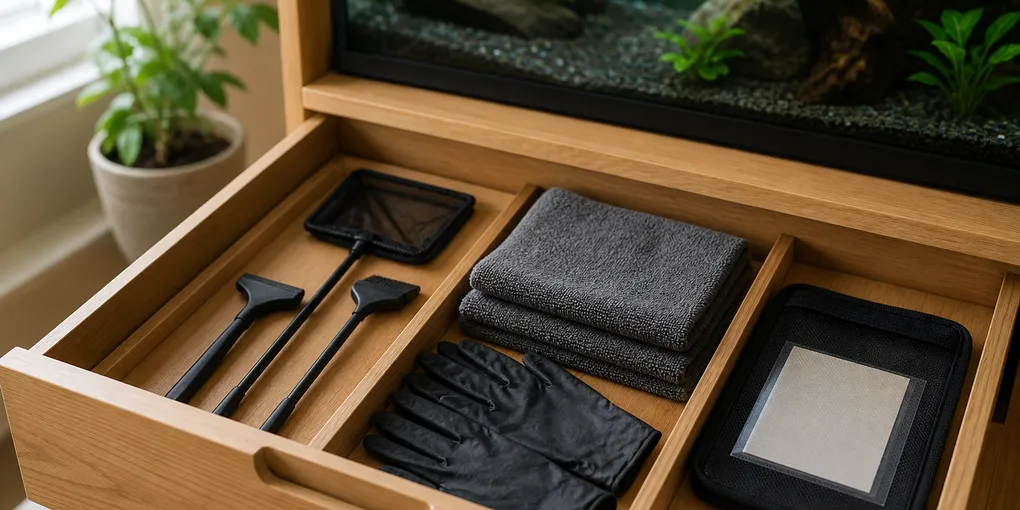
ProtocolWhen the algae scraper is in a kitchen drawer, the net is behind the tank, and the towels have drifted into the laundry, a small maintenance task starts with a scavenger hunt. Give dry aquarium tools one shallow drawer with three jobs: long tools on one side, towels and gloves in the middle, and reference supplies at the far end. The reset is simply putting each item back in its lane.
That division fits the kinds of separate hand tools commonly used around an aquarium. Aqueon groups cleaning equipment such as magnets, siphon vacuums, and water changers in its maintenance catalog, while Tetra lists nets, gravel vacuums, and scrapers as distinct pieces of equipment. A drawer gives the dry items you already use a dependable home.
Start with one drawer that closes easily
Choose a drawer near the tank that will still close when its longest dry tool is laid flat. A shallow drawer is often easier to keep orderly than a deep cabinet because every item remains visible in one layer.
Before adding dividers, make one quick pass through the tools. Set the dry items that return to the drawer after a routine on the counter: a net, scraper, handle, clip, or other small hand tool. Give damp items their own landing place, and keep this drawer for its dry set.
Set the drawer up with its open end facing you. This simple orientation makes it easier to see whether a tool has been dropped crosswise instead of returned to its place.
Make the long-tool zone shallow and obvious
Reserve the widest section for long, narrow tools. Lay them parallel with the handles pointing in one direction. A net can sit flat beside a scraper or handle; a low divider keeps their ends from sliding into the next zone.
Avoid a vertical cup inside the drawer. It hides small parts beneath longer pieces and makes it tempting to drop a tool in wet. A flat lane makes the missing-tool check almost instant: if there is an empty outline of space, something is still out.
If two tools always travel together, park them side by side. The drawer should show where each one goes at a glance.
Keep towels and gloves in their own middle section
Fold clean, dry utility towels into a short stack in the middle zone. Put gloves beside or beneath that stack. This keeps fabric from wrapping around handles when the drawer opens and gives soft supplies a clear limit.
Use simple folds in the middle section. Keep the stack below the divider and clear extras to their usual linen storage when it grows taller.
Leaving a little empty space here also makes the drawer easier to reset after a busy day. You can set down one folded towel while the rest of the drawer stays in place.
Give paper references a dry, separate end zone
Use the smallest section for reference materials: a maintenance notebook, a warranty card, a spare label, or a small zip pouch holding instruction sheets. Place this zone at the end farthest from the tool handles, where paper stays clear as you reach for a net.
A card holder or slim pouch keeps one or two references from winding up under a towel. If you use a phone for most notes, this slot can hold a charging-free pencil and a small blank card instead.
Keep liquids, loose powders, and anything that belongs in another household-storage area out of this section. The reference zone works because it stays dry and easy to scan.
Reset the drawer in the same order every time
After you have put away damp items, return the dry drawer pieces in three moves:
- Lay long tools flat in their lane, handles aligned.
- Fold and return the clean towel or gloves to the middle section.
- Slide the notebook, pouch, or card back into the end zone, then close the drawer.
The three-step order prevents the familiar last-minute pile: fabric stays in its middle zone, and paper has its own corner. It also makes a shared household arrangement easier to understand. Someone opening the drawer sees three named physical destinations.
Keep the system small enough to survive a busy week
This setup works best when the drawer has a fixed capacity. A new tool that needs a different form of storage can have its own home before another organizer enters the drawer. When the towel section is full, clear it back to its normal linen spot and preserve the tool lane.
The single evidence boundary is straightforward: this guidance covers dry drawer storage for tools and references you have already chosen. For supply selection and tank-care procedures, use the relevant product instructions or seek a qualified aquarium professional.
FAQ
What should go in an aquarium tool drawer?
Keep only dry maintenance tools, clean towels or gloves, and the notes or manuals you reach for during a routine. Give each group its own section so it is easy to put back.
How should I organize long aquarium tools in a drawer?
Lay long tools in one shallow section with their handles facing the same direction. Choose a drawer deep enough for them to lie flat.
Should aquarium towels be stored with the tools?
A separate towel-and-glove section keeps those soft supplies from covering the tools. Return only clean, dry items to the drawer.
Where do aquarium manuals and notes belong?
Keep a small pouch, card holder, or notebook in its own section so paper references stay visible beside the long tools and towels.
Sources
- Aqueon: Cleaning & Maintenance
- Tetra: Tropical Fish equipment overview