Do Dogs Need Life Jackets? Water-Safety Evidence and Fit Rules
Evidence ExplainerQuick picks
| Product | Key Specs |
|---|---|
| See price on Amazon |
|
| See price on Amazon |
|
| See price on Amazon |
|
Product availability, certifications, and retailer details can change; check the current Amazon page before buying.
Direct answer
Many dogs benefit from a life jacket anywhere water is deep, moving, cold, hard to exit, or connected to boating. The vest does not make swimming risk-free. It buys buoyancy, visibility, and a handle so a person can help sooner. That matters most when a dog falls from a dock, slips off a paddleboard, misjudges a pool step, or tires far from shore.
Skip the fantasy that all dogs are natural swimmers. Body shape, age, panic, water temperature, and exit design matter. A lean retriever in warm shallow water is not the same risk as a senior pug near a boat ramp.
Safer gear starting points
- Search Amazon for dog life jackets with top handles for boats, docks, kayaks, and first-time swimming.
- Search Amazon for high-visibility dog flotation vests if the dog may be near other swimmers, boards, or low-light shorelines.
- Search Amazon for water-safe dog long lines only for controlled recall practice away from tangles and currents.
How we judged life-jacket value
| Factor | Weight | What mattered for this topic | Practical test |
|---|---|---|---|
| Buoyancy fit | 30% | The vest should support the chest without forcing the dog’s nose down. | Float-test in shallow water with a hand on the handle. |
| Evidence quality | 25% | Veterinary and water-safety guidance supports supervision, heat/cold caution, and rescue planning. | Treat the vest as backup, not permission for risky water. |
| Value | 20% | A durable vest is cheaper than emergency care after a boating or pool incident. | Prioritize fit and handle stitching over decorative fins. |
| User signals | 15% | Common failures include twisting, chafing, weak buckles, and hard-to-see colors. | Check reviews from dogs with similar body shape. |
| Transparency | 10% | Sizing charts and return terms matter because body shapes vary. | Measure chest girth, neck, back length, and weight before ordering. |
Dogs at higher risk in water
Brachycephalic breeds such as bulldogs, pugs, and French bulldogs can struggle with airway and endurance. Heavy-fronted dogs may not float level. Puppies, seniors, overweight dogs, and dogs with arthritis fatigue faster. Dogs recovering from surgery or illness should avoid unsupervised swimming even if they used to love water.
Cold water changes the calculation. A dog that swims comfortably in July can tire quickly in spring water. Current, waves, slippery rocks, fishing line, pool covers, and boat wakes add hazards that a backyard kiddie pool does not have.
When a life jacket is the right default
Use one for boating, paddleboarding, kayaking, dock play, lake cabins, fast rivers, ocean surf, unfamiliar pools, and any situation where the dog might enter water before you can reach them. Use one when teaching a dog to swim, even if you are standing nearby. Use one when children or guests may accidentally leave a gate open near a pool.
For pools, the vest is only one layer. Teach the exit. Dogs can panic if they cannot find steps. Practice short, calm sessions that start at the exit, not in the middle of the pool.
Fit rules that prevent false confidence
Measure the dog’s chest at the widest point behind the front legs. Check the manufacturer’s weight range, but do not rely on weight alone. A deep-chested dog and a barrel-shaped dog can need different sizes at the same weight.
On land, buckle the vest and slide two fingers under each strap. The dog should walk without armpit rubbing. Lift gently from the handle. The jacket should not peel forward over the head or rotate around the ribs. In shallow water, support the dog while you confirm that the nose stays above water and the dog can paddle without fighting the vest.
Features worth paying for
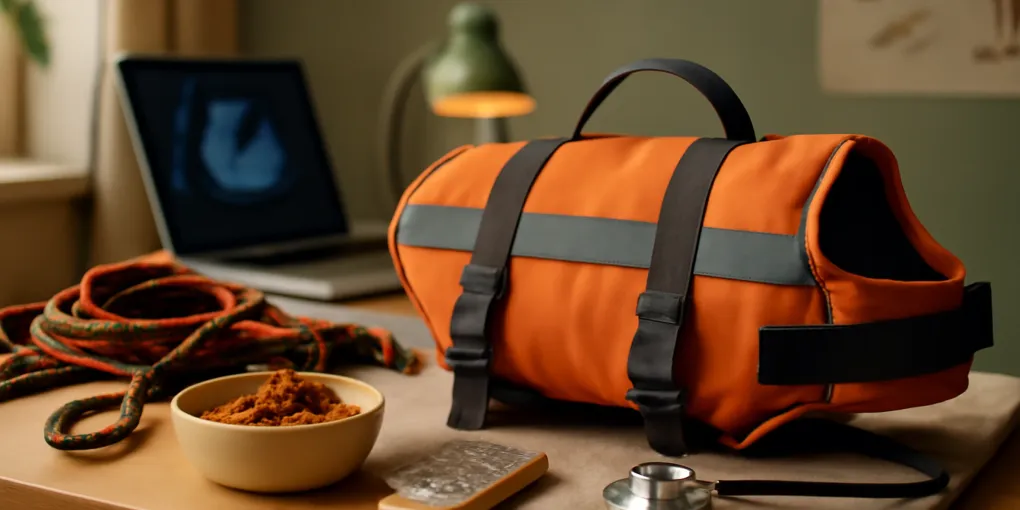
A strong top handle is useful for guiding a dog onto a dock, boat platform, or pool step. Two handles can help with large dogs. Bright color and reflective trim improve visibility. A D-ring can hold an ID tag, but do not rely on a jacket D-ring as your primary leash attachment unless the manufacturer says it is designed for that load.
Avoid novelty designs that add drag, block shoulder movement, or make the dog harder to lift. A shark fin is less important than secure belly panels, smooth edges, and stitching that can survive wet lifting.
When a life jacket is not enough
Do not use a vest to justify swimming in dangerous currents, blue-green algae, ice water, floodwater, or heavy boat traffic. Do not leave a vested dog alone near a pool. Do not clip a long line where it can wrap around dock posts, legs, or another swimmer.
If a dog coughs after water play, seems weak, vomits, has trouble breathing, or acts unusually tired, call a veterinarian. Water aspiration, heat stress, and exhaustion can look subtle at first.
FAQ
Does every dog need a life jacket around water?
Not for every shallow supervised splash. Use one when water is deep, moving, cold, hard to exit, near boats, or unfamiliar, and whenever the dog’s age, body shape, or medical status increases risk.
Can a strong swimmer skip a dog life jacket on a boat?
A strong swimmer can still fall awkwardly, panic, become cold, or fail to climb back aboard. For boating, a fitted vest with a handle is the safer default.
How tight should a dog life jacket be?
Snug enough that it does not rotate, twist, or slide over the head, but not so tight that it restricts breathing or shoulder movement. Test on land and in shallow water before real use.
Related reading
- For product-level fitting steps, see our dog life jacket fit protocol.
- If heat is part of the outing, pair this with how to prevent heatstroke in dogs.
Sources
- AVMA warm weather pet safety guidance includes heat, water, and supervision cautions for pet owners: https://www.avma.org/resources-tools/pet-owners/petcare/warm-weather-pet-safety
- AVMA travel-with-pets guidance covers trip planning and restraint thinking for owners taking pets away from home: https://www.avma.org/resources-tools/pet-owners/petcare/traveling-your-pet-faq
- Pet Poison Helpline guidance on blue-green algae explains why some water bodies are unsafe for dogs even when they can swim: https://www.petpoisonhelpline.com/blog/blue-green-algae/
Bottom line
A dog life jacket is worth buying when water risk is bigger than a quick shallow splash. Choose fit, lift handle, visibility, and exit training first. The best vest is the one your dog can move in and you can use quickly when a fun swim turns into a rescue moment.