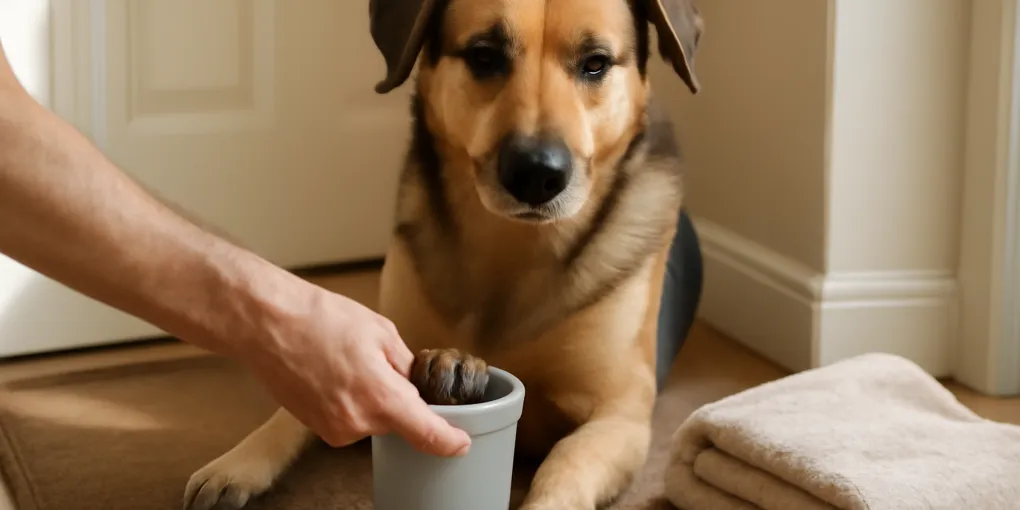
How to Clean Mud and Road Salt From Dog Paws Without Overwashing
ProtocolQuick picks
Dexas MudBuster portable dog paw cleaner
★ Top pick Best rinse cup for one paw at a time- Note: Match the cup size to the paw, use plain lukewarm water, and wash the cup after use so grit is not reused on the next walk.
Microfiber dog paw towel
Best finishing step- Note: Keep a dedicated, clean towel by the door. Dry between toes rather than rubbing hard over irritated skin.
After a muddy or salted walk, rinse the paws with plain lukewarm water, inspect pads and toe spaces, and dry them completely. See price on Amazon for the Dexas MudBuster portable dog paw cleaner if a one-paw rinse would make the job less messy; see price on Amazon for a microfiber dog paw towel for drying. The purpose is to remove a specific contaminant before the dog licks it or tracks it indoors, not to turn every walk into a shampoo bath.
For long-coated dogs, part the fur at the edge of the pad before drying. Grit hidden in feathering can migrate between toes after the visible mud is gone.
Quick picks for the doorway routine
- For thick mud on one paw: Dexas MudBuster portable dog paw cleaner — See price on Amazon. Skip it if the paw must be forced through the opening.
- For drying toe spaces: See price on Amazon for a microfiber dog paw towel. Use a dedicated towel rather than a rough bath mat that holds grit.
Decide whether a rinse is needed
Rinse promptly after contact with road de-icer, slush, wet fertilizer-treated grass, beach salt, muddy trail water, or visible grit. A dry sidewalk walk usually calls for a quick visual check rather than a full wash.
Inspect each paw before cleaning. Look at the pads, nails, fur between toes, and the webbing. Stop trying to scrub if there is bleeding, a torn nail, a deep cut, swelling, a foreign object that is stuck, a burn-like area, or marked pain. Those are veterinary questions, not reasons to keep rinsing.
The two-minute paw routine
- Put a towel on a stable non-slip surface and have a treat ready if the dog is comfortable with cooperative handling.
- Use plain lukewarm water. Avoid hot water on a paw that may already be irritated by pavement or de-icer.
- For one paw at a time, gently rinse the pad and between the toes. A Dexas MudBuster cup is useful when the paw fits without force; See price on Amazon, add clean water, insert the paw slowly, make a few gentle turns, and rinse again if grit remains.
- Blot and separate toes gently with a microfiber dog paw towel; See price on Amazon. Leaving moisture between toes can worsen irritation in a dog prone to licking or skin-fold problems.
- Empty and wash the cup, then wash hands. Do not reuse cloudy water for the next paw.
Do not scrub pads with a brush, use concentrated soap, or shave paw fur as a routine cleaning step. Friction and detergent can make a mildly irritated pad worse.
Road salt needs a real rinse
Dogs can lick residue from paws and fur after a walk. Brush away loose ice and grit first, then rinse with water and dry. If the dog ate a meaningful amount of de-icer, is vomiting, drooling, weak, or unsteady, contact a veterinarian or animal poison resource promptly; do not assume a paw wash solves ingestion.
Boots may reduce contact on planned winter walks, but they need correct fit and a gradual introduction. They are not a substitute for checking the feet after a walk, because moisture, rubbing, and trapped grit can also cause trouble.
Mud, allergens, and over-cleaning
Mud is usually a mechanical cleanup problem. Rinse it off and dry the fur. If a dog repeatedly chews paws after walks, has redness, odor, bumps, ear problems, or recurring skin infections, the cause may be more than surface dirt. A paw washer cannot diagnose allergy, yeast, parasites, or a foreign body.
For a dog with a veterinarian-directed medicated shampoo plan, follow that plan rather than mixing products into a daily rinse. The best default is narrow: water for residue, a towel for drying, and veterinary help when the paw itself is changing.
Make it easier next time
Keep the cup, towel, and a small bowl of water by the entry. Teach a paw cue when the dog is relaxed: touch one paw briefly, reward, then release. Build to one rinse at a time. The dog should be able to shift weight or step away; forcing a fearful dog can turn a quick safety check into a handling fight.
This is a dog-paw-specific protocol, not generic grooming advice: road salt can be licked after contact, and moisture trapped between toes changes the practical goal from simply removing visible mud to rinsing and drying the interdigital spaces.
Check pavement before the walk starts
On hot days, the return-home rinse does not reverse a pad burn. Place the back of your hand on the pavement for several seconds; if it is uncomfortable for your skin, change the route, walk at a cooler time, or use a shaded surface. In winter, prefer a route with less de-icer residue and keep the first post-walk rinse ready at home. A boot that rotates, rubs a dewclaw, or traps snow between toes is a fit problem to solve before a long outing.
If only one paw is being licked, inspect that paw against the others. A single swollen toe, broken nail, or embedded seed head is less consistent with ordinary muddy feet than all-paw salt exposure. Take a photo for a veterinarian if the change progresses, but do not dig into the webbing with tweezers unless a clinician has told you it is safe.
If you are still deciding whether a rinse cup is worthwhile, see our evidence explainer on whether dog paw washers work. For a whole entryway routine after wet-weather walks, use the dog rain-walk drying-station protocol; this page stays focused on cleaning the paw itself without excessive detergent.
Dog paw cleaning FAQ
Can I use baby wipes on my dog’s paws?
Use a dog-safe unscented wipe only when rinsing is impractical, and avoid fragrance, essential oils, or other ingredients that may be harmful if licked. Plain lukewarm water followed by thorough drying is the simpler default for mud or road salt.
How often should I wash my dog’s paws?
Clean them after contact with de-icer, mud, fertilizer, standing water, or visible grit. Routine shampooing after every ordinary walk can dry the skin, so use detergent only when a veterinarian or a product’s directions provide a specific reason.
Sources
- ASPCA, Dog care and health: https://www.aspca.org/pet-care/dog-care
- American Veterinary Medical Association, Winter pet safety: https://www.avma.org/resources-tools/pet-owners/petcare/cold-weather-pet-safety
- Pet Poison Helpline, Ice melts and dogs: https://www.petpoisonhelpline.com/uncategorized/really-safe-ice-melt/
Frequently Asked Questions
- Use a dog-safe unscented wipe only when rinsing is impractical, and avoid products with fragrance, essential oils, or ingredients that could be harmful if licked. Plain water and drying are usually the simpler default for road salt or mud.
- Clean when the paws contacted de-icer, mud, fertilizer, standing water, or visible grit. Repeated detergent washing can dry skin, so do not add shampoo to routine post-walk rinses unless a veterinarian directs it.