Best Dog Paw Washers for Muddy Yards: Cups, Mats, and Wipes That Actually Fit the Job
Buyer's GuideSilicone paw washer cup
Best for muddy yardsBest for: Dogs that track mud between toes after yard time
$12–$25
Quick picks
| Product | Key Specs |
|---|---|
| See price on Amazon |
|
| See price on Amazon |
|
| See price on Amazon |
|
Product availability, certifications, and retailer details can change; check the current Amazon page before buying.
Best Dog Paw Washers for Muddy Yards: Cups, Mats, and Wipes That Actually Fit the Job
The best dog paw washer for a muddy yard is usually not one product. For thick mud between toes, a silicone-bristle paw washer cup plus a towel works best. For wet grass and light dirt, an absorbent door mat may solve most of the problem with less handling. For apartments, car trips, or salt residue, unscented pet wipes are the easiest backup.
If your dog already has cracked pads, red skin, yeast odor, limping, or constant paw licking, treat that as a veterinary or dermatology problem before buying more cleaning gear. Paw washers remove debris. They do not diagnose allergies, infection, interdigital cysts, nail injuries, or burned pads.
For related weather prep, see our dog cooling mat safety guide and safe dog life jacket fitting protocol.
Quick picks for muddy-paw cleanup
- Search Amazon for silicone dog paw washer cup if your dog comes in with mud packed around nails and between toes.
- Search Amazon for absorbent dog door mat muddy paws if the main problem is wet footprints, not caked soil.
- Search Amazon for unscented dog paw wipes if you need a fast car, apartment, or post-sidewalk option.
- Search Amazon for dog microfiber drying towel because wet paws left in skin folds can make irritation worse.
PSR G6 score for this category
| Factor | Weight | Score | Weighted contribution |
|---|---|---|---|
| Research fit | 30% | 4.1 | 1.23 |
| Evidence quality | 25% | 3.8 | 0.95 |
| Value | 20% | 4.3 | 0.86 |
| User signals | 15% | 4.5 | 0.68 |
| Transparency | 10% | 4.4 | 0.44 |
| Composite | 100% | 4.2/5 |
The score is high for practical value, not because paw washer cups have clinical trials behind them. The veterinary logic is simpler: remove mud, salt, pollen, and grit; dry the paw; inspect pads and nails; stop if the routine causes stress or skin irritation.
What a paw washer cup does best
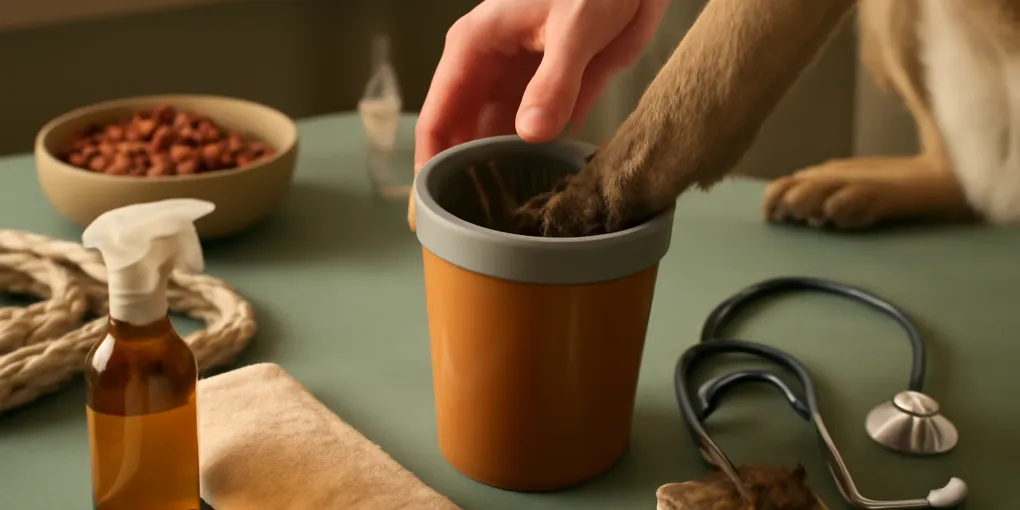
A paw washer cup is a plastic or silicone cup with soft internal bristles. You add a small amount of lukewarm water, insert one paw, twist or pump gently, remove the paw, and towel dry. It is most useful when the mess is stuck between toes, especially after clay soil, mulch, thawing snow, or a muddy dog park.
Buy by paw size, not by breed label. A cup that is too narrow rubs dewclaws and makes the dog resist. A cup that is too wide sloshes water and misses the toes. Measure the widest front paw while the dog is standing, then compare it with current listing dimensions.
The cup should feel soft when pressed against your own fingers. Stiff bristles, sharp seams, strong plastic smell, and hard internal ribs are poor signs. A clear or easy-open design is helpful because dirty water hides grit that can scratch pads if reused.
When a mat is the smarter purchase
Some dogs hate having feet handled. For those dogs, a large absorbent mat at the door may prevent more mess than a cup that sits unused. The mat should be long enough that the dog naturally takes several steps before reaching the clean floor. A towel staged beside the mat lets you blot individual paws without a full wash.
Mats are best for wet grass, drizzle, and light dirt. They are weaker for packed mud, lawn chemicals, sidewalk salt, burrs, and sticky residue. If you can see debris between toes, do not assume a mat removed it.
Choose a washable mat with a non-slip backing. Thin decorative rugs slide when an excited dog enters, which can scare the dog and make the cleanup station fail. If your dog is senior or has arthritis, traction matters as much as absorbency.
Where wipes fit
Unscented pet wipes are useful for travel, elevators, and light residue. They are not a substitute for rinsing heavy mud or chemical exposure. Avoid strongly scented wipes, essential-oil marketing, and human disinfecting wipes. Dogs lick their paws, and irritated skin absorbs products differently than intact skin.
For city walks, wipes can remove salt dust, pollen, or grime before the dog settles on a couch. For muddy yards, use wipes after a mat or cup only if a small spot remains. Rubbing a gritty paw with a wipe can abrade skin.
Safety checks before buying
Look for five listing details before you click a paw-washer cup, mat, or wipe pack:
- Cup opening diameter in inches; compare it with the dog’s standing front-paw width and dewclaw position.
- Removable soft silicone bristles; fixed bristle cartridges are harder to rinse after clay or mulch.
- A grippy base and fill line so the cup does not tip beside the door.
- Plain-water use; avoid required fragrance pods, detergent cartridges, or strong deodorizing fluids.
- Tool-free disassembly so trapped water, hair, and grit do not sit inside the cup between muddy sessions.
Skip any product that asks you to leave paws wet, use scented solution by default, or scrub aggressively. Paw pads are tough, but the skin between toes is not designed for repeated harsh friction.
How to introduce a paw washer without a fight
Start with the empty cup beside the back door, a towel on the floor, and pea-size treats ready. Let the dog sniff the cup, touch the silicone bristles with a fingertip, then reward. Practice touching the cup to the shoulder and lower leg before asking for a paw.
For the first wet session, use one inch of lukewarm water and clean only the easiest front paw. Insert the paw straight down, twist once or twice, lift, separate the toes with the towel, and stop. A calm 20-second repetition is better than chasing all four paws while the dog panics.
Dogs with nail pain, grooming fear, arthritis, or past paw injuries may need a mat-and-towel setup while you rebuild handling. If the dog growls, freezes, tucks the tail, snaps, or repeatedly yanks the paw away, stop and work with a trainer or veterinary team before retrying the cup.
The drying step matters
Drying is not optional. Moisture trapped between toes can worsen irritation in dogs prone to allergies, yeast overgrowth, or interdigital inflammation. Use a clean towel and separate the toes gently enough to see whether grit remains. In long-coated breeds, trim only with appropriate grooming tools or ask a groomer; do not cut mats blindly between toes.
After walks involving salt or de-icer, rinsing and drying are especially useful. If your dog licks paws intensely after winter walks, call the veterinarian rather than assuming the issue is normal cleanup annoyance. For dogs with hairy feet, add a quick visual check under each paw so small gravel, foxtails, or ice balls do not stay hidden between pads.
Best setup by household
For a fenced muddy yard, put the cup, towel, and a small dump bucket beside the back door. Empty dirty water after each session. For an apartment, use a mat plus wipes near the entry and reserve a cup for bathtub or balcony cleanup. For a car after hikes, carry a squeeze bottle of water, a towel, and wipes; do not pour dirty cup water onto upholstery.
For multi-dog homes, buy for the largest paw and use extra water control for smaller dogs, or buy two sizes. Do not share dirty cup water between dogs if one has skin lesions or a suspected infection.
What not to expect
A paw washer will not stop shedding, cure allergies, remove all odor, or replace nail care. It also will not make a dog enjoy foot handling by itself. The product works only when the station is fast, predictable, and followed by drying.
If your dog tracks in mud every day, also fix the environment: add stepping stones, mulch-free paths, a hose-off zone, or a washable runner. Buying a cup while the yard remains a swamp is only a partial solution.
FAQ
Is a paw washer cup safe for dogs with sensitive paws?
It can be safe if the bristles are soft, the water is lukewarm, and the paw is dried afterward. Dogs with cracked pads, open sores, swelling, or repeated licking should be checked by a veterinarian before repeated washing.
Do I need soap in a dog paw washer?
Usually no. Plain lukewarm water is the safest default for mud and grit. Use a veterinary-recommended cleanser only when your veterinarian has a reason, because residue and fragrance can irritate paws.
What size paw washer should I buy?
Measure the widest front paw while your dog is standing and compare it with the listing’s opening diameter. The paw should slide in without squeezing dewclaws but not have so much room that the bristles miss the toes.
Are paw wipes enough after winter sidewalks?
They may be enough for light salt dust, but visible salt crystals, slush, or de-icer residue should be rinsed off and dried. Call your veterinarian if the dog licks paws intensely or develops redness after walks.
Sources and veterinary references
- American Veterinary Medical Association. Pet first aid and routine observation resources: https://www.avma.org/resources-tools/pet-owners/emergency-care/pet-first-aid
- Cornell Richard P. Riney Canine Health Center. Skin and paw health owner resources: https://www.vet.cornell.edu/departments-centers-and-institutes/riney-canine-health-center
- Cornell Richard P. Riney Canine Health Center. Canine health owner education: https://www.vet.cornell.edu/departments-centers-and-institutes/riney-canine-health-center/canine-health-information
- ASPCA. Cold weather safety tips for pets: https://www.aspca.org/pet-care/general-pet-care/cold-weather-safety-tips