How to Set Up a Puppy Playpen: A Safe First-Week Protocol
ProtocolQuick picks
MidWest Foldable Metal Exercise Pen
★ Top pick Sturdy starter pen- Best for: Most small and medium puppies during supervised home routines
- Key feature: Configurable panels with washable metal bars
- Caveat: Jumpers and climbers may need a taller or covered setup
- PSR Score: 4.1/5
Washable whelping or playpen mat
Floor-protection essential- Best for: Hard floors, rental homes, and first-week accidents
- Key feature: Traction plus moisture protection
- Caveat: Edges must not invite chewing
- PSR Score: 4.0/5
How to Set Up a Puppy Playpen: A Safe First-Week Protocol
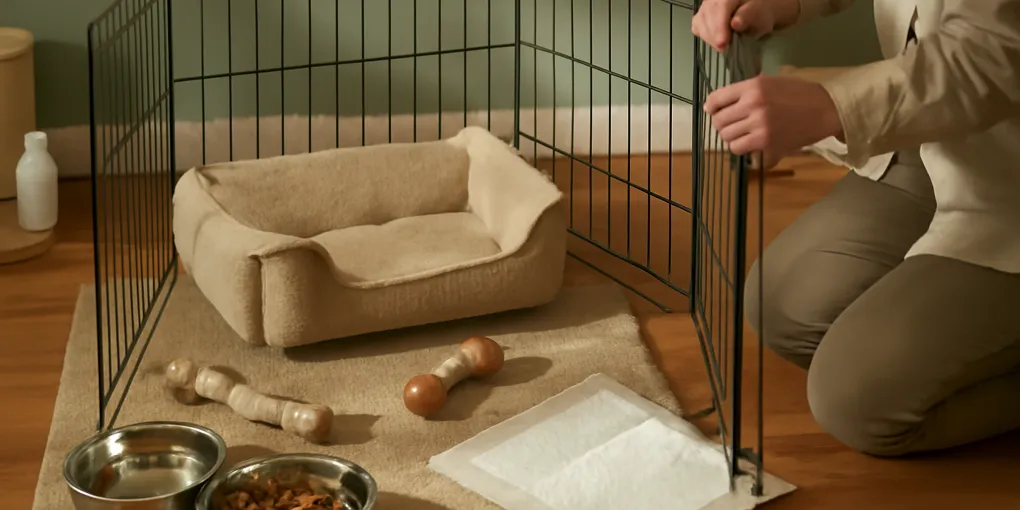
A puppy playpen works best when it is a small safe room, not a storage corral for every new puppy product. The goal is simple: give the puppy a predictable place to rest, chew appropriate toys, drink water, and practice short separations without access to cords, shoes, trash, stairs, or older pets. For most homes, start with a washable metal exercise pen, a non-slip waterproof mat, a crate or bed area, water, and two or three safe chew options.
If the puppy is vomiting, having diarrhea, coughing, refusing food, crying continuously, or suddenly eliminating far more than expected, call the veterinarian. A playpen setup can reduce household chaos, but it cannot diagnose illness or replace supervision.
For adjacent dog routines, see our dog snuffle mat routine and harness-fit safety guide.
Quick picks for puppy playpen setup
- Search Amazon for MidWest foldable metal puppy exercise pen if you need a configurable starter pen.
- Search Amazon for washable puppy playpen mat before the first accident teaches you why bare rugs are a bad idea.
- Search Amazon for puppy crate with divider if you want the pen to connect to a sleep area.
- Search Amazon for puppy safe chew toys and choose size-appropriate options that cannot be swallowed.
PSR G6 score for a puppy playpen setup
| Factor | Weight | Setup priority |
|---|---|---|
| Research fit | 30% | Supports supervision, confinement training, and safe exploration |
| Evidence quality | 25% | Aligned with veterinary and behavior guidance on puppy management |
| Value | 20% | Reusable pen, mat, and crate components beat novelty gadgets |
| User signals | 15% | Jumping, chewing, mat leaks, and latch complaints matter |
| Transparency | 10% | Clear limits: a pen is not babysitting or punishment |
The score depends on setup quality. The same pen can be helpful or unsafe depending on height, floor traction, objects inside it, and how long the puppy is left alone.
Step 1: Choose the right location
Put the pen in a normal family area where the puppy can see daily life without being in the traffic lane. A kitchen corner, washable living-room area, or office corner usually works better than an isolated laundry room. Avoid direct sun, heat vents, dangling blinds, electrical cords, stairs, trash cans, houseplants, and furniture the puppy can climb.
The location should let you supervise quietly. If every pen session happens only when people disappear, the pen becomes a predictor of isolation.
Step 2: Size the pen for rest, not racing
A playpen should be large enough for a bed or crate area, water, a chew zone, and a small movement area. It should not be so large that the puppy uses one corner as a toilet and another as a bedroom without needing to learn a routine. For toy breeds, watch for gaps between panels. For large or athletic puppies, choose taller panels and expect jumping attempts.
If the puppy can climb out, the pen is no longer a safe confinement tool. Remove climbable objects from the edges and upgrade height before leaving the puppy unattended.
Step 3: Build the floor layer first
Use a waterproof mat with enough traction that the puppy can stand, turn, and play without sliding. Slippery floors are a common early mistake. Puppies already have clumsy coordination; a slick surface makes jumping, pouncing, and turning more stressful on joints.
Choose a mat that extends beyond the pen edges if possible. Check the border after the first few sessions. If the puppy chews the mat edge, tape or furniture placement is not enough; choose a safer mat or change the pen layout.
Step 4: Decide whether the crate connects to the pen
Many puppies do well with an open crate attached to one side of the pen. The crate becomes the sleep den, and the pen becomes the awake safe area. Keep the crate comfortable but not stuffed with loose bedding if the puppy chews fabric. For very young puppies, keep confinement periods short and build gradually.
Do not use the pen as punishment after biting or accidents. Calmly reset the puppy with a chew or nap routine. The pen should predict safety and rest.
Step 5: Add only safe essentials
Inside the pen, use water in a stable bowl, one rest surface, and a few chew options. Avoid rope toys that shed strings, plush toys with loose eyes, tiny chews, cooked bones, and anything the puppy can swallow. Rotate items rather than filling the pen with clutter.
If you use food puzzles, supervise until you know how the puppy handles them. A puzzle that frustrates a puppy can increase barking and chewing rather than enrichment.
Step 6: Plan potty trips before accidents
The pen does not replace potty training. Take the puppy out after waking, eating, drinking, playing, and at frequent age-appropriate intervals. If you use pads because of apartment logistics, keep the pad zone clearly separate from the rest area and do not expect the puppy to generalize instantly.
Repeated accidents can mean the schedule is unrealistic, the puppy has too much space, or there is a medical issue. Do not simply leave the puppy longer and hope the pen solves it.
First-week schedule
Start with short calm sessions while you are nearby: two to five minutes with a chew, then release before panic. Build to meal times, short work blocks, and naps. If the puppy screams, paws, or climbs, reduce the difficulty. Reward quiet behavior before the puppy escalates.
At night, many puppies do better sleeping near people at first. A pen in a distant room can make house-training and distress worse. Gradual distance often works better than abrupt isolation.
Puppy playpen setup questions
Should a puppy playpen include a crate?
Often, yes. An open crate can give the puppy a clear sleep area while the pen provides a safe awake zone. The crate should not be used as a threat, and the puppy should still get frequent potty trips and supervised play.
Can I leave a puppy in a playpen while I work all day?
No. A playpen is for managed short periods, naps, and safe transitions. Young puppies need social contact, bathroom breaks, meals, training, and veterinary care. Long unsupervised confinement increases stress and accident risk.
What height should a puppy pen be?
Choose height based on the puppy’s adult size, athleticism, and climbing behavior. If paws reach the top rail or the puppy uses objects to climb, the setup is too easy to escape.
Should I put pee pads in the pen?
Only if they fit your house-training plan. Pads can be useful in apartments or vaccination-limited periods, but they can also teach some puppies that indoor soft surfaces are toilets. Keep the pad area distinct and transition deliberately.